Monday, May 14, 2007

Watching the Dome - TEXAS BILL ALERTS

Action Alerts for May 14-15 for the Texas House and Senate include:

GOOD BILL THAT NEEDS TO BE APPROVED BY BOTH HOUSES:

ACTION ALERT CSSB 439 by Deuell attempts to correct legislation which allows medical providors to withdraw patients from life support over the objection of their families and prior to decisions by ethics or medical review committees. The bill was placed on the Senate Intent Calendar on May 10th. It needs to be passed and go to the house. This is a life and death matter which could impact any Texan if left unaddressed.

BACKGROUND ON THE BILL: Author’s Intent:
Currently, if a physician refuses to honor an advance directive or treatment decision, the physician's decision must be reviewed by an ethics or medical committee, during which time life-sustaining treatment is required to be provided to the patient. Some hospitals are withdrawing life-sustaining treatment from patients before they can be transferred to an alternative facility, often resulting in their death.

C.S.S.B. 439 requires life-sustaining treatment to continue to be provided to the patient until the patient's transfer to another facility is complete and the facility from which the patient is being transferred is required to provide a list of facilities, maintained by the Department of State Health Services, that have volunteered their readiness to accept transfers. The bill ensures the rights of patients and their families in deciding to accept or reject life-sustaining treatment, seeks to improve the doctor-patient relationship, allows doctors to refuse to continue a treatment that conflicts with their personal code of ethics, strengthens the power and legitimacy of advanced directives, and promotes the public's trust in hospitals.


History and Status of Bill:

Text of Bill

Texas Senate Contact Information

Texas House Contact Information

ISSUES BEFORE THE TEXAS HOUSE:

GOOD BILLS:

S.B. 1667 – Good Bill – Relating to the amount of an administrative penalty assessed by the Railroad Commission of Texas for a violation of the Texas Surface Coal Mining and Reclamation Act or a permit issued under that act. Has passed the Senate and was placed on the General State Calendar in the Texas House on May 14th.

Current law sets the maximum penalty fee for a violation of a mining permit at $5,000. The Railroad Commission of Texas recommends increasing the maximum penalty for a violation of the Texas Surface Coal Mining and Reclamation Act to reflect the impact of inflation since the fee was established in the 1970s.

As proposed, S.B. 1667 increases the maximum penalty from $5,000 to $10,000 for a violation of coal mining and reclamation operations or underground mining operations permit.


History and Status of Bill

Text of Bill

Texas House Contact Information

Good Bill: C.S.S.B. 199 Has passed the Senate and was placed on the General State Calendar of the Texas House for May 15, 2007.

Currently, a number of convictions for violent criminal offenses do not bar a person from being employed as a home care attendant. Current law provides a list of hiring prohibitions that prevent a person of certain criminal offenses from being employed to care for certain elderly or persons with disabilities.

As proposed, C.S.S.B. 199 adds to the list of offenses that preclude a person from being employed to care for the elderly or disabled.


History of Bill

Text of Bill

Texas House Contact Information


SB 64 -Good Bill passed by Senate, placed on General Calendar of House on May 14th.
Zaffirini’s bill tightens the campaign finance reporting rules.

History and Status of Bill

Text of Bill

Texas House Contact Information

ISSUES BEFORE THE TEXAS SENATE:

GOOD BILLS:
H.B. 2660 Has been passed by the House and has been received in the Senate. Relating to the use of money from the Texas economic development bank fund for rural rail development atttempts to address some funding issues for Rail initiatives approved in previous sessions of the Legislature

Pursuant to Chapter 91, Transportation Code, the authority to create rural rail districts is granted.
The establishment of rural rail districts (who may own facilities and railways) were authorized under provisions of Chapter 623, Acts of the 67th Legislature, Regular Session, 1981 (Article 6550c, Vernon's Texas Civil Statutes). However, no state funding has been provided to assist in the initial creation of said rural rail districts.

H.B. 2660 will authorize funding to provide, as start up money, for the creation of such rail districts. These powers were authorized to the Texas Department of Transportation (department) under the afore mentioned authority, but funding to assist these local districts has never been provided by the state of Texas.


History and Status of Bill

DANGEROUS BILLS:

Dangerous Bill Alert: HB 2564 was passed by the Texas House and was received by the Texas Senate on May 14th. Many governmental watchdog groups, non-profit groups, and journalist argue that language in this bill could restrict the public’s timely access to information. Previous law allowed citizen examination of unlimited amounts of information and only charged for photocopies. Citizens access for examination of information is curtailed by language in this bill.
History of Bill


Text of Bill

Texas Senate Contact Information

Big Oil Still Running Roughshod - David Van Os

Sharon Wilson (TxSharon) posted an editorial on Daily Kos Mon May 14, 2007 for David Van Os. David's concise analysis of the elastic gasoline prices and political /industry factors which drive such elasticity is a "Must Read"!

Sunday, May 13, 2007

Limit on Property Tax Appraisal Rate Increases voted by House

Weaker tax bill advances in House -
Lawmakers give a tentative OK to limits on revenue for governments

By JANET ELLIOTT
Copyright 2005 Houston Chronicle Austin Bureau April 27, 2005, 6:43AM
AUSTIN - A watered-down bill designed to make cities and counties more accountable to voters for property tax increases finally won tentative approval Tuesday in the Texas House.

Currently in Texas, property tax rates often stay the same, but tax bills increase anyway because of rising property values. That means local officials can rake in additional revenue without having to vote on raising the tax rate, said Rep. Carl Isett, sponsor of House Bill 1006
. Read more

Flawed Voter ID System purges qualified voters from list

The real problem
While lawmakers push additional ID requirements for casting ballots, a flawed computer database is purging already qualified voters from the rolls.

Copyright 2007 Houston Chronicle May 5, 2007, 8:33PM
Editorial
Early balloting around the state for the May 12 election has resulted in long delays and frayed tempers in many locales. The difficulties had nothing to do with the unproven election fraud cited by state legislators as a justification for new laws mandating more extensive ID from voters.

Instead, hundreds of people who went to the polls found their names had been removed because of glitches in a $14 million Web-based state computer program intended to centralize voter registration lists.

In a particularly embarrassing episode, the mayor of Prairie View, Frank Jackson, discovered when he attempted to vote early that his name and registration had vanished from the state-compiled list.

The IBM-Hart InterCivic system had been selected at the direction of former Secretary of State Geoffrey Connor, an appointee of Gov. Rick Perry, despite the fact it cost $800,000 more than a proven competitor, VOTEC. After the purchase, the vendor then substituted an untried computer system that is giving fits to election officials around the state.
Read more

See other coverage of the problem

IRS Leans On Auction Sites to Spill Customer Information

By Lisa Vaas - eWeek.Com
May 10, 2007
Would you trust eBay to keep your name, address and taxpayer identification number safe? What about uBid.com, or what about an obscure online broker you've never heard of?

The Center for Democracy and Technology is raising a red flag over the prospect after language appeared in the President Bush's budget that would require brokers of personal property—including online auction houses and consignment stores—to collect personal data from customers and to share it with the Internal Revenue Service.

The push to put personal customer information into the hands of the Feds is coming from the U.S. Treasury Department, which is attempting to track down millions in unreported small business income. There's serious money at stake: The Treasury Department's proposal in the president's budget estimates that it could raise $20 million in 2008, increasing steadily over the years to hit a cumulative $1.974 billion by 2017.
Read more

Saturday, May 12, 2007

Next: Buying the Brooklyn Bridge

The Fort Worth Weekly
May 9, 2007
Next: Buying the Brooklyn Bridge
The Fort Worth Weekly speaks out on Fort Worth City Town Hall meeting limiting discussion of use of the revenue from gas-drilling in the city to how much should be banked instead of opening it to public comment on what the highest priorities are for its use.

Private Public Partnership for Low Cost Housing in Fort Worth Exposed

Betty Brink of The Fort Worth Weekly exposes problems with the city's low cost housing program in her May 9, 2007 article:
Broken Homes
The city housing agency might not pass inspection

Seems private public partnerships in housing are as difficult to keep free from corruption as are transportation CDA's!

Friday, May 11, 2007

Texas Wildlife Refuges Fast-Tracked for Border "Fence"

by blogger "Land of Enchantment"
posted on TEXAS KAOS Wed May 09, 2007 at 20:55:04 PM CDT
The first name given by Spanish explorers to the Rio Grande was actually the Rio de las Palmas, after the extensive forests of sabal palm trees along its lower reaches. Those forests are mostly gone now, replaced by grapefruit orchards and other farmland. Only small patches of it remain, in sanctuaries and wildlife refuges, such as Sabal Palms run by the Audubon Society east of Brownsville, Texas. The bird life at this southernmost point of the lower 48 has a Central American feel.
READ MORE of this stunning environmental post

Someone’s crying, Laura, kumbaya

Dave Levinthal of the Dallas Morning News reports on a call for harmony during the tense dramatic Dallas 2007 city elections. Opposition to the Trinity Toll Road is a hot topic in this year's election. His post on the "education technicans" employed by backers of the Trinity River Tollway Project is worth our attention. Angela Hunt's letter to Laura Miller in response to harassment of signature seeking petitioners is included in the article. Levinthal doesn't mention in this article that the supporters of the Trinity Toll Road, (Laura Miller and many corporate sponsors including Baylor Health Care System, University of North Texas, and Mary Kay) have established a non-profit educational foundation to promote the project. Some opponents charge that there are violations to the election code in using governmental and corporate money to hire consultants who are interferring with petitioners collecting signatures in opposition to the Trinity Toll Way. Things are getting interesting in Dallas. There have always been bodies were dumped near the levee of the Trinity. We'll watch to see if any political skeletons emerge from relationships with this project.

Road plan at heart of debate Park project gets broad support, but some want to slam brakes on tollway

08:22 AM CDT on Friday, May 11, 2007
By BRUCE TOMASO / The Dallas Morning News
btomaso@dallasnews.com

In the latest fight over the Trinity River Corridor Project, there's one thing both sides agree on:

A lot of water has passed under the bridge since 1998. That's when Dallas voters overwhelmingly approved a $246 million bond proposal to transform the river from a ditch to a downtown jewel.

To City Council member Angela Hunt, the changes made to the plan over the years are so radical and disruptive that the current project is no longer what voters approved.

In particular, she's irate that the "Trinity Parkway" – originally a divided highway with four northbound lanes on the downtown side of the river bottoms and four southbound lanes on the Oak Cliff side – has morphed into a high-speed toll road, all on the downtown side, that will whisk motorists past the river park and lakes while providing little or no access to those recreational amenities.

Read more

House Members Must be Drinking Even Stronger Kool-Aid than Normal

Editorial by Faith Chatham
Legislation passed by the Texas House this week includes deplorable language which stands among some of the worst policies forwarded by that sometimes demenented institution.
1. While refusing to fix Transportation Funding so that Texans can have necessary state infrastucture built and maintained on tax money and pushing approval of 50 year toll contracts with private companies, the Texas House voted to cut gasoline taxes this summer by 20 cents a mile. If they truly cared about high gasoline cost, they could pass a windfall profit tax to hit at the gougers. Instead they send the message that Texas is not in a Transportation funding crisis. Attempting to justify the tax cut by taking the money of the general fund is a sham when they are refusing to stop the diversions from transportation into other uses, refusing to index the gas tax, and refusing to fully fund the Mobility Fund so that the state will have sufficient transportation funds to leverage on the bond market for transportation project financing.
2. The House passed HB 2268 which gives TxDOT, an out-of-control agency which needs an immediate, through investigation and reorganization, more authority.
House Bill 2268 let's TxDOT acquire land before a toll or road project is approved, before environmental studies are completed, before public hearings take place, etc. In short, it lets TxDOT lock in a route in advance, and then pretend like all the public input and research might actually change their decision. - Sal Costello

KRUSEE PASSES TXDOT TOLL EMPOWERMENT BILL

EDITORIAL by Sal Castello
May 11, 2007

A new bill that gives the rogue agency TxDOT more authority, HB 2268, just passed out of the House and is now heading for the Senate.

Rep. Krusee will have others hold hold up this horrible bill and claim it is a solution citizens have been asking for, but it does just the opposite and gives TxDOT MORE power to steal our land and our roads! House Bill 2268 let's TxDOT acquire land before a toll or road project is approved, before environmental studies are completed, before public hearings take place, etc. In short, it lets TxDOT lock in a route in advance, and then pretend like all the public input and research might actually change their decision.
Contact ALL Senate Transportation Committee members and tell them, “Kill HB 2268 in committee. We do not want to give TxDOT more power."

Phone the capitol and ask for each Senator 512-463-4630 (John Carona, Kirk Watson, Kim Brimer, Rodney Ellis, Robert Nichols, Florence Shapiro, Eliot Shapleigh, Jeff Wentworth, Tommy Williams). To email: firstname.lastname@senate.state.tx.us (replace with each senator's first or last name, for example 'john.carona@senate.state.tx.us')

MR. 39% HAS "NO TOLL FREEZE" PRESS CONFERENCE TODAY

Rick "Mr. 39%" Perry will wave a 6 page letter at his press conference Friday from the Federal Highway Administration (to compete with a good letter Hutchison extracted from Secretary Peters) in order to justify vetoing the private toll moratorium bill, HB 1892.

THE MUDRACKER

Governor, lawmakers try to work out agreeable toll road legislation

By Mark Lisheron
AMERICAN-STATESMAN STAFF
Friday, May 11, 2007
At the same time both sides in a state transportation fight were expressing optimism Thursday that a compromise could be reached, each was assessing differently the risks of losing billions of dollars in federal funding for Texas highways.

The main point of contention between lawmakers and Gov. Rick Perry is a bill passed by the House and Senate that would limit toll road contracts with private companies.

A day after Perry threatened to call for a special session on the question of private toll roads, his spokesman Robert Black said lawmakers and the governor are "very enthusiastic" about making a deal.

"We don't have a lot of time, but we have enough time," he said.

Sen. John Carona, R-Dallas, chairman of the Senate's Transportation and Homeland
Security Committee, said Thursday that he and other negotiators might reach an agreement as soon as early next week.
Click here to see complete article

Thursday, May 10, 2007

Cintra proposes to use $2.6 Billion in U.S. Federal Money on the $2.8 Billion SH121 Project

Editorial - By Terri Hall

Problem: Spanish company to take taxpayers for 50 year toll ride

Solution: Index gas tax

Wonder why all the fuss over toll roads? Well, we’re not talking about traditional toll projects. Governor Perry and his Transportation Commission are pushing private toll road deals that limit free routes and allow the private operator to charge very high tolls. Take a gander at what the winning bidder, a Spanish company named Cintra, is telling their shareholders about the Hwy 121 private toll deal in Collin and Denton counties:
“Provides a corridor to Dallas on which there is no alternative roads.”
– Page 6, It will connect I-35 with US-75

“No planned proposed improvements to free alternative routes in the long term. Concessionaire is entitled for compensation in case existing long-term planning is modified.” – Page 11

You see, as ex-Transportation Commissioner Senator Robert Nichols, who is a stickler for details and who is also the author of a bill to halt CDAs, has noted the devil is in the details. These private toll contracts called Comprehensive Development Agreements (CDAs) include non-compete agreements like Cintra brags about to its shareholders. This means there will be no improvements made to existing roads nor any new free routes built within a certain mile radius of the toll road. Doing so would compete with or reduce toll revenues, and a private company simply won’t allow that.

Toll rates $1.50 a mile

TxDOT promises toll rates of 12-15 cents a mile, but the reality has been 44 cents up to $1.50 PER MILE on similar projects that just opened in Austin. You see, when TxDOT has admitted it costs 11 cents just to collect the tolls, they can’t possibly cover the operation or maintenance of that road with 12-15 cent tolls much less pay the private toll operator their guaranteed 12% profit. In fact, TxDOT’s mantra is that the private company will charge “market rate,” which essentially means tolls without limit since there will be few if any alternatives. Bottom line: using CDA private toll contracts is THE most expensive option for motorists. Yet the Governor and his cronies claim they’re doing all this without raising your taxes. Who do they think they think they’re fooling?

Dennis Enright, an expert in these public-private partnerships testified on March 1 to the Senate Transportation and Homeland Security Committee that CDAs cost 50% more than traditional public toll roads. He also stated it’s always better to keep these toll projects in the public sector (having a tolling authority or TxDOT do them) rather than to privatize our highways in these monopolistic 50-year contracts.

What’s perhaps even more appalling is that the U.S. Government was involved in facilitating some $2.6 billion of this $2.8 billion project. So who’s really bringing the money to the table? The U.S. taxpayer, not the private company as TxDOT claims. So the taxpaying public will pay billions both on the front end with federally backed bonds and loans and on the back end of this deal through tolls for the next 50 years just to accelerate the construction of a single 10 mile stretch of highway.

This same company won a deal to build SH 130, won the development rights to build the first 600 miles of the Trans Texas Corridor (called TTC 35), and is one of two foreign companies bidding to takeover existing highways SH 281 and Loop 1604 in San Antonio and turn them into tollways. Senator Eliot Shapleigh asked TxDOT in a recent Senate Transportation Committee hearing if giving that much of our state highway system to a single foreign company for the next half-century gave him pause. TxDOT dodged the question.

So what’s the solution?

Pass the CDA moratorium


It’s past time to rein-in TxDOT’s push to privatize and toll our public highways in these very controversial deals that amount to horrific public policy. HB 2772 and SB 1267 have more than two-thirds majority support and would place a 2 year moratorium on CDAs giving the Legislature time to get the details of these contracts right before signing away our public highways for 50 years! Senate and House Transportation Committee Chairmen Senator John Carona and Mike Krusee are tying them up. Let’s get these bills to the floor for a vote in time to override a promised gubernatorial veto.

Index the gas tax

Let’s assume that even though TxDOT’s budget has tripled since 1990 and doubled since Rick Perry took office, and even though TxDOT has $7 billion in bonds available to them, that we are still short of cash for highways. A recent Texas Transportation Institute study showed that indexing the gas tax to inflation is all that’s needed to meet our future transportation needs without tolls. Politicians in the House, in particular, need to have the political will to enact the most affordable, most sensible financing solution. All the options we’re faced with are tax increases of one sort or another since tolls are clearly a tax, an aggressive one in the hands of a private company. The gas tax increase would cost perhaps $50 - 100 more a year versus $2,000-3,000 more a year per motorist in tolls!

However, before adding ONE DIME to TxDOT’s budget, the Legislature must also pass Senator Wentworth’s bill to stop any further hemorrhaging of the gas tax that’s been going to non-transportation sources and frivolous earmarks. The taxpayers won’t tolerate putting more money into a leaky boat. That’s what got us into this mess in the first place. So since an ounce of prevention equals a pound of cure, let’s revisit the gas tax to prevent this shady widespread shift to private tolling and be done with it.

UPDATE: Financial analysts say NTTA proposal flawed - could bankrupt toll authority - Proved flawed and from TXDOT!

The article in Concession Texas was attributed to Goldman Sachs. It has been revealed that the letter was an internal working document from a highly placed TxDot employee who had project oversight for SH121. Brett Shipp of WFAA Channel 8 broke the story that:
NTTA Chairman Paul Wageman told lawmakers that he could top the Cintra deal and keep toll road money in North Texas.

Days later, a mysterious letter began making the rounds in Austin blasting the NTTA proposal. It alleged "there is a serious flaw," and also said the "NTTA proposal begins to make no sense."


The critical letter also found its way onto a toll road news web site, where it was billed as an analysis prepared by investment banker Goldman Sachs. Sachs says that characterization is false.

News 8 has learned the letter originated in a state office building at the Dallas division of the Department of Transportation.

Deputy engineer Robert Brown admits that he was the author
.
Full Report


Concession Texas
Posted Tuesday, May 8, 2008 18:29
A KPMG/Goldman Sachs analysis of the North Texas Toll Authority (NTTA) and Cintra proposals for a toll concession on SH121 says NTTA have used an unrealistically low discount rate on future revenues - giving only the appearance of a superior bid. They say unless NTTA were able to increase toll rates more than the the Dallas Regional Transportation Council (RTC) limits in force on the TxDOT-selected Cintra proposal, the public toll authority could be bankrupted.

The terse 2-page paper being circulated in Dallas says the NTTA proposal is seriously flawed with its low 5% discount rate. They say that unlike the Cintra offer, the NTTA proposal makes no allowance for risk.

They also suggest NTTA's proposal underfunds operations and maintenance.
Click Here to read the entire article

Mother Jones reported in January that
the Amount that Goldman Sachs gave to a PAC established by its lobbying firm, Hillco Partners, to push a 2001 Texas ballot measure allowing privately operated roads: $10,000


The Charles Webster, staff reporter for a Trenton, NJ publication cited
The report in Mother Jones magazine found that Goldman Sachs has set up an infrastructure investment arm, and has been working closely with Australian-owned Macquarie Infrastructure Group (MIG) and the Spanish construction firm Cintra to leverage lease deals for public roads and building projects for public highways.

The article describes efforts by Goldman Sachs officials to convince government officials around the country of the benefits of privatizing public roads. But the article also points out that Goldman Sachs is playing more than one side of the transaction.

On one end, Goldman Sachs is advising government entities how to proceed with the transaction, the investment firm is also working in tandem with its friends at MIG and Cintra.

On the another side, an account has created by Goldman Sachs to funnel investors’ money into an investment fund with the sole purpose of investing in highway infrastructure projects. More than $3 billion has already been accumulated into the account.


Webster wrote:
Ohio, Kansas and other states could also be headed in the same direction.

To-date, Goldman Sachs has been hired by four government entities to advise them on how to proceed with privatizing highways.

In the past five years, Goldman Sachs has helped turn over several highways from state-owned to privately run, including the 99-year lease deal of the 7.8-mile Chicago Skyway in 2005.


Shipp followed up his May 14th story the next day with a report that TxDOT has decided to allow NTTA to bid on the SH121 project.

Federal Highway Department objects to NTTA bid for SH121

A letter from the US Department of Transportation to Michael Behrens, Executive Director of TxDOT received April 26, 2007 objects to the procurement methods utilized by TxDOT on the SH121 bid. It also states that CINTRA has applied for a Federal loan for up to $700 million dollars on the SH 121 project. I thought the point of using private partners was that 1. private financing would be used instead funding by taxpayers 2. The DFW area was out of compliance with Federal Air Quality and could not qualify for federal funding.

What is true? What is a misconception? What is the understatement of the truth and what is the overstatement of the facts?

Click here to read the letter.

Lawmakers race to rework transportation measure

By JOHN MORITZ
jmoritz@star-telegram.com
Posted on Wed, May. 09, 2007
AUSTIN — Under threat of a special session this summer, a key lawmaker said Wednesday that the Legislature plans to scuttle a sweeping transportation measure considered destined for a veto and send the governor a new bill more to his liking.

“I’m not canceling my vacation plans just yet,” said state Sen. John Carona, R-Dallas, who chairs the Senate’s committee on transportation and homeland security.

Two well-placed sources said earlier in the day that Perry would call lawmakers back to Austin unless they undo an element in House Bill 1892 that could cost Tarrant County and other areas tens of millions of dollars for road construction projections.

That feature would undermine plans by local officials in North Texas to spread those dollars all over the region in an effort to ease ever-growing urban and suburban traffic congestion. At risk would be such planned projects as the North Tarrant Express and the western link of Texas 121.


Full story

Wednesday, April 25, 2007

The Billion Dollar Question

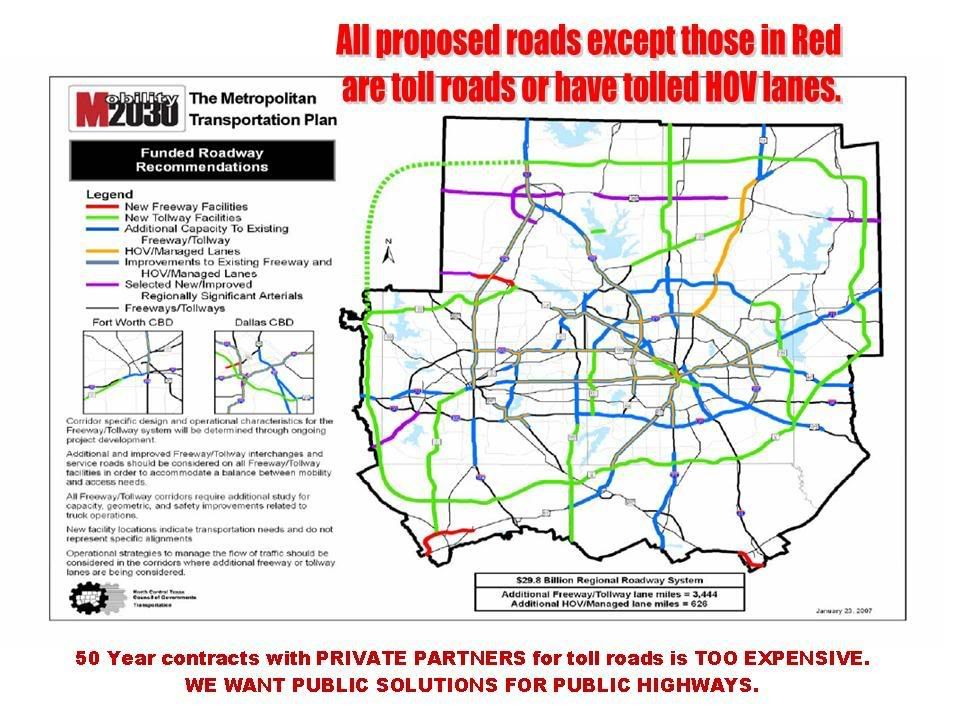
This is the DFW region's 30 year transportation plan. Will this plan make DFW businesses less competitive with companies located in other parts of the state which do not rely on toll roads to raise revenue for state highway construction and maintenance?
[Click on images to enlarge]


During the 30 years (2000-2030) the RTC (Regional Transportation Commission of the NTCOG) and TxDOT propose to add 675 miles of managed lanes (TOLL FREEWAYS and TOLLED HOV LANES on existing Freeways) in the DFW region.


They only propose adding 70 additional miles of NON-TOLLED FREEWAYS! They are planning to sign 50 year contracts for these tolled managed lanes and toll roads! EXEMPTING DFW from the 2 year moratorium is BAD if this is the BEST THEY HAVE TO OFFER!


The legend is hard to read. It says that:


Green is proposed New Toll ways.

Blue is proposed extensions of existing freeways/toll ways
or improving existing highways/freeways
by adding HOV toll lanes.

Black is freeways/toll ways.

Red is non-tolled freeways.


From 2000 to 2030 the Regional Transportation Plan for DFW:

200025 miles of existing toll roads built and managed by public toll authority
2030675 miles of managed lanes and toll road under CDAs
(Public private partnerships with 50 year contracts
financed at higher rates than public bond and with higher tolls
to generate "SURPLUS TOLL REVENUE" for investor return
on investment (profit) and up-front payments to the
RTC for use on non-toll projects).


Will citizens in this area pay more than their fair share for highway construction?
Will they have to pay their fair share of state gasoline and other taxes which builds roads in other regions while still having to pay high tolls to travel in their own region?
Is utilizing state highway right-of-way (real estate) for tolled lanes adjacent to public highway lanes which are insufficient to handle the traffic the best way to address traffic congestion?


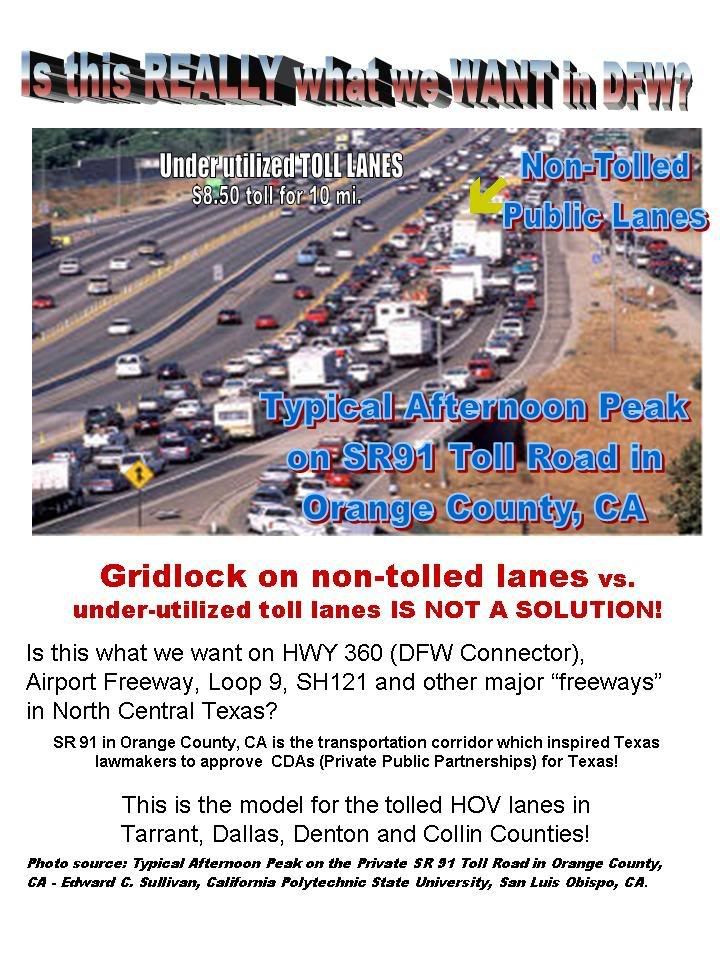
In California, during rush hour traffic, managed HOV toll lanes carry too few cars while public lanes are much too congested. Should we adopt the same model here?

Saturday, April 21, 2007

Here is the DFW plan elected officials insist must be exempted from the 2 year Toll Road moratorium


This is the transportation plan that elected officials chose for citizens in DFW. This is what they want EXEMPTED from the 2 year toll road moratorium!


During the 30 years (2000-2030), the RTC (Regional Transportation Commission of the NTCOG) and TxDOT propose to add 675 miles of managed lanes (TOLL FREEWAYS and TOLLED HOV LANES on existing Freeways) in the DFW region.
They only propose adding 70 additional miles of NON-TOLLED FREEWAYS!

They are planning to sign 50 year contracts for these tolled managed lanes and toll roads!
EXEMPTING DFW from the 2 year moratorium is BAD if this is the BEST THEY HAVE TO OFFER!

The legend is hard to read. It says that:
Green is proposed New Toll ways
Blue is proposed extensions of existing freeways/toll ways or improving existing highways/freeways by adding HOV toll lanes
Black is freeways/toll ways
Red is non-tolled freeways.

From 2000 to 2030 the Regional Transportation Plan for DFW:
2000
25 miles of existing toll roads built and managed by public toll authority

2030
675 miles of managed lanes and toll road under CDAs (Public private partnerships with 50 year contracts financed at higher rates than public bond and with higher tolls to generate "SURPLUS TOLL REVENUE" for investor return on investment (profit) and up-front payments to the RTC for use on non-toll projects).


Those who developed and favor this plan argue that there is no other way to build the roads. However, there has been expert testimony this spring in Austin at House and Senate Transpiration Committee Meetings that says that Texas can build and maintain necessary highway infrastructure without PUBLIC PRIVATE PARTNERSHIPS (CDAs).

Steve Odgen who authored the CDA enabling legislation has testified that the contracts proposed by the DFW RTC for SH121 and other toll projects using 50 year contracts with private partners is NOT WHAT THE LEGISLATURE intended when they passed the legislation.

Sen. Odgen testified that there is sufficient funding available to Texas through the PUBLIC BOND MARKET for Texas to build and maintain the necessary highway infrastructure.
Odgen states that financing road with public bond money is less expensive than financing it with private money (CDA - private public partnerships).

Gov. Perry's Taskforce on Transportation reported in Nov. 2006 that there is sufficient bond money available for the State to build the necessary projects without using CDAs.

Cintra (the private partner proposed for SH121 and the Trans Texas Corridor) offers their investors a 12% return on investment. The State of Texas can borrow on the bond market for much lower interest rates!

Pat Choate, a Washington D.C. based economist who is an expert on roads and public infrastructure, explained the bond market to me last week. Pat says for every dollar the state has, it can borrow at a rate of 1:5. That means that one dollar of public money is put into a project for every four borrowed dollars. In Texas over a billion dollars has been identified that was designated as transportation tax revenue but was diverted to other uses by the legislature. If that billion dollars was returned to Transportation, and the Legislature voted to index the gas tax so that it retains the same buying power despite inflation, there will be sufficient money by borrowing on the bond market and ending the diversions and indexing the gas tax to generate $110 billion dollars over a 30 year period. Originally Gov. Perry estimated that the state was short about $86 billion in transportation funding. His taskforce on transporation revised that estimate down to $44 billion in their November 2006 report. They get this estimate by targeting a desired traffic count index for transportation corridors.

Testimony in Austin has prompted the majority of State Representatives and State Senators to vote on a 2 year moratorium on toll roads to give time to fully assess the premises for the proposed CDA public private partnerships for toll roads.

HOWEVER, through pressure from local elected officials, the NCTCOG, RTC and some of the state representatives and state senators from this region, the 2 year moratorium legislation EXEMPTS DFW toll projects from the moratorium

Citizens from this region DESERVE THE SAME PRUDENT RE-EVALUATION OF TOLL PROJECTS which is being given to residents of other regions of Texas.

If the RTC and TxDOT signs contracts with Cintra or other private partners for 50 year managed lane project, they propose:
for citizens to pay tolls on 675 additional miles of toll lanes in the DFW region.

When the legislature "fixes" state transportation funding they will probably index the gas tax. Citizens in other regions will get their state highways paid for with gas tax money and public bond money while citizens in the DFW region will be paying tolls on our state highways and still have to pay higher gas taxes once it is indexed. Citizens in the DFW regions will still have to pay to help retire the state highway bond debt used to build state highways.

We understand that every day highway construction is delayed the cost escalates. However, right now, it is prudent to DELAY finalizing contracts with private partners for projects in the DFW 2030 mobility plan until state and local lawmakers thoroughly re-evaluate public funding options vs. private/public partnership toll proposals and TxDot planning and management practices. Cost/benefit analysis should include inflation. When inflation is weighed, the impact of profit and surplus upfront toll revenue as passed on in shipping costs to the consumer at the cash register must also be factored into the formula. We need to know the MAXIMUM toll that can be charged under any long term contract. That will allow us to gauge how much we are committing future generations to paying to use public infrastructure.
Toll contracts that allow toll rate increases every two years for 50 years based on unknown rates of inflation and unknown consumer price indexes commit children who have no voice in the contract to paying the highest fees. One agency reported to the Senate Committee on Transportation that the estimated toll for driving SH121 in Denton and Collin Counties during the 49th year of the proposed contract would be $75.00 a trip!

I asked Mike Eastland, Executive Director of the NCTCOG what the RTC's estimation is for the 49th year. He told me that they have only projected tolls for the first 4 years. The RTC, who is developed the 2030 plan and who works with TxDot in oversight of the contract for transportation in this region, plans to finalize the contract without knowing what the tolls will be in the last decade of a 5 decade contract. I don't think this is good enough.

I think that citizens should ACT NOW.

We should push the legislature and Gov. Perry to SOLVE Texas's public transportation funding problems.
We should push the governor to call a special session on Transportation Funding.
We should call every county commissioner and city council member in the 16 counties of the NCTCOG and demand that INSIST THAT THE RTC (of the North Central Texas Council of Governments) and TXDOT WAIT until CDAs are re-evaluated before signing 50 year contracts for toll projects in the DFW region.

We should demand that the NCTCOG, RTC and TxDOT inform the public of the cost of Tolls in the 49th year of proposed 50 year contracts BEFORE the contracts are signed.
(Currently TxDot and the RTC have only projected tolls 4 years and stated that they will escalate every 2 years at the rate of inflation and CPI. That is not good enough. Citizens deserve to know how much it will cost our grandchildren to drive on these proposed toll ways near the end of the contract before elected officials and their appointees who serve on the Regional Transportation Commission and TxDot officials COMMIT to these revenue generating schemes.

We should tell every senator and every state representative and every city council person and every county commissioner that exempting DFW from the 2 year toll road moratorium was not fair to us.

Roads may be built faster in this region... but citizens will probably pay much more for much longer than citizens in other regions of Texas will have to pay for transportation on state highways.

If other regions solve transportation gridlock in their regions with gas dollars and public bond money while DFW commits to building 675 miles of managed toll lanes on 50 years contracts, this region will be at a competitive disadvantage. Who will choose to live and work in a region where all major roads are tolled when they can locate in regions that used bond and gas money and demanded REAL PUBLIC SOLUTIONS FOR PUBLIC INFRASTRUCTURE from Texas lawmakers?

If merchants and manufacturers in the DFW region have to pay tolls to receive and ship goods in this region, while their competitors in other areas are able to utilize non-tolled highways for shipping, the cost of living and doing business in this region will be significantly higher than in other regions. This will not be good for consumers or for businesses. Increased shipping cost and its impact on inflation at the check out counter may exceed the increased construction costs cited as the reason that these highway construction projects should start immediately instead of waiting until the 2 year cooling off period prescribed in the toll road moratorium.

Costs have not been carefully weighed. The economical impact of these projects is much more complex than merely weighing the rising cost of construction over time. Escalating construction costs must be weighed in relation to the differences in the impact of inflation on the economy between lower cost public bond funding and borrowing from private entities at higher interest rates and tolls which generate "surplus toll revenue." It is shortsighted (myopic) to consider one without weighing the other.

Taxpayers understand that we have to pay for roads. We deserve to know that we are paying the least that is possible for the best roads possible. Public bonds are usually retired in 22 to 30 year periods. Private public partnerships are for 50 year terms.

Tuesday, April 17, 2007

Mr. Whitmire Welcomes Mr. Patrick to the Texas Senate

This is one of the highlights of this Legislative Session. Grandstanding, Sen. Dan Patrick, attack one Senator the first morning he returned to the Senate following liver transplant surgery. Patrick has bragged to the press about over 3 billion dollars in budget cuts he could make to the Texas budget, but did not present these items to the appropriations committee or to the House or Senate while budget deliberations were in progress. Senator Whitmire gives the freshman newcomer a lesson in how it should be done in the Texas Legislature.

Thursday, April 12, 2007

Hypocrites in Texas House Pass Marriage Legislation

Wednesday, April 11, 2007 the Texas House passed legislation to raise the cost of a Marriage License from $30.00 to $100.00. To strong-arm couples to submit to an eight-hour class on marriage, the fee is waived for participants! In their eternal concern for the morals of the poor and underclass of Texas, they decreed from their high and lofty moral perches under the dome of the Texas State Capitol that poor couples can apply for scholarships to the class!

Rep. Warren Chisum (R-Pampa) authored two marriage bills. The second includes a "Healthy Marriage Development Program" which includes abstinence education for couples (both previously married and never married). There are parenting skills and premarital counseling components to the program.

Yep, the Texas House, which is littered with Representatives, many of whom have been married and divorced multiple times, passed these bills. They are running from facing hard choices which will give Texas a realistic tax structure to finance public highways from public funds, but have time to dictate good marriage practices to the state's citizens.

There were a few voices who spoke against interfering in citizens' lives. The second bill transfers funds from the State's Temporary Assistance for Needy families program which is grossly under funded in comparison to most other states. Pat Haggerty (R-El Paso) tried to kill the bill by attaching an amendment requiring lawmakers to "take this silly class every year." He invited members to "take the male or female of your choice to these classes." (That amendment failed.) Obviously the House views it more important to dictate and direct others in sound marital practices than they are committed to learning about them themselves!

Dean of Women in the Texas Legislature Rep Senfronia Thompson (D-Houston) was a voice of reason. Unfortunately her words which questioned the appropriateness of the members of the Texas Legislature in dictating pro-family premarital education into law appeared to fall on member’s earwax. She states: "If this body loves marriage so much, then why do we have some members of this House that have been married five or six times?"

A better question is: If this body is qualified to prescribe a pre-marital educational program, why have so many of them been divorced multiple times?

Rep. Charlie Geren, R-Fort Worth, emerged from the pack of hypocrites and asked: "Will there be a test associated with this program? I haven't done too well in the past."

Other posts on this subject are: MUSING

Texas Kos by Lightseeker

Texas House Passes Moratorium -- Now it goes to the Senate

April 11th, 2007, the Texas House of Representatives passed the two year moratorium on private public (CDA) partnership for toll road construction bill. It was passed as an amendment to another bill. In the House and Senate, the Chairs of the Transportation Committee refused to pass the moratorium bill out of committee, despite both housing having a majority of the members committed to pass it. On April 11th, the text of the moratorium bill was added as an amendment to another bill. In debating House Bill 1892, there were 22 amendments proposed. Several attempts were made to exempt proposed CDA toll projects from the moratorium. Some projects in the Houston area were exempted from the bill but it appears that SH121 in Collin County and some of the proposed Tarrant County projects remain under the moratorium

WHAT HAPPENS NOW: The bill (text below) with the amendments will go to the Senate. Hopefully, it will pass the Senate. The biggest hurdle will probably be getting Rick Perry to sign it instead of allowing it to lanquish on his desk until after the session is over.

It would be wise for citizens to keep the heat up on the Senate and Rick Perry. Perry should be persuaded to call a special session to consider all the bills he allows to remain on his desk unsigned at the end of the session and/or which he vetoes.

We need to remind people of the fate of Kent Grusendorf when the Legislature failed to adequately address critical school funding issues. This year the focus is on Transportation.

Here is the text of the "engrossed" bill after the amendments were incorporated into the text of the bill.

Engrossed moratorium toll 1892 passed house 4/11/07
By: Smith of Harris, Dutton, Hartnett, H.B. No. 1892
Creighton, Howard of Fort Bend, et al.


A BILL TO BE ENTITLED
AN ACT
relating to the authority of certain counties and other entities with respect to certain transportation projects.
BE IT ENACTED BY THE LEGISLATURE OF THE STATE OF TEXAS:
SECTION 1. Subchapter E, Chapter 223, Transportation Code, is amended by adding Section 223.210 to read as follows:
Sec. 223.210. MORATORIUM ON CERTAIN TERMS IN COMPREHENSIVE DEVELOPMENT AGREEMENTS OR SALE OF TOLL PROJECTS. (a) In this section:
(1) "Toll project" means a toll project described by Section 201.001(b), regardless of whether the toll project:
(A) is a part of the state highway system; or
(B) is subject to the jurisdiction of the department.
(2) "Toll project entity" means a public entity authorized by law to acquire, design, construct, finance, operate, or maintain a toll project, including:
(A) the department;
(B) a regional tollway authority;
(C) a regional mobility authority; or
(D) a county.
(b) A comprehensive development agreement entered into with a private participant by a toll project entity on or after the effective date of this subsection for the acquisition, design, construction, financing, operation, or maintenance of a toll project may not contain a provision permitting the private participant to operate the toll project or collect revenue from the toll project, regardless of whether the private participant operates the toll project or collects the revenue itself or engages a subcontractor or other entity to operate the toll project or collect the revenue.
(c) On or after the effective date of this subsection, a toll project entity may not sell or enter into a contract to sell a toll project of the entity to a private entity.
(c-1) Subsections (b) and (c) do not apply to any project within the boundaries of a regional tollway authority created on September 1, 1997.
(c-2) To the extent that Subsection (c-1) conflicts with Section 228.012, Section 228.012 shall govern.
(c-3) This section does not apply to a comprehensive development agreement for a managed lane facility toll project the major portion of which is located inside the boundaries of a regional tollway authority created on September 1, 1997, and for which the department has issued a request for qualifications before the effective date of this subsection. Before the department executes a final contract for a project described by this subsection, the commissioners court for any county in which a majority of the project is located must pass a supporting resolution that:
(1) acknowledges that the contract may contain penalties for the construction of future competing transportation projects built at any time during the life of the agreement; and
(2) states that the commissioners court is aware of and agrees to pay the penalties if any are rendered.
(d) A legislative study committee is created. The committee is composed of nine members, appointed as follows:
(1) three members appointed by the lieutenant governor;
(2) three members appointed by the speaker of the house of representatives; and
(3) three members appointed by the governor.
(e) The legislative study committee shall select a presiding officer from among its members and conduct public hearings and study the public policy implications of including in a comprehensive development agreement entered into by a toll project entity with a private participant in connection with a toll project a provision that permits the private participant to operate and collect revenue from the toll project. In addition, the committee shall examine the public policy implications of selling an existing and operating toll project to a private entity.
(f) Not later than December 1, 2008, the legislative study committee shall:
(1) prepare a written report summarizing:
(A) any hearings conducted by the committee;
(B) any legislation proposed by the committee;
(C) the committee's recommendations for safeguards and protections of the public's interest when a contract for the sale of a toll project to a private entity is entered into; and
(D) any other findings or recommendations of the committee; and
(2) deliver a copy of the report to the governor, the lieutenant governor, and the speaker of the house of representatives.
(g) On December 31, 2008, the legislative study committee created under this section is abolished.
(h) This section expires September 1, 2009.
SECTION 2. Section 228.0055, Transportation Code, is amended to read as follows:
Sec. 228.0055. USE OF CONTRACT PAYMENTS. (a) Payments received by the commission or the department under a comprehensive development agreement shall [may] be used by the commission or the department to finance the construction, maintenance, or operation of a transportation project or air quality project in the same department district as the project or facilities to which the payments are attributable or a department district adjacent to that district [region].
(b) The commission or the department may not:
(1) revise the formula as provided in the department's unified transportation program, or its successor document, in a manner that results in a decrease of a department district's allocation because of a payment under Subsection (a); or
(2) take any other action that would reduce funding allocated to a department district because of payments received under a comprehensive development agreement.
SECTION 3. Subchapter A, Chapter 228, Transportation Code, is amended by adding Section 228.011 to read as follows:
Sec. 228.011. TOLL PROJECTS IN CERTAIN COUNTIES. (a) This section applies only to a county acting under Chapter 284.
(b) The county is the entity that has primary responsibility for the financing, construction, and operation of a toll project located in the county.
(c) To the extent authorized by federal law or authorized or required by this title, the commission and the department shall assist the county in the financing, construction, and operation of a toll project in the county by allowing the county to use highway right-of-way owned by the department and to access the state highway system. In connection with the use by the county of improved state highway right-of-way, the county must enter into an agreement with the commission or the department as provided by Section 284.004(b).
(d) Subsections (b) and (c) do not limit the authority of the commission or the department to participate in the cost of acquiring, constructing, maintaining, or operating a turnpike project of the county under Chapter 284.
(e) Before the commission or the department may enter into a contract for the financing, construction, or operation of a proposed or existing toll project any part of which is located in the county, the commission or department shall provide the county the first option to finance, construct, or operate, as applicable, the portion of the toll project located in the county:
(1) on terms agreeable to the county, without the requirement of any payment to the commission or the department except as provided by Section 284.004(a); and
(2) in a manner determined by the county to be consistent with the practices and procedures by which the county finances, constructs, or operates a project.
(f) Except as provided by Section 284.004(a), an agreement entered into by the county and the commission or the department in connection with a project under Chapter 284 that is financed, constructed, or operated by the county and that is on or directly connected to the state highway system may not require the county to make any payments to the commission or the department.
(g) An agreement entered into by the county and the commission or department in connection with a project under Chapter 284 that is financed, constructed, or operated by the county and that is on or directly connected to a highway in the state highway system does not create a joint enterprise for liability purposes.
SECTION 4. Subchapter A, Chapter 228, Transportation Code, is amended by adding Section 228.012 to read as follows:
Sec. 228.012. TOLL PROJECTS WITHIN BOUNDARIES OF REGIONAL TOLLWAY AUTHORITY. (a) This section applies only to a toll project located within the boundaries of a regional tollway authority under Chapter 366.
(b) The tollway authority is the entity that has primary responsibility for the financing, construction, and operation of a toll project located within the boundaries of the authority.
(c) To the extent authorized by federal law or authorized or required by this title, the commission and the department shall assist the tollway authority in the financing, construction, and operation of a toll project located within the boundaries of the authority by allowing the authority to use highway right-of-way owned by the department and to access the state highway system.
(d) Subsections (b) and (c) do not limit the authority of the commission or the department to participate in the cost of acquiring, constructing, maintaining, or operating a turnpike project of the tollway authority under Chapter 366.
(e) Before the commission or the department may enter into a contract for the financing, construction, or operation of a proposed or existing toll project any part of which is located within the boundaries of a tollway authority, the commission or department shall provide the authority the first option to finance, construct, or operate, as applicable, the portion of the toll project located within the boundaries of the authority:
(1) on terms agreeable to the authority, without the requirement of any payment to the commission or the department; and
(2) in a manner determined by the authority to be consistent with the practices and procedures by which the authority finances, constructs, or operates a project.
(f) An agreement entered into by the tollway authority and the commission or the department in connection with a project under Chapter 366 that is financed, constructed, or operated by the authority and that is on or directly connected to the state highway system may not require the authority to make any payments to the commission or the department.
(g) An agreement entered into by the tollway authority and the commission or department in connection with a project under Chapter 366 that is financed, constructed, or operated by the authority and that is on or directly connected to a highway in the state highway system does not create a joint enterprise for liability purposes.
(h) Before a final contract execution by the department for any comprehensive development agreement project, the commissioners court for any county in which a majority of the project is located must pass a supporting resolution.
(i) Once the authority or regional transportation council has received notice from the department relating to a toll project, the authority has 90 days to exercise the first option to finance, construct, or operate, as applicable, the toll project.
SECTION 5. Section 284.001(3), Transportation Code, is amended to read as follows:
(3) "Project" means:
(A) a causeway, bridge, tunnel, turnpike, highway, ferry, or any combination of those facilities, including:
(i) [(A)] a necessary overpass, underpass, interchange, entrance plaza, toll house, service station, approach, fixture, and accessory and necessary equipment that has been designated as part of the project by order of a county;
(ii) [(B)] necessary administration, storage, and other buildings that have been designated as part of the project by order of a county; and
(iii) [(C)] all property rights, easements, and related interests acquired; or
(B) a turnpike project or system as those terms are defined by Section 370.003.
SECTION 6. Section 284.002, Transportation Code, is amended to read as follows:
Sec. 284.002. APPLICABILITY OF CHAPTER [TO CERTAIN COUNTIES AND LOCAL GOVERNMENT CORPORATIONS]. (a) Except as provided by Subsection (b), this chapter applies only to a county that[:
[(1)] has a population of 10,000 [50,000] or more [and borders the Gulf of Mexico or a bay or inlet opening into the gulf;
[(2) has a population of 1.5 million or more;
[(3) is adjacent to a county that has a population of 1.5 million or more; or
[(4) borders the United Mexican States].
(b) A local government corporation created under Chapter 431 in a county to which this chapter applies has the same powers as a county acting under this chapter, except as provided by Chapter 362.
SECTION 7. Section 284.003, Transportation Code, is amended to read as follows:
Sec. 284.003. PROJECT AUTHORIZED; CONSTRUCTION, OPERATION, AND COST. (a) A county, acting through the commissioners court of the county, or a local government corporation, without state approval, supervision, or regulation, may:
(1) construct, acquire, improve, operate, maintain, or pool a project located:
(A) exclusively in the county;
(B) in the county and outside the county; or
(C) in one or more counties adjacent to the county;
(2) issue tax bonds, revenue bonds, or combination tax and revenue bonds to pay the cost of the construction, acquisition, or improvement of a project;
(3) impose tolls or charges as otherwise authorized by this chapter;
(4) construct a bridge over a deepwater [deep water] navigation channel, if the bridge does not hinder maritime transportation; [or]
(5) construct, acquire, or operate a ferry across a deepwater navigation channel;
(6) in connection with a project, on adoption of an order exercise the powers of a regional mobility authority operating under Chapter 370; or
(7) enter into a comprehensive development agreement with a private entity to design, develop, finance, construct, maintain, repair, operate, extend, or expand a proposed or existing project in the county to the extent and in the manner applicable to the department under Chapter 223 or to a regional tollway authority under Chapter 366.
(b) The county or a local government corporation may exercise a power provided by Subsection (a)(6) only in a manner consistent with the other powers provided by this chapter. To the extent of a conflict between this chapter and Chapter 370, this chapter prevails.
(c) A project or any portion of a project that is owned by the county and licensed or leased to a private entity or operated by a private entity under this chapter to provide transportation services to the general public is public property used for a public purpose and exempt from taxation by this state or a political subdivision of this state.
(d) If the county constructs, acquires, improves, operates, maintains, or pools a project under this chapter, before December 31 of each even-numbered year the county shall submit to the department a plan for the project that includes the time schedule for the project and describes the use of project funds. The plan may provide for and permit the use of project funds and other money, including state or federal funds, available to the county for roads, streets, highways, and other related facilities in the county that are not part of a project under this chapter. A plan is not subject to approval, supervision, or regulation by the commission or the department.
(e) Except as provided by federal law, an action of a county taken under this chapter is not subject to approval, supervision, or regulation by a metropolitan planning organization.
(f) The county may enter into a protocol or other agreement with the commission or the department to implement this section through the cooperation of the parties to the agreement.
SECTION 8. Subchapter A, Chapter 284, Transportation Code, is amended by adding Sections 284.0031 and 284.0032 and amending Section 284.004 to read as follows:
Sec. 284.0031. OTHER ROAD, STREET, OR HIGHWAY PROJECTS. (a) The commissioners court of a county or a local government corporation, without state approval, supervision, or regulation may:
(1) authorize the use of surplus revenue of a project for the study, design, construction, maintenance, repair, or operation of roads, streets, highways, or other related facilities that are not part of a project under this chapter; and
(2) prescribe terms for the use of the surplus revenue, including the manner in which the roads, streets, highways, or other related facilities are to be studied, designed, constructed, maintained, repaired, or operated.
(b) To implement this section, a county may enter into an agreement with the commission, the department, a local governmental entity, or another political subdivision of this state.
(c) A county may not take an action under this section that violates or impairs a bond resolution, trust agreement, or indenture that governs the use of the revenue of a project.
(d) Except as provided by this section, a county has the same powers and may use the same procedures with respect to the study, financing, design, construction, maintenance, repair, or operation of a road, street, highway, or other related facility under this section as are available to the county with respect to a project under this chapter.
(e) Notwithstanding any other law, an authority created pursuant to Chapter 451 that is located primarily in a county with a population of more than 3.3 million to which this chapter applies and in which the voters have authorized the dedication of a portion of its sales and use tax revenue for street improvements and mobility projects within the authority's service area must account for the entire amount of that liability on its financial statements in accordance with generally accepted accounting principles.
Sec. 284.0032. TRANS-TEXAS CORRIDOR PROJECTS. If a county requests or is requested by the commission to participate in the development of a project under this chapter that has been designated as part of the Trans-Texas Corridor, in connection with the project and in addition to the other powers granted by this chapter, the county has all the powers of the department related to the development of a project that has been designated as part of the Trans-Texas Corridor.
Sec. 284.004. USE OF COUNTY PROPERTY AND STATE HIGHWAY ALIGNMENT, RIGHT-OF-WAY, AND ACCESS. (a) Notwithstanding any other law, under this chapter a county may use any county property, state highway right-of-way, or access to the state highway system [for a project under this chapter], regardless of when or how the property, right-of-way, or access is acquired. The department or the commission may require the county to comply with any covenant, condition, restriction, or limitation that affects state highway right-of-way, but may not:
(1) adopt rules or establish policies that have the effect of denying the county the use of the right-of-way or access that the county has determined to be necessary or convenient for the construction, acquisition, improvement, operation, maintenance, or pooling of a project under this chapter or the implementation of a plan under Section 284.003(d); or
(2) require the county to pay for the use of the right-of-way or access, except to reimburse the commission or department for actual costs incurred or to be incurred by a third party, including the federal government, as a result of that use by the county.
(b) If a project of the county under this chapter includes the proposed use of improved state highway right-of-way, the county and the commission or the department must enter into an agreement that includes reasonable terms to accommodate that use of the right-of-way by the county and to protect the interests of the commission and the department in the use of the right-of-way for operations of the department.
(c) Notwithstanding any other law, the commission and the department are not liable for any damages that result from a county's use of state highway right-of-way or access to the state highway system under this chapter, regardless of the legal theory, statute, or cause of action under which liability is asserted.
SECTION 9. Sections 284.008(c) and (d), Transportation Code, are amended to read as follows:
(c) Except as provided by Subsection (d), a project becomes a part of the state highway system and the commission shall maintain the project without tolls when:
(1) all of the bonds and interest on the bonds that are payable from or secured by revenues of the project have been paid by the issuer of the bonds or another person with the consent or approval of the issuer; or
(2) a sufficient amount for the payment of all bonds and the interest on the bonds to maturity has been set aside by the issuer of the bonds or another person with the consent or approval of the issuer in a trust fund held for the benefit of the bondholders.
(d) A [Before construction on a project under this chapter begins, a] county may request that the commission adopt an order stating that a [the] project will not become part of the state highway system under Subsection (c). If the commission adopts the order:
(1) Section 362.051 does not apply to the project;
(2) the project must be maintained by the county; and
(3) the project will not become part of the state highway system unless the county transfers the project under Section 284.011.
SECTION 10. Subchapter A, Chapter 284, Transportation Code, is amended by adding Section 284.0092 to read as follows:
Sec. 284.0092. AUDIT BY FEDERAL HIGHWAY ADMINISTRATION. The accounts and records of a county relating to a project under this chapter located in a county that has a population of more than 3.4 million and is within 100 miles of the Gulf of Mexico are subject to audit by the Federal Highway Administration as deemed necessary by that agency.
SECTION 11. Subchapter A, Chapter 284, Transportation Code, is amended by adding Section 284.010 to read as follows:
Sec. 284.010. CONTRACTOR CONTRIBUTIONS PROHIBITED. A person who enters into a contract with a county under this chapter may not make a political contribution to a person who is a commissioner or county judge of the county or who is a candidate for the office of commissioner or county judge of the county.
SECTION 12. Sections 284.065(b) and (c), Transportation Code, are amended to read as follows:
(b) An existing project may be pooled in whole or in part with a new project or another existing project.
(c) A project may [not] be pooled more than once.
SECTION 13. Subtitle G, Title 6, Transportation Code, is amended by adding Chapter 371 to read as follows:
CHAPTER 371. PROVISIONS APPLICABLE TO MORE THAN
ONE TYPE OF TOLL PROJECT
Sec. 371.001. VEHICLES DISPLAYING "HYBRID VEHICLE" INSIGNIA. (a) In this section, "toll project" means a toll project described by Section 201.001(b), regardless of whether the toll project is:
(1) a part of the state highway system;
(2) subject to the jurisdiction of the department; or
(3) constructed or operated by the department or another entity authorized to construct or operate a toll project.
(b) A motor vehicle displaying the "hybrid vehicle" insignia authorized by Section 502.1861 in an easily readable location on the back of the vehicle may use a high occupancy vehicle lane located on a toll project regardless of the number of occupants in the vehicle unless the use would impair the receipt of federal transit funds.
SECTION 14. Subchapter D, Chapter 502, Transportation Code, is amended by adding Section 502.1861 to read as follows:
Sec. 502.1861. "HYBRID VEHICLE" INSIGNIA FOR CERTAIN MOTOR VEHICLES. (a) At the time of registration or reregistration of the motor vehicle, the department shall issue a specially designed "hybrid vehicle" insignia for a motor vehicle that draws propulsion energy from both gasoline or conventional diesel fuel and from a rechargeable energy storage system.
(b) The department shall issue a "hybrid vehicle" insignia under this section without the payment of any additional fee to a person who:
(1) applies to the department on a form provided by the department; and
(2) submits proof that the motor vehicle being registered is a vehicle described by Subsection (a).
SECTION 15. Section 370.031(c), Transportation Code, is repealed.
SECTION 16. Notwithstanding any other provision of this Act, Section 228.012, Transportation Code, as added by this Act, takes effect immediately if this Act receives a vote of two-thirds of all the members elected to each house, as provided by Section 39, Article III, Texas Constitution. If this Act does not receive the vote necessary for immediate effect, Section 228.012, Transportation Code, takes effect September 1, 2007.
SECTION 17. This Act takes effect immediately if it receives a vote of two-thirds of all the members elected to each house, as provided by Section 39, Article III, Texas Constitution. If this Act does not receive the vote necessary for immediate effect, this Act takes effect September 1, 2007.

source: Texas Legislature House website

Friday, April 06, 2007

Bay Area Houston: It's official. Texas worst place to live in US.

Bay Area Houston: It's official. Texas worst place to live in US.

As a Texan whose family was pioneer settlers in the Republic of Texas, it saddens me to acknowledge the realities JOHN COBY succinctly acknowledges in this short diary from the BAY ARE HOUSTON blog.Ignoring them is irresponsible.

Monday, April 02, 2007

Who Owns America's Wealth?

Posted by NUFFRESPECT on U-Tube March 31, 2006. This video basically sums up the distribution of wealth throughout the US population. The distribution of wealth in other countries, like the UK, is very similar. These figures are more than a decade old. It's even more concentrated now.

Texas Commission of the Arts Under Attack by the Abolish or Privatize Crowd

Please contact members of the Texas House Committee on Culture, Recreation and Tourism and express STRONG OPPOSITION to HB 2460 Author: Flynn Title: Relating to the continuation and functions of the Texas Commission on the Arts. This bill calls for the abolition of the TCA. TCA was reviewed recently and the Sunset Review Staff found that the agency's mission is appropriate and meets valid needs of citizens of Texas. They found the Texas Commission of the Arts fulfills its goal to promote art throughout the State of Texas, serving the state both geographically and socio-economically with equity. Please object to any move to PRIVATIZE the Commission of the Arts, to abolish it, or to move it into the Governor's office. The Commission of the Arts is not broken. If more of the State's agencies earned the kind of performance reports like the recent Sunset Review Staff assessment of TCA, we'd have few problems in Texas. Don't mess with that which isn't broken! Urge the Committee to vote No on HB 2460 and not pass it out of committee.

HOUSE OF REPRESENTATIVES NOTICE OF PUBLIC HEARING
COMMITTEE: Culture, Recreation, & Tourism
TIME & DATE: 2:00 PM or upon final adjourn./recess
Tuesday, April 03, 2007
PLACE: E2.014

The identical bill in the Senate is SB 901 filed by Sen. Bob Duell This bill doesn't mention moving the Commission of the Arts to the Governor's office, but during the Sunset Review Committee Hearing on TCA, one member stated that he wanted to see it privatized or moved into the Governor's Office. The Sunset Review Staff stated that their finding show no financial or operational benefit to moving the Commission of the Arts. Please contact your Representative and Senator and members of the Culture, Recreation and Tourism Committee and state opposition to HB 2460 and Senate Bill 901. When you discuss this bill, also state that you oppose any move to either privatize or to move the agency. Art should be independent of politics.

House Committee on Culture, Recreation, & Tourism

Position Member
Chair: Rep. Harvey Hilderbran
Capitol Phone: (512) 463-0536 District Phone: (830) 257-2333
Vice Chair: Rep. Edmund Kuempel
Capitol Phone: (512) 463-0602 District Phone: (830) 379-8732
Budget & Oversight Chair: Rep. Dawnna Dukes
Capitol Phone: (512) 463-0506
Members: Rep. Mark Homer
Capitol Phone: (512) 463-0650
District Phone: (903) 784-0977
Rep. Donna Howard
Capitol Phone: (512) 463-0631 District Phone: (512) 463-0631
Rep. Mike O'Day
Capitol Phone: (512) 463-0707
District Phone: (281) 997-1103
Rep. Larry Phillips
Capitol Phone: (512) 463-0297
District Phone: (903) 891-7297

Here is a link to e-mail for State Representative:
http://www.house.state.tx.us/members/welcome.php

Here is a link to e-mail for State Sentors:
http://www.senate.state.tx.us/75r/senate/Members.htm

In researching this issue, I listened to the Sunset Review Hearing on TCA and telephoned TCA Executive Director Ricardo Hernandez. Mary Beck, TCA Director of Finance e-mailed me financial data on TCA and spoke with me by telephone regarding sources of TCA revenue and their administration of grants.

During the Sunset Review Committee Hearing on TCA, it was disclosed that the Legislature exerts pressure on the agency through the Legislative Budget Board process. TCA Executive Director Ricardo Hernandez testified that "at no time during our meetings with the Legislative Budget Board or with Legislators who are charged with oversight of our agency were we told that we needed to narrow our focus. Instead the discussion was about how to be more efficient in fulfilling our mission." Yet when the questions were developed for Performance Board Measurement, they did not measure the mission of our agency. To meet the criteria of the PMA results in a shift in the mission of the TCA. Yet, the Mission of the TCA is affirmed by both the TCA and Sunset Review Staff as being appropriate and beneficial to the State and serves the people of Texas. In response to discussions with the Legislative Budget Board, Mr. Hernandez stated: "We eliminated some programs... At the time we did not realize that our focus was being redirected by the Legislature through this process. We didn't realize it at the time, but now we know that it was." Selection of questions which do not truly measure how effective the agency meets its goal impacts the focus of the agency. The better the agency responds to meeting its goals, the lower it will score on the existing performance review because of inappropriate questions used in measuring the agency.
Members of the Sunset Review Board testified that the mission of the TCA is valid and beneficial to the State of Texas and its citizens.

THE ENDOWMENT IS THEIR WEAKEST LINK:There is some fine tuning that must be done with the TCA endowement. The State ceased paying interest that accrued to the TCA's endowment fund to the agency in FY06. Members of the Sunset Review Panel and of the Texas Endowment for the Arts Commission Executive Board expressed their belief that private donations to the endowment diminished because donors were afraid that the Legislature would take the fund and divert it to other uses.

Originally a goal was set to acquire $200 mil dollars in the fund by 2005 so that the agency could operate off of the interest. The Legislature appropriated $1 million annually to the endowment for about a decade and other funds came from interest and private donors. When the State faced a severe budget crisis, The Commission for the Arts suggested that the payments to the Endowment fund from the General Fund be curtailed temporarily. The Legislature responded by also stopping payment of of the interest on the endowment as well! That was a violation of the trust of the private donors who also were contributors to the fund. Even though the endowment never came close to attaining its original goal, its interest has served has as buffer in lean years and helped to fund some grants. In years when the State was in financial crisis, interest has been used from the endowment to pay some TCA staff salaries and for funding the Young Masters Program (A scholarship program which has paid a total of $129,000.00 for art scholarships for 25 artists.)

The Sunset Review Staff did not suggest that the fund be diverted to the General Fund, but they did suggest abolishing the trust and using the approximate $10 million in the fund which came from the General Fund for something else and returning the balance to the private donors. This could be a stepping stone toward diverting the dollars previously appropriated to the endowment for the arts to the General Fund or toward some of Governor Perry's other pet projects. The Sunset Review Staff, when quizzed by members of the Sunset Review panel were unable to give sound reasons why it would be beneficial to abolish the endowment fund and return the money to the donors. Some of the Legislators on the Sunset Review Commission seem to lean toward reorganizing the endowment rather than abolishing it.
Ricardo Hernandez and the TCA prefers that existing funds be left in the endowment, and that the Legislature reverse its policy of not paying interest on the endowment. Instead of diverting interest from the endowment to the General Fund, Hernandez says that he hopes that while the economy is healthy, he'd like to see the fund grow to about $50 million dollars (from the current $14.5 million) and the interest be used to fund grants for development of Cultural Arts Districts and other programs.
The Legislative Budget Board and members of the Sunset Committee affirmed the need for appropriations to enable the TCA to increase its grant programs. There does not seem to be much argument over the mission of the TTC.
One member of the Sunset Review Board wants to abolish it because he thinks "it duplicates" what is done in the private sector and thinks it could "be done more effectively in the private sector." However, he stated that he might change his mind. He did not substantiate his assertions that privatization will better serve the public good with any studies or other evidence. Yet he promised to get other legislators to help him abolish the TCA or privatize it.
HB 2460 and SB 901 are bills were authored in support this undocumented unsubstantiated opinion.
The evidence presented by the Sunset Review Staff clearly shows that no benefit will come from privatization or moving it to the Governor's office or abolishing it. Ironically this bill starts out citing Sunset Review or abolish yet when reviewed by the Sunset Review Staff, the authors of this bill ignored their findings!
There appears to be no financial or performance justification in any of the facts or testimony presented before the Sunset Review Committee for moving the Agency to the Office of the Governor as or abolishing it as is proposed in SB 901 or HB2460.
Even though there has been no evidence of the Legislative Review Board or Legislature directing the TCA to limit its focus certain delivery of Arts Education programming, this was a recommendation of the Sunset Review Staff.
It appears to me from listening to the hearing testimony that the TCA has a clearer grasp of their mission and what they must do to best serve the people of Texas in those areas than does the Staff Members of the Texas Sunset Commission who reported their "findings" to the Sunset Review Committee. Committee members questions to the Sunset Review Staff indicates to me that they saw some flaws in the logic of the Staffers regarding abolishment of the endowment fund and restructuring of the TCA.


HERE ARE THE FACTS:
The agency spends about 11% on indirect administration and technology expenses.

In FY 06 the overall TCA budget was $560M. Only $2.4 M came for the State's General Revenue fund.

$462K came from citizens electing to purchase State of the Arts License Plates which nets $22 per plate contribution to the Texas Commission of the Arts.
TCA received $796 in Federal funds from the National Endowment of the Arts raised
$363K in private donations, etc.
A substantial part of the TCAs budget comes through interagency contracts with other state agencies. TCA administers grants involving art and creative design for agencies such as TxDot (Don't Mess with Texas Campaign) and the State Agriculture Commission's Main Street small down development programs.
In FY 06 TCA administered $1,030,000 in interagency contracts with other state agencies. If the TCA were abolished, these funds would still be spent, only they would not be overseen by a state agency with the skill and positive track record that TCA has in administering grants for creative work for governmental agencies with Texas artists.

TCA is very good at administering grants. They have developed tools and guidelines over the years to protect the state's and private donors' investments in the arts... A map showing their programs and grants are spread throughout the state. They service rural communities in counties, even those geographically remote from Austin, reaching places where most politicians rarely visit. They administer and promote art programs in urban inner-city low income neighbors. They are respected and private donors have elected to utilize the TCA in administering private grants. In FY 06 private money, in grants administered by the TCA, funded Hurricane Katrina/Rita relief through the Houston Endowment. TCAs Texas Music Project provided Music Education Grants. With the Texas Cultural Trust Council, grants enabled Literacy Grants to Libraries through the All Americans Project. To learn more about TCA Programs:
http://www2.arts.state.tx.us/tcagrant/Info/LrnMore.htm

We read and hear a lot about graft and corruption and violations of the public trust. We don't hear much about public agencies and state employees who do a very good job. I am writing you about the The Texas Commission of the Art because I think you deserve to hear about a Texas Agency which remains focused on serving the all the citizens of Texas as efficiently, effectively, and with equity. The more I dig the more evidence I see that this is one Texas State Agency which is neither broken, misdirected, nor corrupt.

Texans have cause to be proud of this agency. The staff, director and employees of the Texas Commission of the Arts deserves a hearty sincere thank-you for excellence.
They serve other agencies by providing art expertise in administering contracts involving creative talent and artists.
They administer grants with skill, attracting private money and inspiring citizens to pay more for their car tags so that the work of the TCA can continue. It is obvious that the money from the General Fund enables the agency to attract other revenue and maximize the impact of arts programs and development of culture and the arts throughout the state.


Examination of the TCA endowment shows that the investment from the State General Fund has netted a significant return. For a number of years $1M a year was appropriated to the endowment from the General Fund. Private donors also gave to the fund. During lean years, some of the interest was utilized to pay TCA agency salaries (when the state was in a budget crunch). A few years ago, when the state was asking for budget cuts in every department, TCA suggested that instead of cutting their operation budget, the Legislature just not appropriate the $1M to the endowment that year. Unfortunately the next session of the Legislature elected not only to not contribute to the endowment but also voted not to pay interest on the endowment. This crippled TCA in attracting private donors. Private donors felt betrayed when they learned that the money they had donated to the endowment would not continue to grow because the Legislature had voted to suspend interest payments. However, despite this unfortunate, and in my opinion, stupid move by the Legislature, the endowment, which only had at $10 million investment of state money, still has about $14.5 million in it. It has used interest to pay staff salaries and all of the scholarships to the Young Master's Program.
If you look at it only in mathematical terms, it seems to me that a $4.5 plus Million dollar return on a $10 Million dollar investment of taxpayers money is an excellent rate of return.
Much of what TCA does cannot be measured in dollars and cents. The Legislature has screwed up so much by making changes to the Transportation Code, withholding designated monies from parks and transportation and from elderly low-income citizens needing utility assistance. Usually it is difficult to look as deeply as I have at the TCA without coming away disillusioned and disgusted. However, when However as I look through their Programs and Services, and at the methods, policies of the TCA I am reassured that at least one governmental agency in Texas is working right!

http://www2.arts.state.tx.us/tcagrant/TXArtsPlan/TAPTOC.asp

Please call your Representative and Senator and tell them they should commend the TCA for excellence, leave it alone. Tell them not to move it. Tell them not to privatize it. Tell them to resume paying interest on the endowment

Please call and e-mail MONDAY. The hearing is TUESDAY afternoon.

Monday, March 12, 2007

Thief, Lies and Deception - Power Grabbers Target Children and the Arts

Sunset Review Committee Hearing on the Texas Commmission of the Arts


Commissioner Ricardo Hernandez:

I recommend that you listen to the Sunset Staff Hearing. There is a link to the Real Player video. Move the bar to

Response to TCA Sunset Hearing 3/28/2006
By Ricardo Hernandez

On March 28th, the Sunset Advisory Commission held a hearing to discuss the future of the Texas Commission on the Arts (TCA), a process all state agencies undergo every 12 years. The hearing marked the next step in the ongoing Sunset process and focused on the recommendations contained in the Sunset Commission Staff Report issued in February. Several important issues came up during the hearing, and I want to take a moment to address and clarify those issues. They include:


1. Recommendation to continue the TCA for another 12 years, opposed by Sunset Advisory Commission member Howard Wolf
2. Recommendation to dissolve the Texas Cultural Endowment Fund
3. Recommendation to limit the focus of the agency, especially with regard to arts education activities

Recommendation to continue the TCA for another 12 years, opposed by Sunset Advisory Commission member Howard Wolf

The Sunset Staff Report recommended the arts commission should be continued for another 12 years and not consolidated with any other agency. However, Howard Wolf, a citizen member of the Sunset Advisory Commission, said he was in favor of abolishing the TCA entirely and would lobby fellow commissioners to adopt his position. He argued TCA would do better in the private sector. "You're a distraction and a diversion to your mission by staying under the state umbrella," he said.

The privatization conversation has been ongoing for many years and was the driving idea behind the creation of the Texas Cultural Endowment Fund. While arguing privatization may be appealing, the loss of TCA's public mission would be at risk. It is the reason that TCA asked the Legislature to retain legislative oversight of the Commission after the Endowment Fund reached its goal.

Loss of the public mission can be summed up in three primary areas. The first is equity. TCA provides funding in communities large and small across the state. We have funded programming in all but 14 of the state's 254 counties, and we take our Equity Mandate very seriously. TCA funds an average of 96 percent of all grant applications received. It would be impossible for a private entity to achieve this level of equity because of the need to "follow the money." Most arts programming would only happen in metropolitan areas with large donors and large audiences. Rural Texas, where some of our most important cultural institutions and traditions reside, would lose out to the big cities.

The second is access. TCA stands by its motto "Art is for Everyone!" no matter where your location, ethnicity, age, economic status, or level of education. We are leaders in providing access to the arts for persons with disabilities. Again, a private entity would not be required to provide this level of service, and the arts would be considered elitist, only accessible to those fortunate citizens that have the means to access them on their own.

The third is catalytic effect. When an arts organization receives a grant from TCA, they are getting the State's "seal of approval," which can be leveraged to obtain additional support from foundations, corporations and private citizens. It elevates the status of the funded project and demonstrates the high quality and standards expected by the State. Loss of this designation would result in the loss of this important catalytic effect. Ultimately, this will trickle down and be felt in terms of loss of economic development in communities throughout Texas.

Recommendation to dissolve the Texas Cultural Endowment Fund
The Sunset Staff Report also recommended the dissolution of the 13-year-old Texas Cultural Endowment Fund that was created in 1993 as a potential permanent funding source for TCA. The Sunset staff justified the recommendation by saying the fund has been perpetually under-funded. The Endowment was projected to reach $200 million by 2005, but currently has only $14 million in the corpus. At the time the Endowment was created, the Legislature intended to designate a tax source as the funding mechanism. Such a designated tax source was never agreed upon by the Legislature and the only funds currently in the Endowment came in the form of biennial appropriations of $2 million plus private funds raised by the Texas Cultural Trust Council and associated interest.

According to the Sunset Staff Report, dissolving the fund would free up about $10 million for legislators to use on the arts or other purposes. Private sector funds would be returned to the donor. TCA disagrees with that recommendation, and hopes to see the fund re-purposed. During the 79th Legislative session, HB 2208 was passed giving TCA regulatory authority to designate cultural districts in communities engaged in revitalization, downtown redevelopment, and those looking for alternative economic development strategies. This legislation did not come with any funding, and TCA believes re-purposing funds in the Texas Cultural Endowment Fund towards support for cultural districts is appropriate and of benefit to the State.

Interestingly, as part of Mr. Wolf's comment regarding the discontinuation of TCA through the Sunset process, he suggested the agency develop a plan to move to the private sector and take the "golden handshake" of the state. The Texas Cultural Endowment Fund was originally intended to be that "golden handshake." Had the Endowment been achieved by 2005 as originally intended, TCA would now operate off the interest earnings of the corpus and no longer be dependent upon a biennial appropriation from state general revenue. This would have allowed TCA to operate much like a private entity in terms of being responsible for our own financial success while at the same time preserving our all important public mission of equity, access and catalytic funding for non-profits.

Recommendation to limit the focus of the agency, especially with regard to arts education activities
The Sunset Staff recommends TCA should not be involved in arts education programming but should instead only provide support for arts education in the form of grants to nonprofits. TCA feels this is a misinterpretation of our mission and enabling legislation. The Sunset Advisory Commission specifically questioned the work TCA is doing with regard to an arts education research study, and the study's value to the state. This research is important because it will help us better understand the specific causal effect arts training has on cognition. If we learn that arts education improves cognitive ability in our students by improving focus, memory, ability to study and reason, then we can begin to positively impact our entire education system. Our goal is to harvest empirical data on the direct impact of arts education on student achievement. Having achieved that goal we hope to ensure that state mandated curriculum requirements in the fine arts are finally realized and that comprehensive fine arts staffing exists in every Texas school. We believe TCA should be positioned as a leader and facilitator in this type of research.

Numerous TCA Commissioners and constituents attended the Sunset Hearing, and we thank those who took the time to travel to Austin to provide oral testimony as well as those of you that provided the Sunset Advisory Commission with written testimony.

On May 2nd and 3rd the Sunset Commission will meet again to discuss their recommendations for the TCA. This will be the basis for any legislation introduced in the 80th Regular Session to abolish, continue, or in any way alter the Texas Commission on the Arts.

The Sunset Advisory Commission will continue to accept written information from TCA and the public until April 7, 2006. If you wish to provide your input, please address your letters to:

The Sunset Advisory Commission Staff
sunset@sunset.state.tx.us
P. O. Box 13066
Austin, TX 78711-3066

If you wish to view the hearing online, you may do so at:
http://www.senate.state.tx.us/avarchive/ram.php?ram=00002784

The Texas Commission on the Art's hearing begins at the 6 hour and 4 minute mark.

Related Publications

The Arlington Texan, a portal to news and coverage of issues and events of and about Arlington, Texas. DFW Regional Concerned Citizens is a sister-site of Grassroots News You Can Use. Visitors can subscribe to issues-specific and county specific action alerts using a simple form on the site. About Air and Water focuses on DFW Regional air quality and water/gas drilling issues. We welcome your feedback.