Foreign firm part of public-private partnerships funding highway network
By Jerome R. Corsi - © 2007 WorldNetDaily.com - July 20, 2007
Investment analysts in New York and Australia charge that Macquarie, the Australian conglomerate leasing U.S. toll roads, is a "house of cards" that has made billions by spinning off the highway assets into over-valuated investment trusts controlled by the bank.
Macquarie has been an active participant in the "public-private partnerships" sponsored by Mary Peters when she was head of the Federal Highway Administration.
As documented on the FHWA website, Macquarie recently concluded long-term leasing deals on the Chicago Skyway and the Indiana Toll Road.
In both projects, Macquarie has partnered with Cintra Concesiones de Infraestructuras de Transporte, S.A., the Spanish investment consortium also involved in financing and leasing the Trans-Texas Corridor.
The criticism of Macquarie can be traced to a paper published last year by John L. Goldberg, an honorary associate at the School of Architecture, Design Science, and Planning at the University of Sydney in Australia.
Titled "The Fatal Flaw in the Financing of Private Road Infrastructure in Australia," the paper argued equity investors in Macquarie investment trusts are likely to suffer heavy losses by excessive valuations Macquarie makes of financed toll roads that are packaged together to be sold to pension funds and other institutional investors.
Goldberg also argued that government guarantees on Macquarie projects are often buried in the confidential part of toll road "comprehensive development agreements," such that the public taxpayer liability only comes to light when a toll road project fails.
Jim Chanos, a founding principal in the New York investment firm Kynikos Associates, has been equally critical of Macquarie.
Kynikos, founded in 1985, specializes in short-selling the stock of companies the firm believes are overvalued by the financial markets and likely to fall in price. Chanos distinguished himself as one of the most active critics of Enron prior to the company's fall.
In a May 30 radio interview with Australian talk-show host Mark Colvin, Chanos charged that the "Macquarie model" was seriously flawed.
"The bank scours the world buying assets," Chanos told the radio audience, "buying assets, everything from toll roads to bowling alleys and selling them into separate trusts that the bank controls. This generates triple fees for Macquarie Bank: one for the up-front purchase; a second for selling the assets into the trust; then ongoing management and performance fees from the funds."
Chanos charged that the loser in the scheme was the investor.
"If you look at the financial accounts of the trusts," Chanos explained to the Australian talk show, "you'll see that in almost all the cases the companies are using Australian re-valuation accounting which is legal under [Generally Accepted Accounting Practices] in your country to write up the value of the asset annually and put that through operating income and into equity."
Chanos argued that the practice only works in a financial environment in which cheap credit is readily available and valuations for infrastructure projects are generally rising.
"You need a credit environment that looks the other way, or you need a credit environment where the people lending are just lending on reputation or not numbers," Chanos said.
Eventually, he contended, the self-dealing between Macquarie and the Macquarie-controlled funds into which the infrastructure assets are sold is likely to crash.
"All I would tell your listeners," Chanos said in the radio interview, "is simply just go to the trusts, the financial statements, and simply extract out the asset re-valuation number, which is basically management's guess as to how much, what the asset's worth and just see what the cash flow looks like. In many cases, the cash flows are diminished or actually go negative. That's the simple litmus test to the Macquarie model."
Still, Chanos argued that despite the problem in the underlying cash flows, Macquarie makes hefty profits.
"Capital gains alone in the fiscal year 2007, just for flipping these types of assets into the trusts, accounted for half of the pre-tax income of Macquarie Bank," Chanos asserted.
Macquarie Bank has hit back strongly against both critics.
According to newspaper reports in Australia, Macquarie Bank executive Warwick Smith complained to University of Sidney Vice Chancellor Gavin Brown, demanding that the university dissociate itself from Goldberg over his critical research.
In response, Brown issued a statement clarifying that Goldberg is not an employee of the University of Sydney, though he has been given the title of honorary associate by the Faculty of Architecture. In his statement, Brown claimed Goldberg "speaks as an individual and the university accepts no responsibility for his comments which it does not endorse."
In the subsequent controversy that erupted in Australia, Goldberg was featured as a case study in "Silencing Dissent," a book critical of the administration of Prime Minister John Howard, published in Australia by Clive Hamilton, the executive director of a prominent Australian think-tank, and his co-editor Sarah Maddison.
In the book, Hamilton and Maddison charged that the Howard government used strong-arm tactics to challenge the tax status of non-government organizations and ruin the reputations of academics who were critical of governmental policies, including the sale of highway infrastructure leasing rights to private investment concerns in Australia.
Macquarie used a similar personal attack to discredit Chanos following the interview on Australian radio.
In a May 31 statement posted on the Macquarie website, the investment group charged that Chanos, "a hedge fund short-seller of equities," had an economic self-interest in advancing "incorrect claims" that could cause the stock price of Macquarie to fall.
When contacted for comment, Macquarie's New York representative referred WND to the company's online statement, in which Macquarie asserts that all assets acquired by funds controlled by Macquarie are valued directly from the market and subject to the approval of independent directors of the funds.
The published Macquarie response to Chanos also cited a May 25 Bloomberg report which quoted Chanos as saying Kynikos maintains a short position on Macquarie.
Short-selling is a Wall Street practice in which an investor borrows and sells stock the investor does not own, anticipating the stock will go down in value. The short-seller profits by buying shares at a lower price to replace the shares that originally were borrowed and sold at the higher price.
Short-sellers lose money if the price of the stock increases and the cost to purchase shares to replace those borrowed is greater than the price for which the borrowed shares were sold.
Macquarie Infrastructure Group is a separate subsidiary from Macquarie Bank.
The website of Macquarie Infrastructure Group bills the company as "one of the largest private developers of toll roads in the world."
Read more in World Net Daily
Showing posts with label TTC. Show all posts
Showing posts with label TTC. Show all posts
Tuesday, July 24, 2007


Tuesday, June 05, 2007
Bill Moyers Journal - Cleaning House
Today is Bill Moyer's birthday. Bill Higgins posted a tribute to him on epluribusmedia
He included this UTUBE video of Moyers coverage of lobbyist!
Higgins wrote:
Born on this day in 1934
"America's corporate and political elites now form a regime of their own, they're privatizing democracy. All the benefits, the tax cuts, policies and rewards flow in one direction: up."
Bill Moyers
I happened to be reading Moyer's Blog early this morning looking for his interview with Public Citizen's Joan Claybrook which I missed when it aired on PBS last Friday on "Bill Moyers Journal."
The subject of the segment was lobbying and lobbyists and their pervasive influence on our political system.
I have a large measure of respect for both Moyers and Claybrook and an enormous loathing for lobbyists and their destructive influence on MY country and I was disappointed to have missed the program.
I responded:
Bill Moyers continues to serve
He's from my hometown, Marshall, Texas, and although he was in Washington before I was aware enough to care deeply about the issues he champions and the dark corners he brings to the foreground through intellectual examination and discussion, I like having ties to him, however remote.
Lobbying is not evil in itself. We have laws that can monitor it. However, the way that much of it operates today is out of acceptable boundaries.
We have seen Transportation Codes of states and the Federal Government changed through sophificated change management re-engineering strategies funded by international business and US firms who smell dollars they can transfer from public coffers and private citizens pocketbooks into their corporate bottom lines.
Kansas City Southern (de Mexico) RR, Carter Burgess, Zachry Construction, BSNF Railway, Ross Perot, Jr and the Alliance group, Ed Bass and others involved in the Texas Pacific Group (who are negotiating to buy TXU electric), and other international player (all members of NASCO) helped underwrite legal, educational, lobbyist and other logistical initiatives resulting in more changes to the Texas Transportation Code in two legislative sessions than had been enacted in 50 years plus major changes in US Transportation Code.
Identical language migrated into many bills in both houses of the Texas Legislature during the 78th and 79th sessions. They were accepted by the Legislative Counsel office and the parties presenting the language are legally allowed to remain hidden, protected behind the attorney client priviledge of the attorney who carried the language to the Legislative Counsel. Despite lobby disclosure laws and rules which require lobbyists to disclose their clients, amounts of money spent on contacts with legislators, most of the heavy hitting special influence peddleing is done without ANY DISCLSOURE REQUIRED because of such practices.
Now it is apparent where much of the funding came from for these far sweeping iniatives which have literally changed how America funds public infrastructure. This past weekend in Fort Worth NASCO held its annual conference. Confident that they have succeeded in enacting enough changes that there is little chance that America will revert to practices which have sustained our system for generations, they are now listing resumes of their board members on their websites and taking credit for their efforts.
It was apparent that change agents, opinion leaders, stakeholders were identified about a decade ago. Along the corriders they anticipated developing, they identified local elected officials, courted them, and incorporated them into their organizations. Contacts with folks with very deep pockets are very enticing to ambitious city commissioners and county commissioners. They established a number of non-profit educational 501s. (Educational 501s can act similar to PACS but do not have to comply with the same financial disclosure laws).
They invited Universities, local governments, transportation planning groups, and corporations to join their non-profit educational organizations and attend their seminars. Local and county governments began to help finance the "change management" initiatives by paying membership fees and fees to attend the seminars.
Local elected officials in key counties were invited to join the board of directors. No one yelled about City Council people and County Commissioners holding offices in these educational 501 non-profit transportation organizations (even though their mission statement was lobbying) because the county or city was also a member. No one stopped to consider the responsiblity that an elected official accepts when accepting an elected office: To give fair and impartial consideration to issues coming before the body.
There is no way a person can give fair and impartial consideration to an issue before the local city council or county commission if they are an officer or board member in an organization with a stated mission to adopt one of the alternatives placed before that body for consideration!
In the past decade we have seen formulation of transportation policy move out of the elected bodies and into the private non-profit forums funded by for profit corporations.
Now we are seeing our gas tax money and city tax money used to fund transportation projects where private partners will charge citizens tolls for 50 years to ride on what was previously state or Federal highways. Citizens no longer can control what gets funded by refusing to approve a bond initiative at a bond election. (American rarely vote down transportation bond initiatives --- even though the toll proponents try to create that illusion).
Bill Moyers understands how the process works, how it used to work and how it should work. I'm thankful that he continues to stimulate discussion, inform the people, and question the holes in the system which is designed to protect citizens and preserve Constitutional government in Texas and the USA.
Wednesday, May 23, 2007
TX - Action Alert - Tic Tic Tic the Clock is tickin' - TTC bomb buried in legislation
by Faith Chatham - Daily Kos and Texas Kaos -Wed May 23, 2007
Gov. Perry insisted that MARKET VALUATION be inserted into Texas Senate Bill 792. This is a long bill. They did not open this bill to public testimony. They rushed it through the Senate, suspending the rules so that they could take all three reading in one day and vote it out of the Senate untouched. It became known as Perry's compromise transportation bill and was seen as the last chance to get the 2 year moratorium on toll roads passed and signed into law by the Governor.Read more
Fortunately on the floor of the Texas House there were a few people with more spine than the lap dogs in the Senate who red stamped Perry’s dictates. Some DFW area reps argued against application of Market Valuation on SH 161. They didn't touch the real problem but only complained that it might slow down the projects. The big problem in that adding market valuation turns all toll projects into CDAs requiring rates high enough to generate billions of dollars of surplus toll revenue to be paid as concession payments to the RTCs and TxDOT!
Tuesday, May 22, 2007
T.U.R.F. warns that Market Valuation in SB 792 allows backdoor CDAs
MARKET VALUATION(IE - CONCESSION FEES) WILL BE MANDATORY ON ALL TOLL PROJECTS IF SB 792 PASSES AS WRITTEN! TRADITIONAL TURNPIKES NO LONGER AN OPTION!
A third party appraiser would determine the market value of the road and that amount, once agreed upon by TxDOT and the tolling entity, would be deposited in subaccounts JUST LIKE A CONCESSION FEE with CDAs! Motorists taking that tollway will then be charged OPPRESSIVELY HIGH TOLLS beyond the cost of building that specific road since the toll rate now has to cover the upfront fee (which is just like a concession fee!).
“Market valuation” is TxDOT and the Governor’s GOTCHA in SB 792. In speaking with many legislators, most DO NOT KNOW THIS and thought market valuation only applied to the buy back provisions or were optional or applied only to certain projects. Senator Robert Nichols added an amendment stating if both the tolling entity and TxDOT CANNOT AGREE on the market value the project cannot move forward. However, most legislators don’t realize this means the PROJECT DIES and cannot go forward USING THE TRADITIONAL TURNPIKE model. So unless your tolling entity can agree with this rogue agency, YOUR PROJECT DIES ALTOGETHER!
Market valuation tolling is like a back door CDA! Do we really have a CDA moratorium when this is the case? Will your constituents back home think YOU VOTED FOR A WIN when they’re going to be charged OPPRESSIVELY HIGH tolls anyway?
We fear this opens another can of worms that will bring regrets similar to HB 3588. Many wanted to “correct the sins of the past” this session in regards to tolling and for having “created a monster” in TxDOT.
Here's what Senator Robert Nichols said about market valuation in the Lone Star Report, May 21, 2007: "For the first time you're having a county toll authority or a regional mobility authority that is going to have to come up with a front end concession, kind of like a private entity. They're going to have to commit to spend those funds. Either to TxDOT or to other projects in that area."
Is getting a compromise bill signed more important than enacting good transportation policy that’s been fully vetted and had the proper public debate? Unleashing yet another monster on the taxpaying public with provisions stuck in a bill at the last minute should cause us all to pause. It’s clear few knew what they were voting on last week. This Legislature needs to step back and focus on getting a good bill passed, not on special session threats or rushing to the finish line empty-handed. May it be said you finished well, and in a way that you won’t regret back home.
Signed,
Terri Hall
Founder/Director
Texans Uniting for Reform & Freedom (TURF) &
San Antonio Toll Party
www.TexasTURF.org
Monday, May 21, 2007
What is so bad about the “apply market valuation” clause in SB 792?
Q. Does this clause give landowners a better price for land confiscated by eminent domain?
A. No, in this bill, they are referring to market valuation for the ENTIRE INFRASTRUCTURE PROJECT rather than for getting an appraisal on the real estate before they pay the land owner. There are rules that apply to acquisition of land by eminent domain which will not be changed by this phrase in this bill.
Q. What is Market Valuation as used in HB 792?
A. What they are referring to is HOW THEY VALUE the land years after it is acquired, how they VALUE the entire infrastructure throughout the life of the contract.
Q. Is it a common practice?
A. Applying Market Valuation to state highway projects is a new concept. Market Valuation is a private sector practice where an owner of an asset values that asset over time as the value of the real estate escalates. As demand for adjacent property rises, rental and usage fees rise to reflect what the private company would have to pay for that house or business or real estate on the day they lease it to a user. For example, a friend of mine rents a house she purchased for $20,000.00 but which appraises on today’s market for $45,000.00. Years ago she charged $150.00 a month for rent but today she charges $750.00 a month for a tenant to rent the house.
This is a common practice in the public sector because she used her personal funds or credit to acquire the property. She is not a public housing authority which uses public funds.
Q. Why is it a such "big deal" in this particular bill?
A. Until a few years ago, only public toll authorities were legally allowed to build toll roads in Texas. With changes in the law, we now allow private companies to partner with the state to build toll roads. We also have public toll authorities which build toll roads in Texas. Public and private toll companies are in competition for bids on lucrative projects. Public toll companies (like NTTA) have an advantage in the bidding process because they operate on different rules than private companies like Cintra. A private company is supposed to invest private investor capital into the project and the private investors, wherever they live in the world, get a return on their investment and they can spend or invest that money anywhere in the world in any kind of project they choose. A public authority uses taxpayers money as an agent of the people and the return or user fees goes back into the public coffers, not to private investors. The return must remain in the region for use on public works projects for the public good.
Q. What about use of right of way?
A. If a private company use right of way owned by the state, frequently they must pay a today’s value for that right of way when they acquire the right to use it because they are a company of private investors making a profit off of the taxpayer’s assets. A public authority should not have to pay today's value for acquisition of the right of way because they are agents of the people, whose money was used to acquire the asset and who will be the customers who use the finished transportation project. Profit (or return on stockholders investment) should not apply to public works (public toll authorities) projects.
A. Are there any exceptions?Q. In some versions of legislation that have been passed by various houses of the Texas Legislature (but which have not to date been signed by the Governor), there was language to allow private or public toll authorities to utilize the right of way at the same cost or no cost and not include the difference between what it actually cost the state to acquire the right of way and what the right of way costs today (market valuation) into the project cost. The idea is to try to keep project cost down so lower costs would allow lower usage fees to the public. But that language was an EXCEPTION to normal practices in the private market place.
Q. When Market Valuation is applied to a project, does it apply to anything other than the real estate cost?
A, Yes. By applying market valuation to a project means each year value would would be base on what it would have cost to build that project that year, instead of what it actually cost to build it when it was built. That means calculating what supplies would have cost at current rates of inflation, what real estate would cost if acquired during the year when they are computing the current year's market valuation, what labor would cost now vs. during the year it was actually built. Applying market valuation means that building supplies, labor, land cost, engineering fees, studies, actually every project cost is calculated based on the current rate of inflation and cost for those design/build/acquire elements for the project based on the cost in each year of the contract. It is suspected that projects will cost much more 50 years from now than they do today. Applying market valuation to a project means that what it would cost to build that project 50 years from now is the cost that will be used to calcuate the rates in the formula used to calculate user fees and potential buy-back costs.
Michael Morris of the NCTCOG RTC says that every project they have escalates in cost about a billion dollars a year. Applying Market Valuation to a public toll project would mean that instead of the project costs remaining what was ACTUALLY SPENT by the government on behalf of the people to build that project, they will be artificially applying a bookkeeping model to the project cost each year which will include what it would cost should they build that project at different years in the contract.
Q. Why did Gov. Perry insist that this language be inserted in SB 792?
A. That is a good question and the only way to answer it is to speculate. Pushing application of Market Valuation to public toll projects levels the playing field between Cintra and the NTTA. It removes the advantage of using a public toll authority to build the project. Rick Perry received substantial campaign contributions from Zachry and Zachry family members and associates during each election cycle he has been in office. Zachry is Cintra's partner and TxDOT favors Zachry-Cintra as contractor for the lucrative TTC project and for SH121. TxDOT was not pleased when legislation was passed which required allowing public toll authorities have the "right of first refusal" in bidding on projects in their region.
I think that requiring application of Market Valuation to public toll authorities bids is a tool that Perry’s administration is trying to use so that Cintra and private investors will have a better chance to win state highway toll contracts. (Private investors charge the taxpayer twice what most public toll authorities charge the public to use the infrastructure).
Q. Why shouldn't they apply Market Valuation to a public project?
A.MARKET VALUATION OF A PROJECT IN THE PUBLIC SECTOR SHOULD NOT APPLY BECAUSE THE PUBLIC IS BOTH THE INVESTOR AND THE USER.
A public toll authority is supposed to build the project at as low a cost as possible and any return on investment is actually taxpayer’s money and must be invested in other public infrastructure in the region for the benefit of the people or returned to the taxpayer through payments to the government.
The funding for a public toll project is taxpayer funding – either gas money, public bonds, etc.
Market valuation is not something they push so that land owners get more when their land is claimed by eminent domain. It is a technique they are trying to misapply to public toll authorities to make them act like private companies like Cintra. A public company's assets belong to the state/taxpayer and they are supposed to operate at the lowest cost to the taxpayer to use those assets. That is why states and public toll authorities buy right of way years in advance at lower costs than what the market would value that real estate in the year they actually break ground or later in the contract, in the year in which the driver is actually driving on that real estate. After all, it is taxpayer money that pays for the real estate and for the bonds that build the infrastructure.
Q. What is the difference between a private and a public toll authority?
A. In a private company, private investor money is investedto acquire the asset. Their stockowners want as great a return as possible on their investment. They apply market valuation to the project each year they own the asset, modeling what the land and construction costs would be if acquired and built each year instead of what it actually cost them to acquire and build the asset when the land was actually bought and the project was actually built. Each year, market valuation is used to set rental rates and prices charged to "customers" or tenants. This allows the investors, private people, to get the greatest return on their initial investment. The investors are different from the customers.
A governmental (public) entity building an infrastructure project is acting as an agent of the people. Their customer or renter is the taxpayer, and the government as an agent of the taxpayer, invests the taxpayers money as capital to build the project. Market Valuation is not applied to public projects because the taxpayer, (who is also the investor who puts up the capital), is not seeking PROFIT like a private shareholder. The public, or taxpayer, is seeking to have access to the infrastructure at the lowest possible cost.
It is of no benefit to the investor (taxpayer) in a public project to apply MARKET VALUATION BOOKKEEPING MODELING TECHNIQUES to the project each year the road is used. The investor is the user and the user wants the cost to remain as low as possible for him (the taxpayer) to use their public infrastructure asset.
Q. What harm does it do if they track what it would cost to build the project each year if it were built in that year?
A. Knowing what it would cost to build it each year is somewhat different from "Applying Market Valuation" to a project as used in SB 792. Applying market valuation to SH 161 could allow use of inflated building costs and land values to influence the rate of the tolls. It could mean that more public money would be required should the state decided to terminate the contract before the 50th year. Applying Market Valuation means using each year's market valuation in the modeling for toll rates rather than "just knowing" the value of the infrastructure.
A. Why is it so important that we call all the North Texas Delegation and object to their voting to allow Market Valuation to remain in this bill?
B. The cost to the taxpayer to use a public assess constructed by a public toll authority using taxpayers resources should not escalate over time as adjacent real estate escalates n price. Appling MARKET VALUATION to public toll authorities projects as used in SB 792 will force public toll authorities to pretend like they are private entities and they will be raising the cost to the user over time as the real estate costs rises in the market place for adjacent land. Even though the state acquired the land years ago with taxpayer money so that the cost to the taxpayer to use the infrastructure would be low, the rules will be turned upside down and the taxpayer will see their user fees rise as adjacent real estate costs rise.
Q. What is so bad about the “apply market valuation” clause in SB 792?
A. Gov. Perry and TxDOT wants MARKET VALUATION APPLIED because this will generate “more revenue out of the ground” for right of way already owned by the state and paid for by taxpayer dollars without giving any additional benefit to the taxpayer.
TxDOT and Perry and probably the NCTCOG RTC favors applying MARKET VALUATION to public toll projects because it will “justify” higher tolls and enable greater amounts of surplus toll revenue to travel from the project into the TxDOT/RTC coffers for use on other projects. (We’ll see how much of it trickles down and actually gets spent on infrastructure and how much evaporates in transit). TxDOT favors it because it insures lots of transportation engineers will continue getting paychecks should federal funds dry up because we miss air quality attainment standards.
Q. Who loses if SB 762 is passed with language requring application of Market Valuation to public toll projects in it?
A. The taxpayer. Taxpayers pay for the right of way then it is acquired with gas tax money. Applying market valuation to the project gives private investment companies like Cintra an advantage in bidding. It costs the taxpayer about twice more to use a project constructed by a private toll authority than it should cost if constructed by a public toll authority. Then by applying market valuation to the project, the project cost escalates on paper each year with inflation removing the advantage of having used tax money years ago to acquire right of way. The people get charged on paper artificially high prices for the right of way that was already paid for with the people's money when it is incorporated into a toll project. Then each year, as inflation increases and what it would have cost to build that project in each successive year of the contract rises, they get to apply this MARKET VALUATION TOOL to the project, and can use it to possibly charge greater cost to the public when citizen-taxpayers drive on the highway.
On every front, the taxpayer gets gouged. Double taxation. Escalated values instead of real cost. Inflated user fees “justified” by market valuation in different years of the project.
What they are attempting to do is to jack up the COST of the project on paper so that they can "justify" higher toll rates and higher project costs so that they'll be able to justify artificially jacking up the project pay off cost should the state decide to reacquire the project at some time in the future. The higher the project cost, the easier it is to justify billions more of surplus toll revenue.
We purchase right of way years in advance so that it will require less of the taxpayers money when it is time for us to build new highway infrastructure and it will cost less to the taxpayers to use that infrastructure. Because public taxpayer money was used, the public should be able to use that infrastructure at as low a cost as is absolutely possible during every year of the contract or life of that infrastructure. The entire CDA to generate surplus toll revenue to give to the RTC concept turns the entire concept on its head. Instead of doing it so the citizens can use it as inexpensively as possible, it is build it and now APPLY MARKET VALUATION TO IT in such a way that the citizen will be fleeced as much as possible every time they put their tires on the highway.
A. No, in this bill, they are referring to market valuation for the ENTIRE INFRASTRUCTURE PROJECT rather than for getting an appraisal on the real estate before they pay the land owner. There are rules that apply to acquisition of land by eminent domain which will not be changed by this phrase in this bill.
Q. What is Market Valuation as used in HB 792?
A. What they are referring to is HOW THEY VALUE the land years after it is acquired, how they VALUE the entire infrastructure throughout the life of the contract.
Q. Is it a common practice?
A. Applying Market Valuation to state highway projects is a new concept. Market Valuation is a private sector practice where an owner of an asset values that asset over time as the value of the real estate escalates. As demand for adjacent property rises, rental and usage fees rise to reflect what the private company would have to pay for that house or business or real estate on the day they lease it to a user. For example, a friend of mine rents a house she purchased for $20,000.00 but which appraises on today’s market for $45,000.00. Years ago she charged $150.00 a month for rent but today she charges $750.00 a month for a tenant to rent the house.
This is a common practice in the public sector because she used her personal funds or credit to acquire the property. She is not a public housing authority which uses public funds.
Q. Why is it a such "big deal" in this particular bill?
A. Until a few years ago, only public toll authorities were legally allowed to build toll roads in Texas. With changes in the law, we now allow private companies to partner with the state to build toll roads. We also have public toll authorities which build toll roads in Texas. Public and private toll companies are in competition for bids on lucrative projects. Public toll companies (like NTTA) have an advantage in the bidding process because they operate on different rules than private companies like Cintra. A private company is supposed to invest private investor capital into the project and the private investors, wherever they live in the world, get a return on their investment and they can spend or invest that money anywhere in the world in any kind of project they choose. A public authority uses taxpayers money as an agent of the people and the return or user fees goes back into the public coffers, not to private investors. The return must remain in the region for use on public works projects for the public good.
Q. What about use of right of way?
A. If a private company use right of way owned by the state, frequently they must pay a today’s value for that right of way when they acquire the right to use it because they are a company of private investors making a profit off of the taxpayer’s assets. A public authority should not have to pay today's value for acquisition of the right of way because they are agents of the people, whose money was used to acquire the asset and who will be the customers who use the finished transportation project. Profit (or return on stockholders investment) should not apply to public works (public toll authorities) projects.
A. Are there any exceptions?Q. In some versions of legislation that have been passed by various houses of the Texas Legislature (but which have not to date been signed by the Governor), there was language to allow private or public toll authorities to utilize the right of way at the same cost or no cost and not include the difference between what it actually cost the state to acquire the right of way and what the right of way costs today (market valuation) into the project cost. The idea is to try to keep project cost down so lower costs would allow lower usage fees to the public. But that language was an EXCEPTION to normal practices in the private market place.
Q. When Market Valuation is applied to a project, does it apply to anything other than the real estate cost?
A, Yes. By applying market valuation to a project means each year value would would be base on what it would have cost to build that project that year, instead of what it actually cost to build it when it was built. That means calculating what supplies would have cost at current rates of inflation, what real estate would cost if acquired during the year when they are computing the current year's market valuation, what labor would cost now vs. during the year it was actually built. Applying market valuation means that building supplies, labor, land cost, engineering fees, studies, actually every project cost is calculated based on the current rate of inflation and cost for those design/build/acquire elements for the project based on the cost in each year of the contract. It is suspected that projects will cost much more 50 years from now than they do today. Applying market valuation to a project means that what it would cost to build that project 50 years from now is the cost that will be used to calcuate the rates in the formula used to calculate user fees and potential buy-back costs.
Michael Morris of the NCTCOG RTC says that every project they have escalates in cost about a billion dollars a year. Applying Market Valuation to a public toll project would mean that instead of the project costs remaining what was ACTUALLY SPENT by the government on behalf of the people to build that project, they will be artificially applying a bookkeeping model to the project cost each year which will include what it would cost should they build that project at different years in the contract.
Q. Why did Gov. Perry insist that this language be inserted in SB 792?
A. That is a good question and the only way to answer it is to speculate. Pushing application of Market Valuation to public toll projects levels the playing field between Cintra and the NTTA. It removes the advantage of using a public toll authority to build the project. Rick Perry received substantial campaign contributions from Zachry and Zachry family members and associates during each election cycle he has been in office. Zachry is Cintra's partner and TxDOT favors Zachry-Cintra as contractor for the lucrative TTC project and for SH121. TxDOT was not pleased when legislation was passed which required allowing public toll authorities have the "right of first refusal" in bidding on projects in their region.
I think that requiring application of Market Valuation to public toll authorities bids is a tool that Perry’s administration is trying to use so that Cintra and private investors will have a better chance to win state highway toll contracts. (Private investors charge the taxpayer twice what most public toll authorities charge the public to use the infrastructure).
Q. Why shouldn't they apply Market Valuation to a public project?
A.MARKET VALUATION OF A PROJECT IN THE PUBLIC SECTOR SHOULD NOT APPLY BECAUSE THE PUBLIC IS BOTH THE INVESTOR AND THE USER.
A public toll authority is supposed to build the project at as low a cost as possible and any return on investment is actually taxpayer’s money and must be invested in other public infrastructure in the region for the benefit of the people or returned to the taxpayer through payments to the government.
The funding for a public toll project is taxpayer funding – either gas money, public bonds, etc.
Market valuation is not something they push so that land owners get more when their land is claimed by eminent domain. It is a technique they are trying to misapply to public toll authorities to make them act like private companies like Cintra. A public company's assets belong to the state/taxpayer and they are supposed to operate at the lowest cost to the taxpayer to use those assets. That is why states and public toll authorities buy right of way years in advance at lower costs than what the market would value that real estate in the year they actually break ground or later in the contract, in the year in which the driver is actually driving on that real estate. After all, it is taxpayer money that pays for the real estate and for the bonds that build the infrastructure.
Q. What is the difference between a private and a public toll authority?
A. In a private company, private investor money is investedto acquire the asset. Their stockowners want as great a return as possible on their investment. They apply market valuation to the project each year they own the asset, modeling what the land and construction costs would be if acquired and built each year instead of what it actually cost them to acquire and build the asset when the land was actually bought and the project was actually built. Each year, market valuation is used to set rental rates and prices charged to "customers" or tenants. This allows the investors, private people, to get the greatest return on their initial investment. The investors are different from the customers.
A governmental (public) entity building an infrastructure project is acting as an agent of the people. Their customer or renter is the taxpayer, and the government as an agent of the taxpayer, invests the taxpayers money as capital to build the project. Market Valuation is not applied to public projects because the taxpayer, (who is also the investor who puts up the capital), is not seeking PROFIT like a private shareholder. The public, or taxpayer, is seeking to have access to the infrastructure at the lowest possible cost.
It is of no benefit to the investor (taxpayer) in a public project to apply MARKET VALUATION BOOKKEEPING MODELING TECHNIQUES to the project each year the road is used. The investor is the user and the user wants the cost to remain as low as possible for him (the taxpayer) to use their public infrastructure asset.
Q. What harm does it do if they track what it would cost to build the project each year if it were built in that year?
A. Knowing what it would cost to build it each year is somewhat different from "Applying Market Valuation" to a project as used in SB 792. Applying market valuation to SH 161 could allow use of inflated building costs and land values to influence the rate of the tolls. It could mean that more public money would be required should the state decided to terminate the contract before the 50th year. Applying Market Valuation means using each year's market valuation in the modeling for toll rates rather than "just knowing" the value of the infrastructure.
A. Why is it so important that we call all the North Texas Delegation and object to their voting to allow Market Valuation to remain in this bill?
B. The cost to the taxpayer to use a public assess constructed by a public toll authority using taxpayers resources should not escalate over time as adjacent real estate escalates n price. Appling MARKET VALUATION to public toll authorities projects as used in SB 792 will force public toll authorities to pretend like they are private entities and they will be raising the cost to the user over time as the real estate costs rises in the market place for adjacent land. Even though the state acquired the land years ago with taxpayer money so that the cost to the taxpayer to use the infrastructure would be low, the rules will be turned upside down and the taxpayer will see their user fees rise as adjacent real estate costs rise.
Q. What is so bad about the “apply market valuation” clause in SB 792?
A. Gov. Perry and TxDOT wants MARKET VALUATION APPLIED because this will generate “more revenue out of the ground” for right of way already owned by the state and paid for by taxpayer dollars without giving any additional benefit to the taxpayer.
TxDOT and Perry and probably the NCTCOG RTC favors applying MARKET VALUATION to public toll projects because it will “justify” higher tolls and enable greater amounts of surplus toll revenue to travel from the project into the TxDOT/RTC coffers for use on other projects. (We’ll see how much of it trickles down and actually gets spent on infrastructure and how much evaporates in transit). TxDOT favors it because it insures lots of transportation engineers will continue getting paychecks should federal funds dry up because we miss air quality attainment standards.
Q. Who loses if SB 762 is passed with language requring application of Market Valuation to public toll projects in it?
A. The taxpayer. Taxpayers pay for the right of way then it is acquired with gas tax money. Applying market valuation to the project gives private investment companies like Cintra an advantage in bidding. It costs the taxpayer about twice more to use a project constructed by a private toll authority than it should cost if constructed by a public toll authority. Then by applying market valuation to the project, the project cost escalates on paper each year with inflation removing the advantage of having used tax money years ago to acquire right of way. The people get charged on paper artificially high prices for the right of way that was already paid for with the people's money when it is incorporated into a toll project. Then each year, as inflation increases and what it would have cost to build that project in each successive year of the contract rises, they get to apply this MARKET VALUATION TOOL to the project, and can use it to possibly charge greater cost to the public when citizen-taxpayers drive on the highway.
On every front, the taxpayer gets gouged. Double taxation. Escalated values instead of real cost. Inflated user fees “justified” by market valuation in different years of the project.
What they are attempting to do is to jack up the COST of the project on paper so that they can "justify" higher toll rates and higher project costs so that they'll be able to justify artificially jacking up the project pay off cost should the state decide to reacquire the project at some time in the future. The higher the project cost, the easier it is to justify billions more of surplus toll revenue.
We purchase right of way years in advance so that it will require less of the taxpayers money when it is time for us to build new highway infrastructure and it will cost less to the taxpayers to use that infrastructure. Because public taxpayer money was used, the public should be able to use that infrastructure at as low a cost as is absolutely possible during every year of the contract or life of that infrastructure. The entire CDA to generate surplus toll revenue to give to the RTC concept turns the entire concept on its head. Instead of doing it so the citizens can use it as inexpensively as possible, it is build it and now APPLY MARKET VALUATION TO IT in such a way that the citizen will be fleeced as much as possible every time they put their tires on the highway.
Sunday, May 20, 2007
State's actions affecting commuters
By GORDON DICKSON - Star-Telegram staff writer - Fri, May. 18, 2007
Read more See map of roads affected in NCTexas
How are the state's actions affecting commuters? The Legislature is wrapping up its 2007 session, and the House passed a compromise bill Thursday that would put the brakes on some future toll road projects but allow others. The Senate will be asked to give final approval today.
Want examples of what you'll see on the street? This guide uses a thumbs up to show projects moving forward, thumbs down to show projects in trouble and fingers crossed to show projects somewhere in between.
1. Grapevine funnel
Expansion of Texas 114/121 in Grapevine is funded and scheduled to start in 2008. It's not included in the state's toll road moratorium.
2. Regional rail
A proposed half-cent sales tax hardly got a hearing. It's a setback for cities that don't belong to the T. Fort Worth and Grapevine may have Cotton Belt service to D/FW Airport by 2012, but others such as Arlington may wait.
3. North Tarrant Express
Managed toll lanes on Airport Freeway, Northeast Loop 820 and Interstate 35W aren't part of the two-year moratorium. But the project still isn't environmentally cleared and is only partially funded. A private partner is needed.
4. Texas 161
The long-awaited alternative to Texas 360 is under construction but may get caught in the same political dispute as Texas 121 in Denton and Collin counties. The question will be: Should a private company, or the North Texas Tollway Authority, be in charge of this road?
5. Southwest Parkway
This project was never in question, but people often ask about it. Ground should break before the end of the year. The North Texas Tollway Authority is the lead agency.
Trans-Texas Corridor (not shown)
Consider it on the back burner. It will be delayed at least two years by the moratorium. By then, proponent Gov. Rick Perry will be near the end of his term.
gdickson@star-telegram.com
Gordon Dickson, 817-685-3816
Read more See map of roads affected in NCTexas
Toll-road ban includes exemptions
By AMAN BATHEJA - Star-Telegram staff writer -Fri, May. 18, 2007
Read more
AUSTIN -- Maybe the second time's the charm.
After three hours of tweaking, the Texas House on Thursday overwhelmingly approved a second bill calling for a two-year moratorium on most new privately built and operated toll roads after Gov. Rick Perry threatened to veto a similar measure sitting on his desk.
"The citizens want to take a look at how we're building private entity toll roads and ... make sure it's the right way to go," said Rep. Wayne Smith, R-Baytown, the bill's sponsor in the House.
What happened?
After considering a flurry of amendments, the bill passed 145-2. Reps. Debbie Riddle, R-Tomball, and Nathan Macias, R-Bulverde, voted against it.
The bill had passed the Senate on Monday. The measure retains the moratorium on private toll roads but carves out more exemptions in parts of the state.
Several North Texas lawmakers strongly lobbied to make sure no amendments would jeopardize projects already under way in the region.
At one point, Rep. Vicki Truitt, R-Keller, told Rep. Lois Kolkhorst, R-Brenham, that the wording in her amendment could be misinterpreted to include North Texas projects that were already in the works. Kolkhorst insisted those projects were exempt from her amendment, but Truitt wasn't buying that explanation.
"Unless you can stand there and tell me unequivocally that these changes don't affect projects in our area ... I'm going to ask you why you can't keep your nose out of our business," Truitt said.
Kolkhorst later revised the amendment and it was adopted.
Several lawmakers relayed serious concerns from constituents with Perry's proposed Trans-Texas Corridor, especially the specter of having major roads around the state privately owned for decades.
"This is a tip of the hat to the grassroots," Kolkhorst said. "The populists said, 'We don't like what you're doing.'"
The problem
Perry said he wouldn't sign the original version of the bill because it contained language that would hamper North Texas officials trying to go forward with much-needed projects such as the North Tarrant Express and improvements to Texas 121 between downtown Fort Worth and Dallas/Fort Worth Airport.
Read more
Wednesday, May 16, 2007
Opposition to Moratorium Bill cost I-69 Alliance - Harris County pulls out
NAFTA Super Highway proponent lose support. Twenty-four hours after the I-69 Alliance issued a memo calling for Governor Perry to veto the Toll Moratorium Bill, Harris County Commmissioners voted unaniously to pull out of the Alliance.
In December 2005 Governor Perry instructed TxDOT to
Perry's instructions said:
Now I-69 it has become one of the major legs of the proposed TTC/NAFTA Super Highway.
-69 today connects Indianapolis with the Canadian border at Port Huron, Michigan/Sarnia, Ontario. While it only passes through two states now, it is an important link between the lower Midwest and the most populous provinces of Canada. However, current plans will extend Interstate 69 much further.
"The alliance's interests have changed since Harris County joined it," Emmett said. "The original intent was to upgrade U.S. 59 to an interstate."
In December 2005 Governor Perry instructed TxDOT to
Recast I-69 as Trans Texas Corridor-69, using tools of the private marketplace to advance the project.
Perry's instructions said:
This should include: Improvements to U.S. Highways 59, 77 and 281
•Adding truck lanes beside existing lanes
•Adding freight rail capacity•Use a mix of toll lanes and non-tolled lanes
•Immediately begin work to build an interstate-quality highway to connect the Lower Rio Grande Valley to I-37
•Begin soliciting TTC-69 proposals from the private sector and invest state equity as needed•Balance transportation needs with the preservation of open space and the private property rights of Texans. Source
Now I-69 it has become one of the major legs of the proposed TTC/NAFTA Super Highway.
-69 today connects Indianapolis with the Canadian border at Port Huron, Michigan/Sarnia, Ontario. While it only passes through two states now, it is an important link between the lower Midwest and the most populous provinces of Canada. However, current plans will extend Interstate 69 much further.
The proposed I-69 extension will connect three different border crossings in Texas (Laredo, McAllen, and Brownsville) to I-465 in Indianapolis; from there, traffic will continue over the existing I-69 and other freeways (such as U.S. 127 [possible future I-73] and U.S. 24) to border crossings in Detroit, Port Huron or Sault Ste. Marie, Michigan. Approximately 1600 miles of freeway (including the 3 Texas branches) will be added to existing I-69 when it is complete.Read more
In some areas, particularly in Kentucky, Mississippi, and Texas, much of I-69 will probably be built as upgrades of existing four-lane highways to modern freeway standards, while in other areas construction on new alignment is likely. (This is similar to what happened when the original Interstates were built; particularly in the desert Southwest, the Interstates were simply upgrades of preexisting highways.)
Interstate 69 is often characterized as lots of little projects rolled into one big package.
I-69 in TexasRead more
Current Status
Segments being designed:
EIS for these segments is pending; FR Notice (15 January 2004).
Description
The I-69 corridor starts on the Texas-Mexico border with crossings of the Rio Grande at Laredo, McAllen, and Brownsville. The corridors proceed north and east along U.S. 59, U.S. 281, and U.S. 77 to near Victoria, Texas, where they join and follow U.S. 59 northeast to the Houston area.
From the Houston area, Interstate 69 will continue to follow the U.S. 59 corridor north, bypassing Cleveland, Shepherd, Livingston, Lufkin, and Nacogdoches. From the Nacogdoches area, I-69 will continue to the northeast, passing near Carthage and crossing into Louisiana to the east, and then continuing eastward to I-49 around Stonewall.
There are some existing freeway sections, but most of the existing routes along the I-69 corridor through Texas are rural 4-lane expressways. The U.S. 59 bypass of Nacogdoches and Lufkin is being designed to be part of I-69; other local freeway bypasses may be built before the rural segments are upgraded.
Texas' route also includes a freeway spur between I-69 near Nacogdoches and the west side of Texarkana, which presumably would follow U.S. 59's general path. However, it seems unlikely that both this spur and I-49 (between Texarkana and Shreveport) will be built in the forseeable future, and the I-69 spur may eventually be discarded due to this duplication.
During 2002 and 2003, it was decided that Gov. Rick Perry's Trans Texas Corridor proposal would be the basis for developing Interstate 69 in Texas. Accordingly, the original division of the route into 15 SIUs is being treated as preliminary, and the entire corridor in the state (as well as the connection to national SIU 15 near Shreveport, La.) will be studied using a unified, two-tier Environmental Impact Statement process.
Friday, May 11, 2007
House Members Must be Drinking Even Stronger Kool-Aid than Normal
Editorial by Faith Chatham
Legislation passed by the Texas House this week includes deplorable language which stands among some of the worst policies forwarded by that sometimes demenented institution.
1. While refusing to fix Transportation Funding so that Texans can have necessary state infrastucture built and maintained on tax money and pushing approval of 50 year toll contracts with private companies, the Texas House voted to cut gasoline taxes this summer by 20 cents a mile. If they truly cared about high gasoline cost, they could pass a windfall profit tax to hit at the gougers. Instead they send the message that Texas is not in a Transportation funding crisis. Attempting to justify the tax cut by taking the money of the general fund is a sham when they are refusing to stop the diversions from transportation into other uses, refusing to index the gas tax, and refusing to fully fund the Mobility Fund so that the state will have sufficient transportation funds to leverage on the bond market for transportation project financing.
2. The House passed HB 2268 which gives TxDOT, an out-of-control agency which needs an immediate, through investigation and reorganization, more authority.
Legislation passed by the Texas House this week includes deplorable language which stands among some of the worst policies forwarded by that sometimes demenented institution.
1. While refusing to fix Transportation Funding so that Texans can have necessary state infrastucture built and maintained on tax money and pushing approval of 50 year toll contracts with private companies, the Texas House voted to cut gasoline taxes this summer by 20 cents a mile. If they truly cared about high gasoline cost, they could pass a windfall profit tax to hit at the gougers. Instead they send the message that Texas is not in a Transportation funding crisis. Attempting to justify the tax cut by taking the money of the general fund is a sham when they are refusing to stop the diversions from transportation into other uses, refusing to index the gas tax, and refusing to fully fund the Mobility Fund so that the state will have sufficient transportation funds to leverage on the bond market for transportation project financing.
2. The House passed HB 2268 which gives TxDOT, an out-of-control agency which needs an immediate, through investigation and reorganization, more authority.
House Bill 2268 let's TxDOT acquire land before a toll or road project is approved, before environmental studies are completed, before public hearings take place, etc. In short, it lets TxDOT lock in a route in advance, and then pretend like all the public input and research might actually change their decision. - Sal Costello
KRUSEE PASSES TXDOT TOLL EMPOWERMENT BILL
EDITORIAL by Sal Castello
May 11, 2007
A new bill that gives the rogue agency TxDOT more authority, HB 2268, just passed out of the House and is now heading for the Senate.
Rep. Krusee will have others hold hold up this horrible bill and claim it is a solution citizens have been asking for, but it does just the opposite and gives TxDOT MORE power to steal our land and our roads! House Bill 2268 let's TxDOT acquire land before a toll or road project is approved, before environmental studies are completed, before public hearings take place, etc. In short, it lets TxDOT lock in a route in advance, and then pretend like all the public input and research might actually change their decision.
Contact ALL Senate Transportation Committee members and tell them, “Kill HB 2268 in committee. We do not want to give TxDOT more power."
Phone the capitol and ask for each Senator 512-463-4630 (John Carona, Kirk Watson, Kim Brimer, Rodney Ellis, Robert Nichols, Florence Shapiro, Eliot Shapleigh, Jeff Wentworth, Tommy Williams). To email: firstname.lastname@senate.state.tx.us (replace with each senator's first or last name, for example 'john.carona@senate.state.tx.us')
MR. 39% HAS "NO TOLL FREEZE" PRESS CONFERENCE TODAY
Rick "Mr. 39%" Perry will wave a 6 page letter at his press conference Friday from the Federal Highway Administration (to compete with a good letter Hutchison extracted from Secretary Peters) in order to justify vetoing the private toll moratorium bill, HB 1892.
THE MUDRACKER
May 11, 2007
A new bill that gives the rogue agency TxDOT more authority, HB 2268, just passed out of the House and is now heading for the Senate.
Rep. Krusee will have others hold hold up this horrible bill and claim it is a solution citizens have been asking for, but it does just the opposite and gives TxDOT MORE power to steal our land and our roads! House Bill 2268 let's TxDOT acquire land before a toll or road project is approved, before environmental studies are completed, before public hearings take place, etc. In short, it lets TxDOT lock in a route in advance, and then pretend like all the public input and research might actually change their decision.
Contact ALL Senate Transportation Committee members and tell them, “Kill HB 2268 in committee. We do not want to give TxDOT more power."
Phone the capitol and ask for each Senator 512-463-4630 (John Carona, Kirk Watson, Kim Brimer, Rodney Ellis, Robert Nichols, Florence Shapiro, Eliot Shapleigh, Jeff Wentworth, Tommy Williams). To email: firstname.lastname@senate.state.tx.us (replace with each senator's first or last name, for example 'john.carona@senate.state.tx.us')
MR. 39% HAS "NO TOLL FREEZE" PRESS CONFERENCE TODAY
Rick "Mr. 39%" Perry will wave a 6 page letter at his press conference Friday from the Federal Highway Administration (to compete with a good letter Hutchison extracted from Secretary Peters) in order to justify vetoing the private toll moratorium bill, HB 1892.
THE MUDRACKER
Wednesday, April 25, 2007
The Billion Dollar Question
This is the DFW region's 30 year transportation plan. Will this plan make DFW businesses less competitive with companies located in other parts of the state which do not rely on toll roads to raise revenue for state highway construction and maintenance?
[Click on images to enlarge]
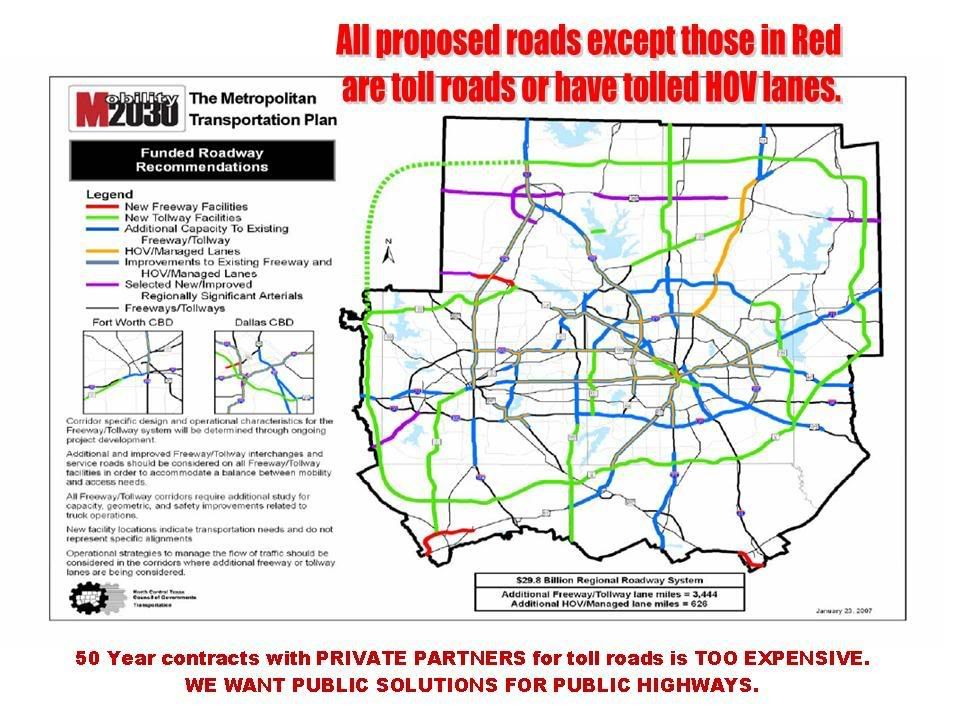
During the 30 years (2000-2030) the RTC (Regional Transportation Commission of the NTCOG) and TxDOT propose to add 675 miles of managed lanes (TOLL FREEWAYS and TOLLED HOV LANES on existing Freeways) in the DFW region.
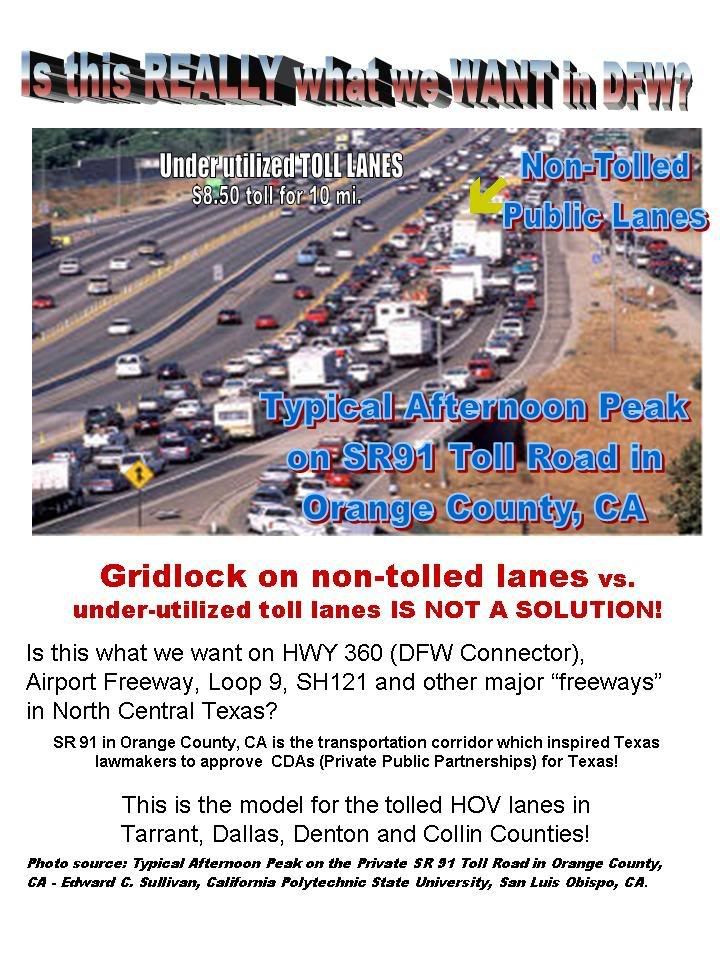
In California, during rush hour traffic, managed HOV toll lanes carry too few cars while public lanes are much too congested. Should we adopt the same model here?
[Click on images to enlarge]
During the 30 years (2000-2030) the RTC (Regional Transportation Commission of the NTCOG) and TxDOT propose to add 675 miles of managed lanes (TOLL FREEWAYS and TOLLED HOV LANES on existing Freeways) in the DFW region.
They only propose adding 70 additional miles of NON-TOLLED FREEWAYS! They are planning to sign 50 year contracts for these tolled managed lanes and toll roads! EXEMPTING DFW from the 2 year moratorium is BAD if this is the BEST THEY HAVE TO OFFER!
The legend is hard to read. It says that:
Green is proposed New Toll ways.
Blue is proposed extensions of existing freeways/toll ways
or improving existing highways/freeways
by adding HOV toll lanes.
Black is freeways/toll ways.
Red is non-tolled freeways.
From 2000 to 2030 the Regional Transportation Plan for DFW:
| 2000 | 25 miles of existing toll roads built and managed by public toll authority |
| 2030 | 675 miles of managed lanes and toll road under CDAs (Public private partnerships with 50 year contracts financed at higher rates than public bond and with higher tolls to generate "SURPLUS TOLL REVENUE" for investor return on investment (profit) and up-front payments to the RTC for use on non-toll projects). |
Will citizens in this area pay more than their fair share for highway construction?
Will they have to pay their fair share of state gasoline and other taxes which builds roads in other regions while still having to pay high tolls to travel in their own region?
Is utilizing state highway right-of-way (real estate) for tolled lanes adjacent to public highway lanes which are insufficient to handle the traffic the best way to address traffic congestion?
In California, during rush hour traffic, managed HOV toll lanes carry too few cars while public lanes are much too congested. Should we adopt the same model here?
Saturday, March 10, 2007
Toll & ID Schemes Unravel - Lies, Deceit and Betrayal - Part 4
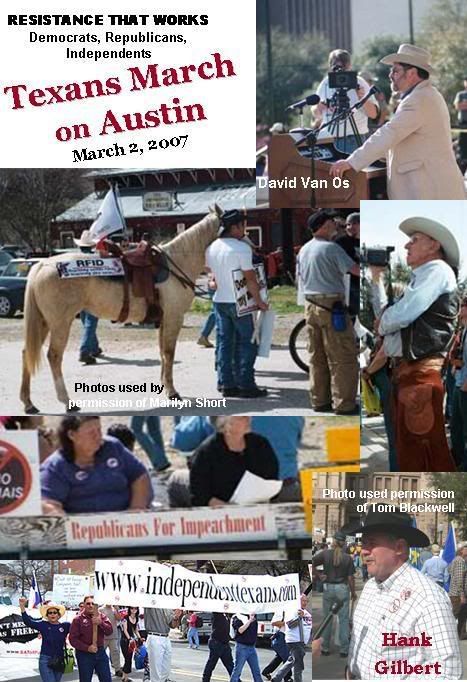
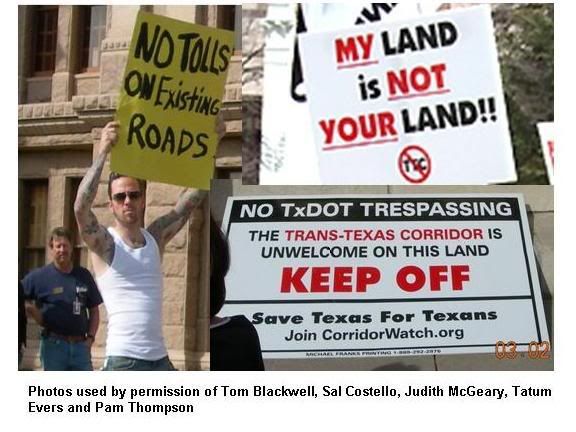
Photos used by permission of Sal Costello, David Stall, Pam Thompson, Tatum Evers, Tom Blackwell and Marilyn Short.
Part 4 of this series is intended to be a primer for keeping the fire turned up under elected officials and for keeping the light shining on dirty, underhanded deeds. This journal is about resistence that is occurring in Texas. However, it chronicles a small segment of current day American Society. From New York to Pennsylvania to Chicago and Indiana and Colorado the same forces are operating contrary to the public good. The same lies are being told. The same tactics are being use.
There are effective ways to combat fat cats with deep pockets who are lickin' their greasy chops in anticipation of big payoffs at the expense of ordinary citizens, business men and women, farmers, ranchers, truckers and children. The battle isn't won yet in Texas but recently there have been some squirmishes which have left the fat cats ducking for cover and compliant politicans yelling about repentance and know understanding what they were doing!
RULE No. 1: My enemies enemy is my friend.
Forget about partisan differences and identify neighbors and leaders of other parties who share your distain for private/public partnerships for toll roads, secret negotiations by politicians and bureaucracies, and legislation which benefits a few at the expense of many.
RULE No. 2: Forge coalitions across party lines to encircle the wagons and get the attention of politicians.
Don't hesitate to invite people who agree with you on this (these issues) but usually oppose your position on other issues to go with you to the State Capitol to hearings and to speak with legislators. When citizens from all parties show up and say the same things, some legislators are smart enough to realize that discontent is mounting which may be large enough to unseat them when they face re-election. Even the worse transgressors, when frightened enough, tend to try to start distancing themselves from some of their bills and votes.
RULE No. 3: Don't hesitate to allow Legislators whose performance riles you the most to come on board and do right on this particular issue. You don't have to like them. You need not vote for them. You need not trust them. Let them step across the line and VOTE RIGHT on this issue. Votes count even from scroundrels.
RULE 4: Don't rely on the main stream media to get the word out. Use them when you can but develop other communication tools.
RULE 5: Share, share, share.
Share contacts, forward pertinent e-mail messages, introduce people who share common interests even if they disagree on many other things.
RULE 6: Teach, mentor, and enable.
Everyone doesn't have the same education, skills, or resources. Everyone has something to contribute. Assist, encourage, share, utilize.
RULE 7: Thank people. Thanks is fuel for the battle.
When an elected official makes a correct stand, whether in an interview, at a hearing, or by sponsoring or co-sponsoring or voting on legislation, call, write or e-mail and thank him or her. When a reporter gives fair coverage to the issue, send a thank-you stating your appreciation of the coverage. When you see others leading the charge and contributing to the effort, pat them on the back and tell others what a good job they have done for the cause.
RULE 8: Research, research, research -- verify, verify, verify -- communicate, communicate, communicate.
Email and internet allows us to link our home offices together into a virtual network. Don't hesitate to shout when you need help, are confused, or are overwhelmed. This is a relay race. One carries the torch for a leg or two while other recharge and prepare to step in for the next leg of the journey. The enemy is large with deep pockets and highly motivated by greed. Alone we are defeated. Together we are an army attracting new recruits with fresh resources and skill sets. It isn't about any one person's ego or position. It is about the welfare of humankind. We are each one voice in a mighty chorus.
Below is an Action Alert for NAIS. Tomorrow a similar Action Alert will be posted for Toll Roads. Use this as an example. Even if you are in another State, it shows you how to keep the heat turned up to change the positions of elected officials on oppressive legislation. Most of the content of this Action Alert was written by Judith McGeary of the Farm and Ranch Freedom Alliance.
Thursday, March 08, 2007
TTC & NAIS Unraveling - part 3
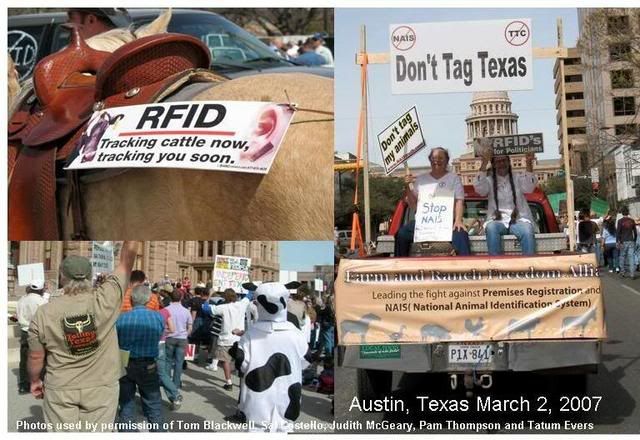
Premise Registration of pets and farm animals is a FEDERAL GOVERNMENTAL initiative that is worming its way through state legislatures across American. In 2005 a one page bill was passed by the Texas Legislature and signed into law. It has not been implemented yet. Texans who are furious about the Trans Texas Corridor Toll Road landgrab are standing with Ranchers who are opposed to the implementation of mandatory microchip ID for animals and premise registration.
Outrage is bridging partisian boundaries. Liberals, progressives, moderates, conservatives, ultra conservatives and even those who are normally politically apathetic united in Austin March 1st and 2nd, sending clear messages.
Don't Tag my pets, Don't register my home or farm as a premise! Don't take my land!
The message was clearly conveyed: Trans Texas Corridor -- Zachry, Cintra, TxDot, Rick Perry: STAY OFF MY LAND! "My Land is NOT Your Land" was the battle cry.
Why should this matter to people who live in Pennsylvania, New York, Oklahoma, and other states? It matters because these "policies" are being pushed from Washington down to the states. The Texas Department of Transportation (TxDot) announced the selection of Cintra, a Spanish based corporation to manage part of an existing State Highway (SH-121) as a private/public partnership toll road. Cintra, with Texas based Zachry Construction, has been chosen by TxDot to build and operate the massive Trans Texas Corridor. Contracts have not been signed. They must be reviewed and approved by the Transportation Committee.
During the past three years, massive portions of the Texas Transportation Code was revoked or amended . Much TTC and private/public partnership toll project language was inserted into numerous bills in both houses of the Texas Legislature. Many of the Senators and State Representatives who sponsored and voted for the changes received generous campaign contributions from Zachry and other businesses and individuals with financial interests in the TTC.
Last week the Texas Senate Committee on Transportation held an eight hour hearing on SH-121 and the TTC. People came from all over the State. They had to open two additional large hearing rooms and connect them with live television feeds to accommodate the hundreds of Texans who drove to Austin for the hearing.
(Videotaped testimony is available at http://www.senate.state.tx.us/avarchive/ (Select March 1 Senate Committee on Transportation & Homeland Security Hearing Regarding the Trans Texas Corridor)
It is challenging to unravel the methodology which was utilized to sell local and State officials on this massive land grab. It is an ill-conceived overly expensive plot. Similar things are occurring in other States. Driven from Washington, legislation to change laws to implement the NAIS and Public Private Toll Road Partnerships have turned Texas into the frontline for national implementation of significant and far-reaching changes in property rights, transportation financing, removal of appropriation control from elected legislative bodies to control of obscure bodies of political appointees. It is probable that Governor Rick Perry's close ties to George W. Bush and Bush's ties in Austin resulted in Texas acquiring the dubious "pleasure" of being selected as the pilot for the Bush Administrations "vision" for revamping the nation's transportation and homeland security. NAIS is definitely Washington driven. National Animal Identification System is a Federal Initiative with joint Agriculture, FDA and Homeland Security oversight!
This is the third in a five part series of journals on the uproar in Texas. Citizens have banded together demanding repeal of legislation which mandates computer chip animal identification and premise registration and of TTC enabling language.
SO HOW DID WE GET HERE? HOW CAN WE INSURE THESE BAD POLICIES CONTINUE TO UNRAVEL?
Rick Perry was re-elected governor in 2006 with the lowest percentage of votes cast for any winning governorial candidate in Texas in modern history. Many more Texans voted for statewide candidates for Agriculture Commissioner and Attorney General who did not win the election than voted for Rick Perry. Incumbents who have been Perry adminstration team players watched massive numbers of their constituents voice disapproval of the TTC at TxDOT hearings all over Texas last summer. They saw support shift from conservative incumbent to anti-TTC populist challengers. Now many who have sponsored TTC enabling legislation or voted in favor of it are back peddlings, saying "I want a do over!"
It takes a lot to get a lot of thousands Texans motivated enough to descend on Austin at one time. Austin is not the easiest place to get to in Texas. Trains only run through Austin once a day. Air service isn't the greatest. Highways are congested and there always seems to be some construction project on the more narrow, overcrowded corridors. It was probably by design. Legislators have historically been viewed by Texans as problems which need to be contained. Constitutionally, State Representatives are "part-time" and the Legislative session is much shorter than in many smaller states with greater population. My College History and Political Science professors all said it was because Texans fear that they'll do too much damage if given more time. Yet last week between 5000 to 6000 people from all over Texas took to the streets. They hauled their horses, chickens, tractors, goats and family pets and marched down Congress Avenue to the State Capitol. It was Texas Independence Day and Texans were declaring INDEPENDENCE over current tyrrany!
Examination of the butcher job they've done on Transportation and Agriculture codes in the past 2 years gives us good cause for such caution. Some of the most far-reaching, radical changes to the Transportation Code were passed in the middle of the night. Much of what has brought us to this particular place occurred in small working groups, at privately funded transportation seminars, in poorly advertised "public meetings" of obscure committees in Councils of Government all over the state. TTC enabling language was presented to Legislative Counsel by attorney's working for various special interest and the language made its way into numerous pieces of legislation in both houses. The clients of these attorneys can hide behind "attorney client privilege", circumventing the ethics rules. The attorneys are able to avoid disclosing who they are representing and these visits are not classified as "Lobbyist" activity! It is not a loophole. It is not even a hole the size of a barn door. It is more like an opening the size of the pasture where the barn should be standing!
A one page bill (C.S.H.B. 1361) passed inro law in Texas September 1, 2005 (but not yet implemented)requires mandatory registration of all premises with animals or poultry, mandatory computerchip ID system, and 24-hour reporting of death or transfer of animal ownership. With only a few paragraphs the way farming, ranching and ownership of horses and domestic pets was reengineered (at least on paper). The cost to implement this program are astounding --on both the bureaucratic level. The shift in privacy rights, property rights, and potential civil rights resulting from implementation of NAIS are mind boggling. We'll explore them in greater detail in journals later this week.
Rick Perry's administration will probably become known as one of the most corrupt administrations in the past quarter of a century. Media doesn't really cover what goes on policy wise in Austin very throughly. Transportation stories usually get buried in obscure places in newspapers. It is difficult to explain complex scenarios in television news bites. Most assignment editors think that the public just isn't all that interested in what the Legislature does. Fortunately the internet and search engines allow us to get some coverage of "our tax dollars at work!" Shame that they are usually not working for us!
The cherry on top is that the folks in public office in Austin are the ones that the majority of Texans (probably) voted for. I say probably because we have had some really big problems with the electronic voting machines -- especially with how accurately they tabulate the votes. During the 2006 Primary, there was over a 100,000 vote tabulation error in Tarrant County and many other snafu's reported in other counties. Few of us are confident that anyone really knows how many people voted for any one candidate. But a lot of people have invested time, and money and faith in the folks in Austin. It is difficult to accept the truth about people you have supported and trusted. Denial reigns supreme in many circles.
When it comes to faith in Texas incumbents, I haven't invested much faith in any of them. There are a few that occasionally get my attention and surprise me pleasantly. Whether Republican or Democrat, I usually try give them a call when I see them do anything good that impresses me. However, I don't have to spend a lot of time on such calls because overall, most of them never rise above C-, even when they "pleasantly surprise" me!
There is nothing that says you have to be intelligent to be elected to the Texas Legislature. There are some who are very intelligent. There are some who are relatively honest. There are few who are both honest and intelligent. They are responsible for that but the voters are the ones who are responsible for selecting them. And we entrust them with setting policies which are complex and have far-reaching consequence to billions of people every day. Selecting the least qualified, academically challenged and intellectually deficient candidates seems to be a pattern of both major parties -- in Texas and elsewhere. (One example is the election of Paula Hightower-Pierson, a high-school drop-out who did not return to school to get a college education, as a Democratic State Representative in 2006). State Party leaders (and the media) tend to rate candidates only in terms of how much money they can access for media buys rather than on credentials, track record, character or intellect!
Once elected, most legislators rely on the Legislative Counsel (and lowly paid staff) to explain the bills and language contained in bills. Counsel frequently relies on contacts from trade groups who come to them on behalf of unnamed entities with language for bills. It is difficult to determine who staffers rely on for their interpretation of complex policies and legislation! Now that there has been consistent, loud, sometimes stringent outcry from Texans from all political parties on the Cintra-Zachry TTC deal and NAIS, many Senators and State Representatives are are saying that they 'didn't understand' what they were doing when they sponsored certain TTC enabling legislation. Many of them probably didn't comprehend the implications in the language of the bills they put their names on as author or sponsor. However, for many, it probably just appears better politically to them right now to try to deny it and distance themselves as far as possible from their previous positions and votes.
A former State Representative told me that he thinks that many of them probably didn't have a clue what language in the TTC Transportation bills really meant. They were told that private public partnerships for toll roads would help them keep gasoline taxes low. Since they'd raided the designated transportation funds and refused to call for bond issues or raises to the gasoline tax for decades for highway construction, they grasp for straws. Legislative session after legislative session for over 20 years, highway and bridge maintenance has been deferred. Population explosions in the major urban centers has resulted in increased urban sprawl and traffic gridlock. Federal funds for rail and mass transit dried up and cities and counties looked for sources (other than local tax money or bond elections) for local transportation projects.
There is a lot of cronyism and out and out thievery in Austin. But the buck really rests with those of us in the hinterlands. We're the folks who allowed them to be elected to office and we're the folks who have allowed them to continue there. There are ways to rein-in errant elected officials. One immediate thing we can do is continue to exert pressure on the Texas Legislature to repeal NAIS. Here is a background paper on legislation that will change "mandatory" to "voluntary".
http://www.capitol.state.tx.us/tlodocs/79R/analysis/doc/HB01361H.doc
Amazing how one short, one page document can raise so much havoc in so very very many lives.
C.S.H.B. 1361 By: Hardcastle
Agriculture & Livestock Committee Report (Substituted)
… Because of its complexity, the United States Department of Agriculture (USDA) plans on phasing in the National Animal Identification System (NAIS). It is vital that Texas develop and implement within the state an animal identification program that is consistent with that of the USDA.
RULEMAKING AUTHORITY
It is the committee's opinion that rulemaking authority is expressly granted to the Texas Animal Health Commission in SECTION 1 of this bill.
ANALYSIS
This bill creates an animal identification program to provide for disease control and to enhance the ability to trace disease-infected animals, which is consistent with the United States Department of Agriculture's National Animal Identification System. The Texas Animal Health Commission (Commission) may require the use of official identification numbers and may establish a date by which all premises must be registered. The Commission may further assess a registration fee on all entities that register for a premises identification number. This bill provides that information collected by the Commission is exempt from public disclosure requirements. The bill authorizes the Commission to disclose information to certain persons, including a governmental entity. The bill provides for penalties for failure to comply with the Commission's order. The bill authorizes the Commission to adopt, implement and enforce rules for the animal identification system.
EFFECTIVE DATE
This Act takes effect September 1, 2005.
CALL TO ACTION ON NAIS:
Status in Texas In 2005, the Texas Legislature adopted HB 1361, codified at §161.056 of the Agriculture Code, authorizing the TAHC to implement NAIS on a mandatory basis in Texas. The TAHC proposed mandatory regulations for premises registration in December 2005, but withdrew them after a public outcry.
In November 2006, the USDA stated that it does not intend to adopt mandatory federal regulations, so there is no federal law or regulation requiring implementation of this program by Texas.
Issues
The NAIS will cause a variety of problems:
• Massive intrusion into people’s lives: individuals will have to provide detailed information about their property, businesses, and their own movements to government and private databases;
• Burden on property rights: the premises registration number will attach to the land forever, and people’s rights to manage their land and animals will be restricted;
• High costs: registration, tagging, and reporting all carry costs in both time and money;
• Loss of small farmers and ranchers: many will be unable to afford the program, or unwilling to accept the government intrusion;
• Damage to the economy: businesses that rely on small farmers, such as sales barns, supply stores, and even tourism, will be harmed;
• Reduced choices and increased costs for consumers;
• Violation of many Americans’ religious beliefs; and
• Increased government bureaucracy and waste of taxpayer dollars. Neither the USDA nor the TAHC has performed a cost analysis of the program. Costs for similar programs in other countries are estimated to range from $37/head to $69/head. According to the 2002 USDA census and a 1998 study, Texans own over 14 million cattle, 1 million sheep, 1 million goats, and 1 million horses, the majority of which are on small farms. The NAIS will likely cost Texans hundreds of millions of dollars.
The NAIS will not provide benefits to justify these costs.
The stated purpose of the NAIS is to provide 48-hour traceback to address animal disease. But the NAIS does not address the critical issues for disease prevention and control:
• the causes of disease, especially differences in management;
• the vectors of disease transmission, including wild animals, insects, and imports;
• testing for disease, including tests for Mad Cow and other food-safety issues; and
• the unique issues posed by each species and each disease Contrary to claims, the NAIS will not protect against bio-terrorism.
Terrorists are unlikely to target hobby animal owners and small farmers. Microchips are vulnerable to cloning and computer viruses. The type of microchip specifically recommended for horses and cattle, the ISO microchip, is designed to be reprogrammable, so anyone can easily change the numbers.
The large databases will provide an easy target for hackers. Indeed, even without intentional tampering, the large databases will be unmanageable, as has already been found in Australia. The USDA has stated that NAIS is not a food safety program. Under NAIS, tracking ends when the animal is killed at the slaughterhouse. Most food-borne illnesses occur because of contamination from poor practices after slaughter. NAIS will do nothing to address these issues. Food safety needs to be addressed by increased standards and inspection of food processing facilities, including testing for Mad Cow Disease.
The final stated justification for the NAIS is to improve the export market. However, there are better ways to reach agreement with Japan and other foreign countries, including allowing those meat packers who wish to export beef to test their animals for BSE.
If tracing is a market benefit, let the market implement it, not a mandatory government program using our tax dollars. The USDA also has a “Process Verified Program,” which allows qualifying suppliers to market themselves as “USDA Process Verified,” including age and source verified. Any such program should be voluntary, non-coercive, allow for true competition, and paid for by the participants so that it does not distort market forces.
Some of the alternatives to NAIS for improving animal health
• Develop educational programs for animal owners, addressing disease prevention through animal management and biosecurity, and identification of diseases requiring the intervention of a vet.
• Improve training for veterinarians in recognizing foreign and emerging animal diseases and develop a protocol for the use of rapid diagnostic tools in the field. (recommended by the United States Government Accountability Office in GAO-05-214 (Mar. 2005))
• Increase inspections of animals and agricultural products entering into Texas.
• Consider existing mechanisms for tracking livestock: brucellosis program, scrapie program, tuberculosis program, brand system, sales and slaughter records, and producers’ records. Analyze the costs and benefits of minor modifications to existing programs and alternative programs, such as a “book-end” system (i.e. no tracking of movements) that uses non-electronic means of identification when the animal enters the stream of commerce.
• Conduct scientific modeling to identify high-risk situations and quantify important factors, such as the level of contagion, the means of transmission, and the severity of the diseases of concern.
Proposed legislation HB 461 would amend the current statute to limit the TAHC’s authority to a voluntary program. HB 637 would also limit the program to voluntary only. HB 637 also:
(1) bars any coercive measures from being used; and
(2) requires full disclosure before any person can be enrolled in the program, and provides an unrestricted right to withdraw from it.
This legislation would allow the TAHC to develop NAIS as a voluntary, market-driven program, consistent with the USDA’s November 2006 announcements.
Crossposted on Daily Kos, Texas Kos and Diatribune.
Wednesday, March 07, 2007
Toll Scheme Unravels - Part 2 - TTC With NAIS fuels inflation
Texans of all generations descended on Austin last week demanding repeal and /or defeat of legislation which will fuel inflation. They didn't mention inflation out right. Instead they talked about the impact implementation of the National Animal Identification System (NAIS) passed by the Texas Legislature in 2005 will have on farm and ranch management. They spoke out against the loss of family farms and ranch and farm land to the Trans Texas Corridor and other proposed private/public toll road projects.

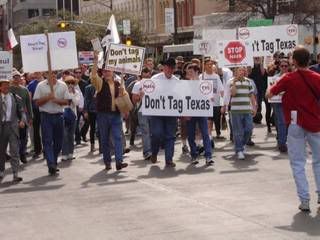
Supporters of the TTC and NAIS appear to be concentrated in urban center. Regional Councils of Government Transportation Committees (RTCs) are the most ardent supporters of the TTC and other proposed private public partnership toll road construction and /or operation contracts. In attempting to get a short term solution for scarce transportation funding for local and regional projects, many city councils and county governments have signed on to the "Toll them as much as you can for as long as you can" schemes which will cost motorists (and consumers) more to travel and ship goods along most of the states future roads and road expansion projects.
It could appear to be a rural vs. city issue, but it is not. It is really a power grab through TxDot by some local elected politicians to transfer "upfront" money to unelected appointed Regional Transportation Committees. Combined with implementation of the mandatory National Animal Identification System in Texas, it will result in surges of inflation which will threaten the economic welfare of every person and business in Texas.
They sold this scheme with a carrot of "up front money" dangled to local governmental officials through RTCs. No one examined the payload of hidden costs, detrimental financial impact or short term/long term inflation. TxDot and RTCs have downplayed the significant difference in the cost for funding road projects with private for profit companies instead of using public money, indexing the gas tax and applying designated funding to transportation.
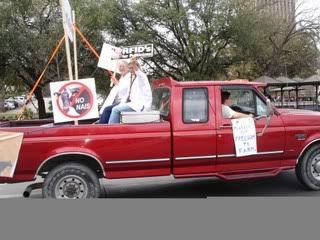
This series of journals discusses two issues which are linked. They are linked because they are both schemes which will transfer money and financial opportunities from many for the benefit of a few for terms of at least 50 years. Through proposed exercise of eminent domain, more acreage will move from private ownership to State ownership to be controlled for the financial benefit of private concessionaires (Cintra and Zachry). NAIS hits the farmers and ranchers hardest economically. However its impact reverberates throughout the economy and will fuel inflation which will take "buying power for the same dollar" out of the pockets of every business, man, woman and child in Texas. It will impact every consumer of goods produced and or marketed from Texas -- irregardless of where they live.
Construction of the Trans Texas Corridor and expansion and construction of other new highways using the private public partnership models of the TTC and Texas State Highway 121 will take money out of the pockets of every consumer who purchases goods that originate in Texas or are shipped through Texas.
I'll start out by discussing the cost of tuna fish. Most folks are familiar with buying tuna fish in the grocery store on sale. Last year we could usually find it on sale at 3 cans for a dollar. This year on sale it is more frequently offered as 10 cans for $10. Last year it was 33 cents can – this year it is a dollar a can. That is a 200% increase in one year for a commonly purchased food product. Rich and poor alike buy groceries. They are basic necessities. We could have used hamburger meat instead of tuna fish for this example but I chose tuna. The cost of tuna rose, not because of increase manufacturing cost or a significant shift in supply or demand for tuna. It rose last year because of increased gasoline costs for shipping. Shipping costs are usually passed on 100% to the consumer. Inflated fuel costs results in inflation when we go to the checkout counter in the grocery store.
Implementing the private public toll road partnership for building Texas Highways as toll roads will have a very similar impact on the price of goods when we are standing at the check out counter. When we buy hammers or nails, when we buy feed, when we buy tuna fish, when we buy clothes, when we buy medication, we'll pay higher prices to cover the merchants’ increases in shipping costs for the goods. When we buy meat we’ll pay for the increase in shipping for the feed and supplies to feed the beef plus increases in shipping costs to the slaughter houses and then to the market. If the TTC or another toll road is cut through a ranch or farm, that will be the route to market. They’ll have to pay to use the road that cuts through land they used to own!
Proponents of the private/public transportation partnership argue that those who choose to drive on the roads will be the ones to pay the tolls. However, all of us, no matter where we live and even if we never drive or ride down the toll road, we’ll pay for it. When we check out at the grocery store, part of our grocery bill will cover profit for the private company operating toll roads and for “up front money” for local politicians to control and divide up as “pork”. It will be a very poorly hidden regressive tax which will fuel inflation and force us to make tough personal financial decisions. State and local elected officials have ducked out and avoided facing the tough budgetary issues head-on. These private/public partnerships are appealing to them on the surface but will deliver a financial payload that will be devastating to local citizens, businesses and government alike.
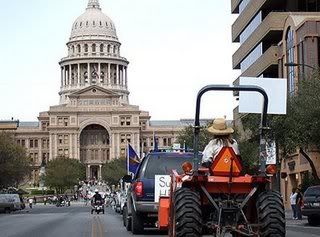
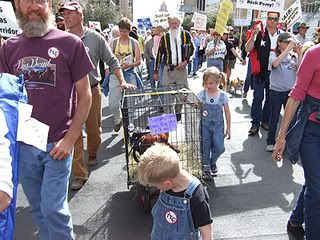
One of the cruelest aspects of the Cintra/SH121 contract (which is the first of many TxDot plans to sign in the near future all over Texas) is that children (including two generations who are not even born yet) will be paying the highest tolls and related shipping fees for goods and services under the escalating toll private public partnership agreements.
There will be some increase to pay for road maintenance and construction no matter what policies are implemented. However, the private/public partnership toll road schemes devised to generate as much "excess toll revenue" so that private partners can make profit while distributing substantial sums as "up front money" to regional transportation committees will help accelerate the rise in inflation. It is probable, that coupled with implementation of NAIS and continuing high energy costs, we'll return to the nightmare days of double-digit inflation. It is quite possible that we'll be seeing escalating inflation while salaries and real income stays flat or drops off. To control inflation we usually see interest rates on loans, and home mortgages rise. Folk make only the same or less money but have to spend more for a can of tuna, for clothes, people have to pay higher house payments for the same house when inflation rises. Folks pay more to finance automobiles. These are issues which are of paramount importance to every city dweller and every business person.
The farmers and ranchers are leading the charge in Texas in opposition to NAIS and TTC. We all must join in.
There are many cost in implementation of NAIS. We'll discuss them further in the comments section and in journals later this week. Please pass links to this journal along to your friends and ask them to join in the conversation. The more that recommend and comment on this series, the more visibility we can give this issue.
Crossposted on Texas Koas, Daily Kos and Diatribune.
Photos used by permission, courtesy of Sal Costello, Judith McGeary, Pam Thompson, Tatum Evans and Tom Blackwell.
Supporters of the TTC and NAIS appear to be concentrated in urban center. Regional Councils of Government Transportation Committees (RTCs) are the most ardent supporters of the TTC and other proposed private public partnership toll road construction and /or operation contracts. In attempting to get a short term solution for scarce transportation funding for local and regional projects, many city councils and county governments have signed on to the "Toll them as much as you can for as long as you can" schemes which will cost motorists (and consumers) more to travel and ship goods along most of the states future roads and road expansion projects.
It could appear to be a rural vs. city issue, but it is not. It is really a power grab through TxDot by some local elected politicians to transfer "upfront" money to unelected appointed Regional Transportation Committees. Combined with implementation of the mandatory National Animal Identification System in Texas, it will result in surges of inflation which will threaten the economic welfare of every person and business in Texas.
They sold this scheme with a carrot of "up front money" dangled to local governmental officials through RTCs. No one examined the payload of hidden costs, detrimental financial impact or short term/long term inflation. TxDot and RTCs have downplayed the significant difference in the cost for funding road projects with private for profit companies instead of using public money, indexing the gas tax and applying designated funding to transportation.
This series of journals discusses two issues which are linked. They are linked because they are both schemes which will transfer money and financial opportunities from many for the benefit of a few for terms of at least 50 years. Through proposed exercise of eminent domain, more acreage will move from private ownership to State ownership to be controlled for the financial benefit of private concessionaires (Cintra and Zachry). NAIS hits the farmers and ranchers hardest economically. However its impact reverberates throughout the economy and will fuel inflation which will take "buying power for the same dollar" out of the pockets of every business, man, woman and child in Texas. It will impact every consumer of goods produced and or marketed from Texas -- irregardless of where they live.
Construction of the Trans Texas Corridor and expansion and construction of other new highways using the private public partnership models of the TTC and Texas State Highway 121 will take money out of the pockets of every consumer who purchases goods that originate in Texas or are shipped through Texas.
I'll start out by discussing the cost of tuna fish. Most folks are familiar with buying tuna fish in the grocery store on sale. Last year we could usually find it on sale at 3 cans for a dollar. This year on sale it is more frequently offered as 10 cans for $10. Last year it was 33 cents can – this year it is a dollar a can. That is a 200% increase in one year for a commonly purchased food product. Rich and poor alike buy groceries. They are basic necessities. We could have used hamburger meat instead of tuna fish for this example but I chose tuna. The cost of tuna rose, not because of increase manufacturing cost or a significant shift in supply or demand for tuna. It rose last year because of increased gasoline costs for shipping. Shipping costs are usually passed on 100% to the consumer. Inflated fuel costs results in inflation when we go to the checkout counter in the grocery store.
Implementing the private public toll road partnership for building Texas Highways as toll roads will have a very similar impact on the price of goods when we are standing at the check out counter. When we buy hammers or nails, when we buy feed, when we buy tuna fish, when we buy clothes, when we buy medication, we'll pay higher prices to cover the merchants’ increases in shipping costs for the goods. When we buy meat we’ll pay for the increase in shipping for the feed and supplies to feed the beef plus increases in shipping costs to the slaughter houses and then to the market. If the TTC or another toll road is cut through a ranch or farm, that will be the route to market. They’ll have to pay to use the road that cuts through land they used to own!
Proponents of the private/public transportation partnership argue that those who choose to drive on the roads will be the ones to pay the tolls. However, all of us, no matter where we live and even if we never drive or ride down the toll road, we’ll pay for it. When we check out at the grocery store, part of our grocery bill will cover profit for the private company operating toll roads and for “up front money” for local politicians to control and divide up as “pork”. It will be a very poorly hidden regressive tax which will fuel inflation and force us to make tough personal financial decisions. State and local elected officials have ducked out and avoided facing the tough budgetary issues head-on. These private/public partnerships are appealing to them on the surface but will deliver a financial payload that will be devastating to local citizens, businesses and government alike.
One of the cruelest aspects of the Cintra/SH121 contract (which is the first of many TxDot plans to sign in the near future all over Texas) is that children (including two generations who are not even born yet) will be paying the highest tolls and related shipping fees for goods and services under the escalating toll private public partnership agreements.
There will be some increase to pay for road maintenance and construction no matter what policies are implemented. However, the private/public partnership toll road schemes devised to generate as much "excess toll revenue" so that private partners can make profit while distributing substantial sums as "up front money" to regional transportation committees will help accelerate the rise in inflation. It is probable, that coupled with implementation of NAIS and continuing high energy costs, we'll return to the nightmare days of double-digit inflation. It is quite possible that we'll be seeing escalating inflation while salaries and real income stays flat or drops off. To control inflation we usually see interest rates on loans, and home mortgages rise. Folk make only the same or less money but have to spend more for a can of tuna, for clothes, people have to pay higher house payments for the same house when inflation rises. Folks pay more to finance automobiles. These are issues which are of paramount importance to every city dweller and every business person.
The farmers and ranchers are leading the charge in Texas in opposition to NAIS and TTC. We all must join in.
There are many cost in implementation of NAIS. We'll discuss them further in the comments section and in journals later this week. Please pass links to this journal along to your friends and ask them to join in the conversation. The more that recommend and comment on this series, the more visibility we can give this issue.
Crossposted on Texas Koas, Daily Kos and Diatribune.
Photos used by permission, courtesy of Sal Costello, Judith McGeary, Pam Thompson, Tatum Evans and Tom Blackwell.
Tuesday, March 06, 2007
Toll Scheme Unravels - Texans March on State Capitol
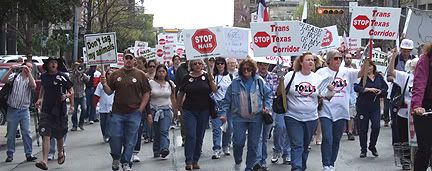
Photos by Judy McGeary, used by permission
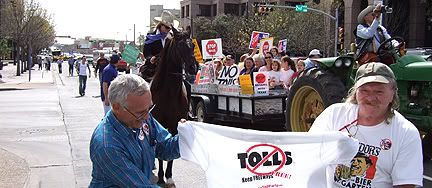
Thousands of people from all over the state of Texas descended on Austin Friday, March 2nd, registering extreme discontent with the Trans Texas Corridor and Mandatory Animal Microchip ID.
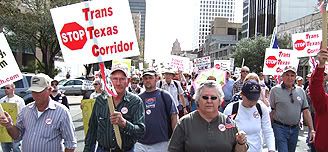
A few months earlier, the TTC was described as "a done deal." Now, at the mercy of enraged citizenry, many legislators who sponsored TTC enabling bills are back peddling and attempting to distance themselves from previous support for the private/public partnership toll road, pipeline and rail corridor scheme. Positioned to be the first major leg of a multi-state NAFTA transportation corridor, the TTC would gobble up millions of acres of Texas land, while transferring resources from many to a few over a timeframe of 50 years.
Texans cried out against the TTC. Some came to Austin wearing t-shirt labeled "Tyranny Response Team!" Others called Perry's TTC a Texas Nightmare!
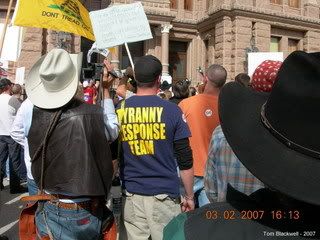
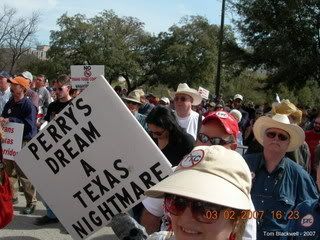
Photos by Tom Blackwell, used by permission.
A few months earlier, the TTC was described as "a done deal." Now, at the mercy of enraged citizenry, many legislators who sponsored TTC enabling bills are back peddling and attempting to distance themselves from previous support for the private/public partnership toll road, pipeline and rail corridor scheme. Positioned to be the first major leg of a multi-state NAFTA transportation corridor, the TTC would gobble up millions of acres of Texas land, while transferring resources from many to a few over a timeframe of 50 years.
Texans cried out against the TTC. Some came to Austin wearing t-shirt labeled "Tyranny Response Team!" Others called Perry's TTC a Texas Nightmare!
For the next five days I will be posting journals on three blogs: Grassroots News You Can Use, Daily Kos and Texas Kos examining how the Toll Scheme and Animal Mandatory Microchip ID plans evolved, their impact on the state and nation, and the methodology of special interest groups and pockets of greedy, ambitious, corrupt local and state elected officials conspired to re-engineer the funding mechanism of transportation in Texas in violation of the public trust.
Jesse James and his gang of bandits and all other bank robbers never pulled off a "job" of the magnitude attempted by "players" who conspired to revise highway construction and replace known models of toll road construction with newer models designed to generate the largest amount of SURPLUS TOLL REVENUE to distribute to local (non elected) Regional Mobility Commissions (RMC) and as profit for private partners. Low bids which would have kept tolls low, and retired the debt as rapidly as possible submitted by reputable toll authorities such as the NTTA (which has operated the North Dallas Toll Road efficiently for decades) were rejected in favor of higher bids and higher toll fees to generate greater up front barrels of pork to be distributed by regional transportation committees on HW121. The Spanish based Cintra was selected by TxDot as the contractor for the I-121 project, a toll project in the Dallas Fort Worth Metroplex. Local toll road operators with positive proven track records in the region for "building good roads at the lowest cost, keeping tolls as low as possible, and retiring the debt as soon as possible" were bypassed because their toll models "did not generate sufficient surplus toll revenue to generate up-front money to pay to the RMC and profit for the private partners."
At the Hearing Thursday it was revealed that TxDot intends to sign contracts on five more transportation projects in the Dallas Fort Worth area in the next 12 months -- and these projects are to be toll projects following the I-121 toll model. One witness describes them as encompassing all the major transportation arteries in the DFW Metroplex. TxDot Chairman Williamson stated that these projects have all been publicized through many hearings with good attendance in the DFW area. However, until Thursday's hearing, none of the activists I know in Tarrant County were aware that any of these roadways (except for I-121) were slated to be contracted as private/public partnerships! The hearings on I-121 were held in Denton and Collin County even though Tarrant County tax money has financed some of the right of way purchases. Most people learned of the I-121 hearings through reports of the letting of the contract to Cintra. Few people attended the TxDot I-121 hearing. Few heard of it before it occurred. TxDot’s TTC hearings last summer drew auditorium and convention halls filled with people. The Senate Hearing in Austin filled up three large hearing rooms. Yet only a few people showed up to the hearings for I-121. The reality is that people have difficulty showing up to hearings that are poorly publicized.
The Senate Hearing on Transportation and Homeland Security was a good start in the right direction for transportation planning it Texas. It is unfortunate that they waited until after TxDot had spent taxpayer money for engineering studies, PR, legal and other expenses in relation to the Trans Texas Corridor to hold it! The Senate Committee on Transportation and Homeland Security Hearing March 1st is the first major step toward a serious examination of the problems which brought the state to this impasse. Senator John Corona, Chairman, is applauded for holding this hearing. It is unfortunate that the hearing was not held prior to TxDot squandering billions of tax dollars. The money already spent on the TTC would have completed one or more of the state's many unfunded transportation projects.
Non compete clauses in the I-121 contract restrict construction of public non-toll roads parallel to the toll road for 50 years. The rejected NTAA bid allowed for 1.5% toll increases every 5 years. The Cintra contract calls for up to 3.5% toll increases every 2 years!
One of the transportation experts testifying at the Senate Committee on Transportation and Homeland Security Hearing estimates that indexing the gasoline tax to pay for road construction will be significantly less expensive for taxpayers than building roads utilizing the I-121 private/public partnership toll model. Travelers on I-121 would probably pay an additional $80 annually in the last year of the contract (year 49) to travel on the toll road if it is paid for by gasoline tax indexing. It is estimated that in year 49 travelers on the toll road under the Cintra TxDot I-121 contract will probably spend $3000.00 annually in tolls!
Crossposted on Daily Kos
Friday, January 19, 2007
TCC big money interests spread propoganda
Despite a record surplus, the Governor of Texas and TxDot leaders claim that Texas cannot afford to build highways without tolls. Gee whiz. They seem to think that Texans are idoits. Somehow they think we will believe that money out of our pockets to pay tolls is better than money out of our pockets to pay taxes to build and maintain highways.
It is a big shell game and they persist in playing Texas voters (Democratic, Republican and Independent)as fools. Across Texas billboards have appeared claiming that the TTC will give us jobs and make us safer! These boards appear to be Clear Channel bulletins paid for by the Outdoor Advertising Association. Wonder if they have an under the table agreement with the state that they'll get the contracts for new billboards? Something is up folks and it isn't good.
Texans are uniting against the TTC. Texas Toll Party, Independent Texans are joining with Texas Democrats and Republicans. March 2nd (Texas Independence Day) there will be a rally in Austin by Texans who want their tax money to be spent for the highest priorities --- good roads and highways, no tolls, state control of infrastructure. We'll share more information as we get it.
It is a big shell game and they persist in playing Texas voters (Democratic, Republican and Independent)as fools. Across Texas billboards have appeared claiming that the TTC will give us jobs and make us safer! These boards appear to be Clear Channel bulletins paid for by the Outdoor Advertising Association. Wonder if they have an under the table agreement with the state that they'll get the contracts for new billboards? Something is up folks and it isn't good.
Texans are uniting against the TTC. Texas Toll Party, Independent Texans are joining with Texas Democrats and Republicans. March 2nd (Texas Independence Day) there will be a rally in Austin by Texans who want their tax money to be spent for the highest priorities --- good roads and highways, no tolls, state control of infrastructure. We'll share more information as we get it.
Tuesday, August 01, 2006
TTC is Sparking a Prairie War at Texas A & M
It's been really interesting what I've been digging up as I follow the money of influential folks in this toll project here in Texas. Texas A&M (Hank Gilbert's alma mater) is also the home of one of our state's foremost Colleges of Civil Engineering. There are also a lot of petroleum engineers who graduated from Texas A&M. I think it's wonderful for folks who make good to give back to help the next generation along. However, this time, many of the alumni of Texas A&M are ending up on opposite sides of the TTC issue.
Farmers and Ranchers are mad because they need to keep their farms and ranches intact to continue making a living. History buffs are upset because the enabling language of the TTC legislation exempts TTC and related toll projects from the normal laws regarding land sites of historical significance. The way much of the bills were drafted exempts this project from normal public hearings on Historical Significance! Heck, they could be within the law and plough right through Washington on the Brazos where the Texas Declaration of Independence was signed! What the folks behind getting that language in the bills really probably intends to do is to dispense with public hearings on Historical Significance when they move to condemn farmland. Texas has a Historical Family Farm program which recognizes farms which have been continuously operated and owned by the same family for over 100 years. There are several farms belonging to some of my relatives in East Texas which have that designation and others which probably could get it if folks took the time to apply. One farm I know of with that designation has buildings on it which date from prior to the War between the States.
Contractors and transportation planners don't want to be slowed down and enmeshed in hearings on how important old great grandpa's barn is. When the kind of dollars are on the table and the smell of PROFIT is as strong as it is currently on the Texas prairie, some ambitious folks have "inspired" some of their friends in the Texas Senate and Texas Legislature to draft bills with language which will dispense with open meetings, normal competitive bidding processes, and messy historical significance hearings.
There are environmentalist who are affiliated with Texas A& M. The contractors aren't very concerned with all the same things that are high on the list of priorities of the environmental crowd. Many of the bills which I term "TTC enabling legislation" have clauses which permits TDoT to perform, or contract to consultants who will perform under their supervision, the environmental /ecological impact studies. Many of us see this as a blatant conflict of interest.
Texas A&M is one of the more heavily endowed Universities in Texas. Most of us thought this was a good thing but since the TTC moved to the forefront, a few of us are questioning how independent can a University's research be when it is as heavily endowed as Texas A&M? For example: The Texas A&M School of Engineering received $10 million from the Zachry Foundation. Folks were thrilled. That money allows the University to do a lot of good things. The main building where engineering classes are held is now the Zachry building in the Texas A&M School of Engineering.
About the same time the University received this endowment, the TTC initiative moved onto the planning boards in Texas. At first it looked like Halliburton and Citras (a Spanish corporation which operates toll roads in Canada) were going to get the biggest slices of the pie. It rapidly became evident from the public outcry that Halliburton's involvement would probably kill the project. Having a foreign corporation involved is not popular either. So the dreamers and schemers went shopping for a Texas Corporation with strong ties in Austin. Because the negotiations and records of the TTC are sealed from public scrunity, I don't know if Zachry was involved as a potential contractor and player under Halliburton and Citras or if they got involved after Halliburton fell from favor. However, now H.B. Zachry Corporation is teamed with Citras as the most favorable (in the view of TDoT) companies to construct, finances, operate and share in a return on their investment by concessions (rest stops, restaurants, gas stations, and toll plazas other facilities) along the TTC route. How the energy sector fits into the picture is still fuzzy. But is is probably that several of the $ 1.5 million and larger donors to Texas A&M who are in the petroleum engineering field will be considered in the pipeline/utility phase of the project.
Additionally, located within the Zachry Engineering Building is the Texas Transportation Institute (TTI). TTI was founded in the 1950s. For many years funding to the TTI was rather flat. Since 2000 TTI has been blessed with success when it comes to funding. There has been dramatic increase in the budget during the past few years. Over 60% of TTI's consulting contracts are with the TDoT. There may be NO TIE between the funding or donations to Texas A&M and the decisions TDoT has made in selecting H.B. Zachry Construction as one of the two major players in the TTC. However because of the secret method they have employed in the "vetting" process, the political maneuvering in Austin with TTC enabling legislation by officials who receieved substantial political contributions from Zachry during or just prior to the introduction and passage of said bills, there is a culture of distrust on the Texas Prairie.
I suspect that the riff will grow greater unless TDoT votes to take NO ACTION on the TTC. If TDoT moves forward after these hearings and announces that they are intending to construct the TTC, all hell will break loose between the Farmers and the Ranchers, the environmentalist and the contractors, the historians and the government. Might be more action than was seen in the TV Show "Dallas" in the days of ole J.R. Ewing.
-------
THERE NEEDS TO BE AN EXAMINATION OF THE APPEARANCE OF CONFLICT(S) OF INTEREST by Universities when they accept large endowments. Corporate and private endowment dollars can help further the University in conducting research. They can also erect clouds over the process that moves people to question how independent and unbiased research really can be when it is performed in a department which receives a significant amount of its funding from influential people in the industry. The researchers don't deserve to come under any UNDESERVED CLOUDS.
It is obvious that there is a close relationship between TTI, local and regional traffic planning entities who are endorsing the TTC, TDoT and the Administration of Texas A&M University which receives considerable funding from H.B. Zachry Foundation. Over 60% of the contracts for consulting by TTI is with TDoT, the agency making decisions about letting contracts to contractors. There does not have to be any actual influence peddling for these ties to create an APPEARANCE of A CONFLICT OF INTEREST.
In ethics we are told that it is AS IMPORTANT to avoid the appearance of a CONFLICT of INTEREST. No laws have to be broken. No one has to gain financially via special favors for there do be a serious breach of the public trust when bureaucratic and elected officials and state colleges and/or private research institutes receive large sums, whether in the form of LEGAL campaign contributions or generous endowments from benefactors who profit financially from contracts let by agencies and clients served by the endowed institutions.
The lines are blurred enough here for there to be an APPEARANCE of several CONFLICTS of INTEREST between these inter-related entities for the independence of the research to be questioned. No innocent researcher deserves to have a cloud come over their independence. Unless the University immediately examines these intermeshed relationships and sets up guidelines to insure that the researchers remain independent from influence from the endowers an erosion of trust can occur.
It is important that TTI not recommend a contractor to TDoT one way or the other. If they recommend or influence, they have violated ethical standards in this particular instance because the instution where they work benefits financially from at least one contractor who does business with TDoT, TTI's number one client. One of the biggest problems is the method TDoT is using for vetting contractor for the short list for the TTC Project. The backroom, out of the public view methods currently practiced by TDoT makes it impossible for the public to examine the negotiation process to determine if it is fair. The Texas House and Senate has recently passed massive changes to the Transportation Code, some of which is intended to allow TDoT to conduct their own studies, including environmental studies, refuse court orders for records regarding planning studies, proposals for contracts, and contract negotiation processes. The public is especially distrustful of elected officials, TDoT and contractors who have been "vetted" by TDoT as the most appropriate to slice up the lion's share of the TTC contracts.
There is a vast divide between where most local citizens who are testifying at TTC TDoT Public Hearings stand on the TTC and where members of RMA's, COG's, and county and city governments who are members of The Texas High Speed Rail Transportation Corporation stand. The Texas High Speed Rail Transportation Corporation utilizes TTI and the Texas A&M Bush School of Public Policy as major resources. It appears that the TTI, though the THRTC and related regional transit planning agencies, influences local member governments through education and joint planning initiatives. I do not know how great a role TTI and THSRTC has played in moving these governmental officials to endorse the TTC. It is apparent that many ordinary citizens disagree vehemently with positions stated by many of their local leaders. In Fort Worth at the TDoT TTC hearing, several stated that "They didn't ask us before they endorsed the TTC!" Mayor Mike Moncrief, County Judge-Elect Glen Whitley (Secretary of the THSRTC), officials from the City of North Richland Hills, and a representative of the City of Arlington (all members of the THSRTC) endorsed the TTC asking that the route be modified to incorporate the local RMA's transportation plan. All of the other speakers opposed the TTC and left trying to figure out how their elected officials came to endorse it!
Perhaps there has been failure to educate the public. However, DFW regional media has publicized the RMA's plan. The RMA's transportation plan does not resemble the TTC in any way except that both include rail and highway components. Everything else is vastly different.
It is obvious that much work has been done by somebody to get local leaders to buy into the TTC plan.
Farmers and Ranchers are mad because they need to keep their farms and ranches intact to continue making a living. History buffs are upset because the enabling language of the TTC legislation exempts TTC and related toll projects from the normal laws regarding land sites of historical significance. The way much of the bills were drafted exempts this project from normal public hearings on Historical Significance! Heck, they could be within the law and plough right through Washington on the Brazos where the Texas Declaration of Independence was signed! What the folks behind getting that language in the bills really probably intends to do is to dispense with public hearings on Historical Significance when they move to condemn farmland. Texas has a Historical Family Farm program which recognizes farms which have been continuously operated and owned by the same family for over 100 years. There are several farms belonging to some of my relatives in East Texas which have that designation and others which probably could get it if folks took the time to apply. One farm I know of with that designation has buildings on it which date from prior to the War between the States.
Contractors and transportation planners don't want to be slowed down and enmeshed in hearings on how important old great grandpa's barn is. When the kind of dollars are on the table and the smell of PROFIT is as strong as it is currently on the Texas prairie, some ambitious folks have "inspired" some of their friends in the Texas Senate and Texas Legislature to draft bills with language which will dispense with open meetings, normal competitive bidding processes, and messy historical significance hearings.
There are environmentalist who are affiliated with Texas A& M. The contractors aren't very concerned with all the same things that are high on the list of priorities of the environmental crowd. Many of the bills which I term "TTC enabling legislation" have clauses which permits TDoT to perform, or contract to consultants who will perform under their supervision, the environmental /ecological impact studies. Many of us see this as a blatant conflict of interest.
Texas A&M is one of the more heavily endowed Universities in Texas. Most of us thought this was a good thing but since the TTC moved to the forefront, a few of us are questioning how independent can a University's research be when it is as heavily endowed as Texas A&M? For example: The Texas A&M School of Engineering received $10 million from the Zachry Foundation. Folks were thrilled. That money allows the University to do a lot of good things. The main building where engineering classes are held is now the Zachry building in the Texas A&M School of Engineering.
About the same time the University received this endowment, the TTC initiative moved onto the planning boards in Texas. At first it looked like Halliburton and Citras (a Spanish corporation which operates toll roads in Canada) were going to get the biggest slices of the pie. It rapidly became evident from the public outcry that Halliburton's involvement would probably kill the project. Having a foreign corporation involved is not popular either. So the dreamers and schemers went shopping for a Texas Corporation with strong ties in Austin. Because the negotiations and records of the TTC are sealed from public scrunity, I don't know if Zachry was involved as a potential contractor and player under Halliburton and Citras or if they got involved after Halliburton fell from favor. However, now H.B. Zachry Corporation is teamed with Citras as the most favorable (in the view of TDoT) companies to construct, finances, operate and share in a return on their investment by concessions (rest stops, restaurants, gas stations, and toll plazas other facilities) along the TTC route. How the energy sector fits into the picture is still fuzzy. But is is probably that several of the $ 1.5 million and larger donors to Texas A&M who are in the petroleum engineering field will be considered in the pipeline/utility phase of the project.
Additionally, located within the Zachry Engineering Building is the Texas Transportation Institute (TTI). TTI was founded in the 1950s. For many years funding to the TTI was rather flat. Since 2000 TTI has been blessed with success when it comes to funding. There has been dramatic increase in the budget during the past few years. Over 60% of TTI's consulting contracts are with the TDoT. There may be NO TIE between the funding or donations to Texas A&M and the decisions TDoT has made in selecting H.B. Zachry Construction as one of the two major players in the TTC. However because of the secret method they have employed in the "vetting" process, the political maneuvering in Austin with TTC enabling legislation by officials who receieved substantial political contributions from Zachry during or just prior to the introduction and passage of said bills, there is a culture of distrust on the Texas Prairie.
I suspect that the riff will grow greater unless TDoT votes to take NO ACTION on the TTC. If TDoT moves forward after these hearings and announces that they are intending to construct the TTC, all hell will break loose between the Farmers and the Ranchers, the environmentalist and the contractors, the historians and the government. Might be more action than was seen in the TV Show "Dallas" in the days of ole J.R. Ewing.
-------
THERE NEEDS TO BE AN EXAMINATION OF THE APPEARANCE OF CONFLICT(S) OF INTEREST by Universities when they accept large endowments. Corporate and private endowment dollars can help further the University in conducting research. They can also erect clouds over the process that moves people to question how independent and unbiased research really can be when it is performed in a department which receives a significant amount of its funding from influential people in the industry. The researchers don't deserve to come under any UNDESERVED CLOUDS.
It is obvious that there is a close relationship between TTI, local and regional traffic planning entities who are endorsing the TTC, TDoT and the Administration of Texas A&M University which receives considerable funding from H.B. Zachry Foundation. Over 60% of the contracts for consulting by TTI is with TDoT, the agency making decisions about letting contracts to contractors. There does not have to be any actual influence peddling for these ties to create an APPEARANCE of A CONFLICT OF INTEREST.
In ethics we are told that it is AS IMPORTANT to avoid the appearance of a CONFLICT of INTEREST. No laws have to be broken. No one has to gain financially via special favors for there do be a serious breach of the public trust when bureaucratic and elected officials and state colleges and/or private research institutes receive large sums, whether in the form of LEGAL campaign contributions or generous endowments from benefactors who profit financially from contracts let by agencies and clients served by the endowed institutions.
The lines are blurred enough here for there to be an APPEARANCE of several CONFLICTS of INTEREST between these inter-related entities for the independence of the research to be questioned. No innocent researcher deserves to have a cloud come over their independence. Unless the University immediately examines these intermeshed relationships and sets up guidelines to insure that the researchers remain independent from influence from the endowers an erosion of trust can occur.
It is important that TTI not recommend a contractor to TDoT one way or the other. If they recommend or influence, they have violated ethical standards in this particular instance because the instution where they work benefits financially from at least one contractor who does business with TDoT, TTI's number one client. One of the biggest problems is the method TDoT is using for vetting contractor for the short list for the TTC Project. The backroom, out of the public view methods currently practiced by TDoT makes it impossible for the public to examine the negotiation process to determine if it is fair. The Texas House and Senate has recently passed massive changes to the Transportation Code, some of which is intended to allow TDoT to conduct their own studies, including environmental studies, refuse court orders for records regarding planning studies, proposals for contracts, and contract negotiation processes. The public is especially distrustful of elected officials, TDoT and contractors who have been "vetted" by TDoT as the most appropriate to slice up the lion's share of the TTC contracts.
There is a vast divide between where most local citizens who are testifying at TTC TDoT Public Hearings stand on the TTC and where members of RMA's, COG's, and county and city governments who are members of The Texas High Speed Rail Transportation Corporation stand. The Texas High Speed Rail Transportation Corporation utilizes TTI and the Texas A&M Bush School of Public Policy as major resources. It appears that the TTI, though the THRTC and related regional transit planning agencies, influences local member governments through education and joint planning initiatives. I do not know how great a role TTI and THSRTC has played in moving these governmental officials to endorse the TTC. It is apparent that many ordinary citizens disagree vehemently with positions stated by many of their local leaders. In Fort Worth at the TDoT TTC hearing, several stated that "They didn't ask us before they endorsed the TTC!" Mayor Mike Moncrief, County Judge-Elect Glen Whitley (Secretary of the THSRTC), officials from the City of North Richland Hills, and a representative of the City of Arlington (all members of the THSRTC) endorsed the TTC asking that the route be modified to incorporate the local RMA's transportation plan. All of the other speakers opposed the TTC and left trying to figure out how their elected officials came to endorse it!
Perhaps there has been failure to educate the public. However, DFW regional media has publicized the RMA's plan. The RMA's transportation plan does not resemble the TTC in any way except that both include rail and highway components. Everything else is vastly different.
It is obvious that much work has been done by somebody to get local leaders to buy into the TTC plan.
Subscribe to:
Posts (Atom)
