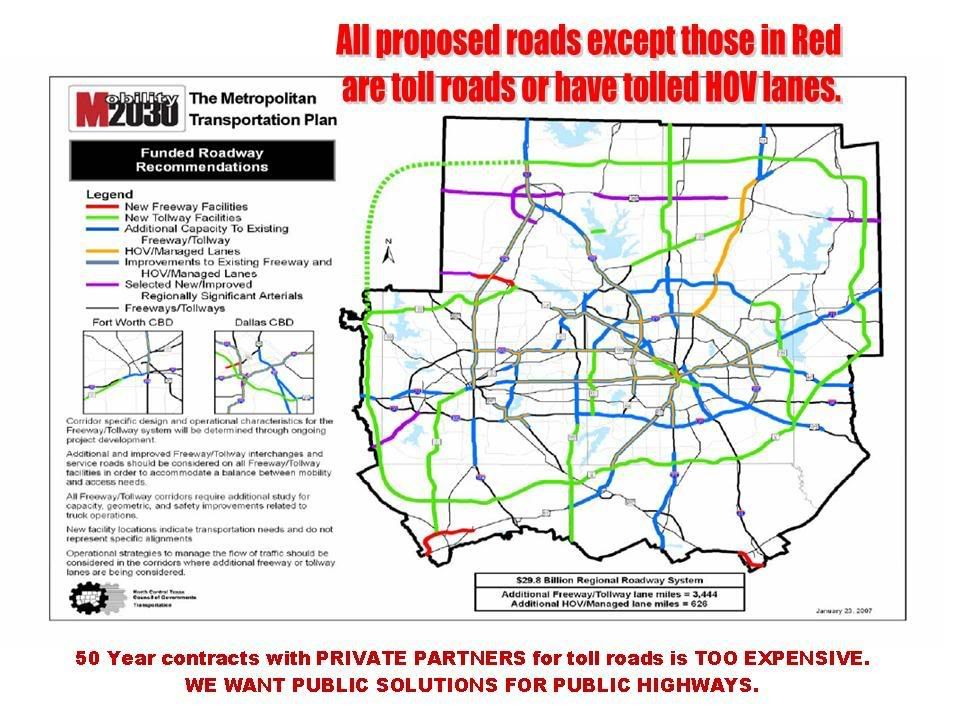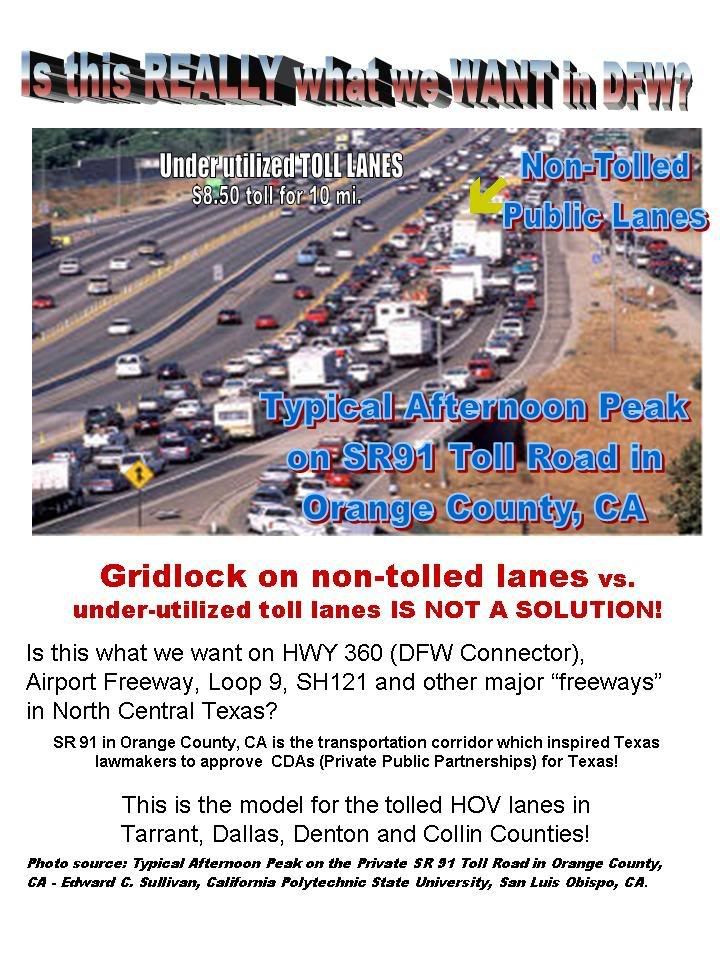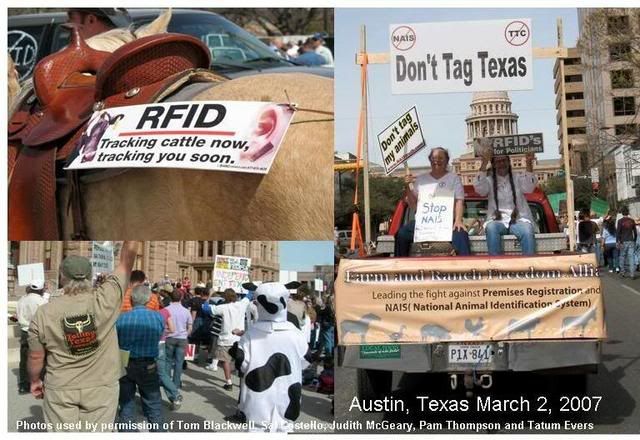
Premise Registration of pets and farm animals is a FEDERAL GOVERNMENTAL initiative that is worming its way through state legislatures across American. In 2005 a one page bill was passed by the Texas Legislature and signed into law. It has not been implemented yet. Texans who are furious about the Trans Texas Corridor Toll Road landgrab are standing with Ranchers who are opposed to the implementation of mandatory microchip ID for animals and premise registration.
Outrage is bridging partisian boundaries. Liberals, progressives, moderates, conservatives, ultra conservatives and even those who are normally politically apathetic united in Austin March 1st and 2nd, sending clear messages.
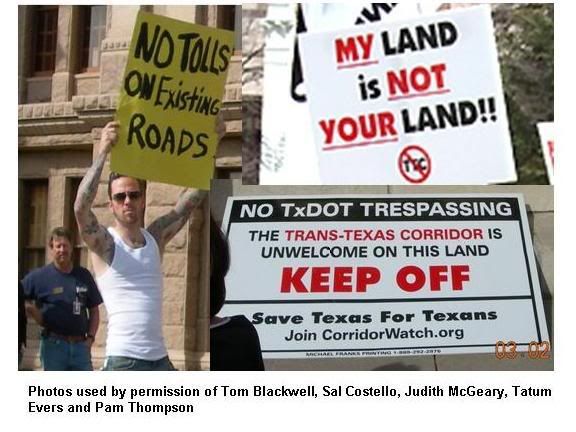
Don't Tag my pets, Don't register my home or farm as a premise! Don't take my land!
The message was clearly conveyed: Trans Texas Corridor -- Zachry, Cintra, TxDot, Rick Perry:
STAY OFF MY LAND! "My Land is NOT Your Land" was the battle cry.
Why should this matter to people who live in Pennsylvania, New York, Oklahoma, and other states? It matters because these "policies" are being pushed from Washington down to the states. The Texas Department of Transportation (TxDot) announced the selection of Cintra, a Spanish based corporation to manage part of an existing State Highway (SH-121) as a private/public partnership toll road. Cintra, with Texas based Zachry Construction, has been chosen by TxDot to build and operate the massive Trans Texas Corridor. Contracts have not been signed. They must be reviewed and approved by the Transportation Committee.
During the past three years, massive portions of the Texas Transportation Code was revoked or amended . Much TTC and private/public partnership toll project language was inserted into numerous bills in both houses of the Texas Legislature. Many of the Senators and State Representatives who sponsored and voted for the changes received generous campaign contributions from Zachry and other businesses and individuals with financial interests in the TTC.
Last week the Texas Senate Committee on Transportation held an eight hour hearing on SH-121 and the TTC. People came from all over the State. They had to open two additional large hearing rooms and connect them with live television feeds to accommodate the hundreds of Texans who drove to Austin for the hearing.
(Videotaped testimony is available at http://www.senate.state.tx.us/avarchive/ (Select March 1 Senate Committee on Transportation & Homeland Security Hearing Regarding the Trans Texas Corridor)
It is challenging to unravel the methodology which was utilized to sell local and State officials on this massive land grab. It is an ill-conceived overly expensive plot. Similar things are occurring in other States. Driven from Washington, legislation to change laws to implement the NAIS and Public Private Toll Road Partnerships have turned Texas into the frontline for national implementation of significant and far-reaching changes in property rights, transportation financing, removal of appropriation control from elected legislative bodies to control of obscure bodies of political appointees. It is probable that Governor Rick Perry's close ties to George W. Bush and Bush's ties in Austin resulted in Texas acquiring the dubious "pleasure" of being selected as the pilot for the Bush Administrations "vision" for revamping the nation's transportation and homeland security. NAIS is definitely Washington driven. National Animal Identification System is a Federal Initiative with joint Agriculture, FDA and Homeland Security oversight!
This is the third in a five part series of journals on the uproar in Texas. Citizens have banded together demanding repeal of legislation which mandates computer chip animal identification and premise registration and of TTC enabling language.
SO HOW DID WE GET HERE? HOW CAN WE INSURE THESE BAD POLICIES CONTINUE TO UNRAVEL?Rick Perry was re-elected governor in 2006 with the lowest percentage of votes cast for any winning governorial candidate in Texas in modern history. Many more Texans voted for statewide candidates for Agriculture Commissioner and Attorney General who did not win the election than voted for Rick Perry. Incumbents who have been Perry adminstration team players watched massive numbers of their constituents voice disapproval of the TTC at TxDOT hearings all over Texas last summer. They saw support shift from conservative incumbent to anti-TTC populist challengers. Now many who have sponsored TTC enabling legislation or voted in favor of it are back peddlings, saying "I want a do over!"
It takes a lot to get a lot of thousands Texans motivated enough to descend on Austin at one time. Austin is not the easiest place to get to in Texas. Trains only run through Austin once a day. Air service isn't the greatest. Highways are congested and there always seems to be some construction project on the more narrow, overcrowded corridors. It was probably by design. Legislators have historically been viewed by Texans as problems which need to be contained. Constitutionally, State Representatives are "part-time" and the Legislative session is much shorter than in many smaller states with greater population. My College History and Political Science professors all said it was because Texans fear that they'll do too much damage if given more time. Yet last week between 5000 to 6000 people from all over Texas took to the streets. They hauled their horses, chickens, tractors, goats and family pets and marched down Congress Avenue to the State Capitol. It was Texas Independence Day and Texans were declaring INDEPENDENCE over current tyrrany!
Examination of the butcher job they've done on Transportation and Agriculture codes in the past 2 years gives us good cause for such caution. Some of the most far-reaching, radical changes to the Transportation Code were passed in the middle of the night. Much of what has brought us to this particular place occurred in small working groups, at privately funded transportation seminars, in poorly advertised "public meetings" of obscure committees in Councils of Government all over the state. TTC enabling language was presented to Legislative Counsel by attorney's working for various special interest and the language made its way into numerous pieces of legislation in both houses. The clients of these attorneys can hide behind "attorney client privilege", circumventing the ethics rules. The attorneys are able to avoid disclosing who they are representing and these visits are not classified as "Lobbyist" activity! It is not a loophole. It is not even a hole the size of a barn door. It is more like an opening the size of the pasture where the barn should be standing!
A one page bill (C.S.H.B. 1361) passed inro law in Texas September 1, 2005 (but not yet implemented)requires mandatory registration of all premises with animals or poultry, mandatory computerchip ID system, and 24-hour reporting of death or transfer of animal ownership. With only a few paragraphs the way farming, ranching and ownership of horses and domestic pets was reengineered (at least on paper). The cost to implement this program are astounding --on both the bureaucratic level. The shift in privacy rights, property rights, and potential civil rights resulting from implementation of NAIS are mind boggling. We'll explore them in greater detail in journals later this week.
Rick Perry's administration will probably become known as one of the most corrupt administrations in the past quarter of a century. Media doesn't really cover what goes on policy wise in Austin very throughly. Transportation stories usually get buried in obscure places in newspapers. It is difficult to explain complex scenarios in television news bites. Most assignment editors think that the public just isn't all that interested in what the Legislature does. Fortunately the internet and search engines allow us to get some coverage of "our tax dollars at work!" Shame that they are usually not working for us!
The cherry on top is that the folks in public office in Austin are the ones that the majority of Texans (probably) voted for. I say probably because we have had some really big problems with the electronic voting machines -- especially with how accurately they tabulate the votes. During the 2006 Primary, there was over a 100,000 vote tabulation error in Tarrant County and many other snafu's reported in other counties. Few of us are confident that anyone really knows how many people voted for any one candidate. But a lot of people have invested time, and money and faith in the folks in Austin. It is difficult to accept the truth about people you have supported and trusted. Denial reigns supreme in many circles.
When it comes to faith in Texas incumbents, I haven't invested much faith in any of them. There are a few that occasionally get my attention and surprise me pleasantly. Whether Republican or Democrat, I usually try give them a call when I see them do anything good that impresses me. However, I don't have to spend a lot of time on such calls because overall, most of them never rise above C-, even when they "pleasantly surprise" me!
There is nothing that says you have to be intelligent to be elected to the Texas Legislature. There are some who are very intelligent. There are some who are relatively honest. There are few who are both honest and intelligent. They are responsible for that but the voters are the ones who are responsible for selecting them. And we entrust them with setting policies which are complex and have far-reaching consequence to billions of people every day. Selecting the least qualified, academically challenged and intellectually deficient candidates seems to be a pattern of both major parties -- in Texas and elsewhere. (One example is the election of Paula Hightower-Pierson, a high-school drop-out who did not return to school to get a college education, as a Democratic State Representative in 2006). State Party leaders (and the media) tend to rate candidates only in terms of how much money they can access for media buys rather than on credentials, track record, character or intellect!
Once elected, most legislators rely on the Legislative Counsel (and lowly paid staff) to explain the bills and language contained in bills. Counsel frequently relies on contacts from trade groups who come to them on behalf of unnamed entities with language for bills. It is difficult to determine who staffers rely on for their interpretation of complex policies and legislation! Now that there has been consistent, loud, sometimes stringent outcry from Texans from all political parties on the Cintra-Zachry TTC deal and NAIS, many Senators and State Representatives are are saying that they 'didn't understand' what they were doing when they sponsored certain TTC enabling legislation. Many of them probably didn't comprehend the implications in the language of the bills they put their names on as author or sponsor. However, for many, it probably just appears better politically to them right now to try to deny it and distance themselves as far as possible from their previous positions and votes.
A former State Representative told me that he thinks that many of them probably didn't have a clue what language in the TTC Transportation bills really meant. They were told that private public partnerships for toll roads would help them keep gasoline taxes low. Since they'd raided the designated transportation funds and refused to call for bond issues or raises to the gasoline tax for decades for highway construction, they grasp for straws. Legislative session after legislative session for over 20 years, highway and bridge maintenance has been deferred. Population explosions in the major urban centers has resulted in increased urban sprawl and traffic gridlock. Federal funds for rail and mass transit dried up and cities and counties looked for sources (other than local tax money or bond elections) for local transportation projects.
There is a lot of cronyism and out and out thievery in Austin. But the buck really rests with those of us in the hinterlands. We're the folks who allowed them to be elected to office and we're the folks who have allowed them to continue there. There are ways to rein-in errant elected officials. One immediate thing we can do is continue to exert pressure on the Texas Legislature to repeal NAIS. Here is a background paper on legislation that will change "mandatory" to "voluntary".
http://www.capitol.state.tx.us/tlodocs/79R/analysis/doc/HB01361H.doc
Amazing how one short, one page document can raise so much havoc in so very very many lives.
C.S.H.B. 1361 By: Hardcastle
Agriculture & Livestock Committee Report (Substituted)
… Because of its complexity, the United States Department of Agriculture (USDA) plans on phasing in the National Animal Identification System (NAIS). It is vital that Texas develop and implement within the state an animal identification program that is consistent with that of the USDA.
RULEMAKING AUTHORITY
It is the committee's opinion that rulemaking authority is expressly granted to the Texas Animal Health Commission in SECTION 1 of this bill.
ANALYSIS
This bill creates an animal identification program to provide for disease control and to enhance the ability to trace disease-infected animals, which is consistent with the United States Department of Agriculture's National Animal Identification System. The Texas Animal Health Commission (Commission) may require the use of official identification numbers and may establish a date by which all premises must be registered. The Commission may further assess a registration fee on all entities that register for a premises identification number. This bill provides that information collected by the Commission is exempt from public disclosure requirements. The bill authorizes the Commission to disclose information to certain persons, including a governmental entity. The bill provides for penalties for failure to comply with the Commission's order. The bill authorizes the Commission to adopt, implement and enforce rules for the animal identification system.
EFFECTIVE DATE
This Act takes effect September 1, 2005.
CALL TO ACTION ON NAIS:
Status in Texas In 2005, the Texas Legislature adopted HB 1361, codified at §161.056 of the Agriculture Code, authorizing the TAHC to implement NAIS on a mandatory basis in Texas. The TAHC proposed mandatory regulations for premises registration in December 2005, but withdrew them after a public outcry.
In November 2006, the USDA stated that it does not intend to adopt mandatory federal regulations, so there is no federal law or regulation requiring implementation of this program by Texas.
Issues
The NAIS will cause a variety of problems:
• Massive intrusion into people’s lives: individuals will have to provide detailed information about their property, businesses, and their own movements to government and private databases;
• Burden on property rights: the premises registration number will attach to the land forever, and people’s rights to manage their land and animals will be restricted;
• High costs: registration, tagging, and reporting all carry costs in both time and money;
• Loss of small farmers and ranchers: many will be unable to afford the program, or unwilling to accept the government intrusion;
• Damage to the economy: businesses that rely on small farmers, such as sales barns, supply stores, and even tourism, will be harmed;
• Reduced choices and increased costs for consumers;
• Violation of many Americans’ religious beliefs; and
• Increased government bureaucracy and waste of taxpayer dollars. Neither the USDA nor the TAHC has performed a cost analysis of the program. Costs for similar programs in other countries are estimated to range from $37/head to $69/head. According to the 2002 USDA census and a 1998 study, Texans own over 14 million cattle, 1 million sheep, 1 million goats, and 1 million horses, the majority of which are on small farms. The NAIS will likely cost Texans hundreds of millions of dollars.
The NAIS will not provide benefits to justify these costs.
The stated purpose of the NAIS is to provide 48-hour traceback to address animal disease. But the NAIS does not address the critical issues for disease prevention and control:
• the causes of disease, especially differences in management;
• the vectors of disease transmission, including wild animals, insects, and imports;
• testing for disease, including tests for Mad Cow and other food-safety issues; and
• the unique issues posed by each species and each disease Contrary to claims, the NAIS will not protect against bio-terrorism.
Terrorists are unlikely to target hobby animal owners and small farmers. Microchips are vulnerable to cloning and computer viruses. The type of microchip specifically recommended for horses and cattle, the ISO microchip, is designed to be reprogrammable, so anyone can easily change the numbers.
The large databases will provide an easy target for hackers. Indeed, even without intentional tampering, the large databases will be unmanageable, as has already been found in Australia. The USDA has stated that NAIS is not a food safety program. Under NAIS, tracking ends when the animal is killed at the slaughterhouse. Most food-borne illnesses occur because of contamination from poor practices after slaughter. NAIS will do nothing to address these issues. Food safety needs to be addressed by increased standards and inspection of food processing facilities, including testing for Mad Cow Disease.
The final stated justification for the NAIS is to improve the export market. However, there are better ways to reach agreement with Japan and other foreign countries, including allowing those meat packers who wish to export beef to test their animals for BSE.
If tracing is a market benefit, let the market implement it, not a mandatory government program using our tax dollars. The USDA also has a “Process Verified Program,” which allows qualifying suppliers to market themselves as “USDA Process Verified,” including age and source verified. Any such program should be voluntary, non-coercive, allow for true competition, and paid for by the participants so that it does not distort market forces.
Some of the alternatives to NAIS for improving animal health
• Develop educational programs for animal owners, addressing disease prevention through animal management and biosecurity, and identification of diseases requiring the intervention of a vet.
• Improve training for veterinarians in recognizing foreign and emerging animal diseases and develop a protocol for the use of rapid diagnostic tools in the field. (recommended by the United States Government Accountability Office in GAO-05-214 (Mar. 2005))
• Increase inspections of animals and agricultural products entering into Texas.
• Consider existing mechanisms for tracking livestock: brucellosis program, scrapie program, tuberculosis program, brand system, sales and slaughter records, and producers’ records. Analyze the costs and benefits of minor modifications to existing programs and alternative programs, such as a “book-end” system (i.e. no tracking of movements) that uses non-electronic means of identification when the animal enters the stream of commerce.
• Conduct scientific modeling to identify high-risk situations and quantify important factors, such as the level of contagion, the means of transmission, and the severity of the diseases of concern.
Proposed legislation HB 461 would amend the current statute to limit the TAHC’s authority to a voluntary program. HB 637 would also limit the program to voluntary only. HB 637 also:
(1) bars any coercive measures from being used; and
(2) requires full disclosure before any person can be enrolled in the program, and provides an unrestricted right to withdraw from it.
This legislation would allow the TAHC to develop NAIS as a voluntary, market-driven program, consistent with the USDA’s November 2006 announcements.
Crossposted on Daily Kos, Texas Kos and Diatribune.