By BETSY BLANEY - Associated Press - Tuesday, July 3, 2007
LUBBOCK - One Central Texas farmer said he was "dumbfounded" by Gov. Rick Perry's veto of an eminent domain bill designed to protect landowners when the state wants to take their property.
Robert Fleming is not alone in an area worried about the massive Trans Texas Corridor proposal. The planned route cuts through Fleming's Bell County farms. He's bewildered by Perry's veto.
"We were so close to getting something done," Fleming said. "We've worked hard trying to get private property rights."
Perry vetoed the bill, and 48 others, June 15.
In 2005, the U.S. Supreme Court ruled in Kelo et al v. City of New London that cities can seize homes under eminent domain for use by private developers. Texas Farm Bureau spokesman Gene Hall said the ruling also said that states that want it otherwise can craft laws to do so. That's what the bill Perry vetoed would have done, he said.
Perry in 2005 named the eminent domain issue as an emergency item in a special session, Perry spokesman Robert Black said.
"The bill Governor Perry vetoed would have had little impact on rural Texas. It was targeted at high-growth urban areas," Black said.
The Trans Texas Corridor is the plan kick-started several years ago by Perry to build 4,000-plus miles of tollways and railways that would incorporate oil and gas pipelines, utility and water lines and broadband data lines.
One reason Perry gave for vetoing the bill was that it would have expanded damages a landowner could recover to include diminished access to roads from remaining property when a portion of the property is condemned, according to a release from Perry's office.
Also, landowners would have been able to collect damages for factors that include changes in traffic patterns and a property's visibility from the road, which Texas courts have knocked down because of the added costs to public projects that taxpayers would have to pay, the release states.
After the bill passed both houses - 125 of 150 votes in the House and unanimously in the Senate - Perry's office heard from most fast-growing cities and counties asking him to veto the bill; the cost of constructing state and local projects would have increased by more than $1 billion, the release stated.
"As someone who grew up in rural Texas, and farmed our family's piece of land, I am a strong proponent of protecting private property rights," Perry said in the statement. "But the issue is one of fairness to taxpayers, who will get fleeced in order to benefit condemnation attorneys."
Perry supported the bill early on but had objections to amendments added later, the release states.
The eminent domain issue for portions of the corridor proposal currently is on a back burner, Texas Farm Bureau officials said.
"The more time we have to spread our story and to make an issue out of [eminent domain] is certainly going to help the property owners," said Fleming, who grows corn and wheat and raises cattle.
Bureau officials said they believed Perry wanted to fix Texas' eminent domain law, having met with him early in the session.
"The taking of private property has become far too easy in this state," Kenneth Dierschke, president of the bureau, said in a statement. "Obviously, there are many powerful interests that prefer it stay that way."
Fleming took aim at Perry, saying he has turned his back on agriculture and his veto makes that clear.
"I feel like he's let us down a little bit," Fleming said. "He's got big ag background but since he's become a politician, he's kind of left ag out."
Bureau spokesman Gene Hall said the group will work to revisit the issue when legislators next gather in regular session in 2009. And they will talk with Perry.
"All we can do now is talk with him and work with him," Hall said. "We are serious about this."
Read more in Land and Livestock
Showing posts with label eminent domain. Show all posts
Showing posts with label eminent domain. Show all posts
Monday, July 16, 2007


Wednesday, March 07, 2007
Toll Scheme Unravels - Part 2 - TTC With NAIS fuels inflation
Texans of all generations descended on Austin last week demanding repeal and /or defeat of legislation which will fuel inflation. They didn't mention inflation out right. Instead they talked about the impact implementation of the National Animal Identification System (NAIS) passed by the Texas Legislature in 2005 will have on farm and ranch management. They spoke out against the loss of family farms and ranch and farm land to the Trans Texas Corridor and other proposed private/public toll road projects.
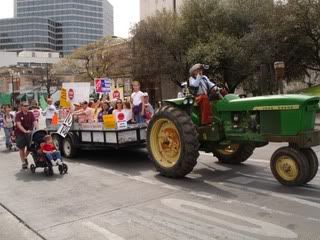
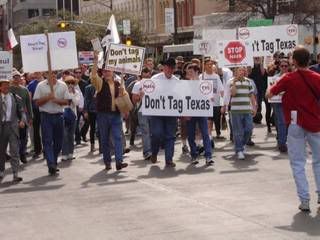
Supporters of the TTC and NAIS appear to be concentrated in urban center. Regional Councils of Government Transportation Committees (RTCs) are the most ardent supporters of the TTC and other proposed private public partnership toll road construction and /or operation contracts. In attempting to get a short term solution for scarce transportation funding for local and regional projects, many city councils and county governments have signed on to the "Toll them as much as you can for as long as you can" schemes which will cost motorists (and consumers) more to travel and ship goods along most of the states future roads and road expansion projects.
It could appear to be a rural vs. city issue, but it is not. It is really a power grab through TxDot by some local elected politicians to transfer "upfront" money to unelected appointed Regional Transportation Committees. Combined with implementation of the mandatory National Animal Identification System in Texas, it will result in surges of inflation which will threaten the economic welfare of every person and business in Texas.
They sold this scheme with a carrot of "up front money" dangled to local governmental officials through RTCs. No one examined the payload of hidden costs, detrimental financial impact or short term/long term inflation. TxDot and RTCs have downplayed the significant difference in the cost for funding road projects with private for profit companies instead of using public money, indexing the gas tax and applying designated funding to transportation.
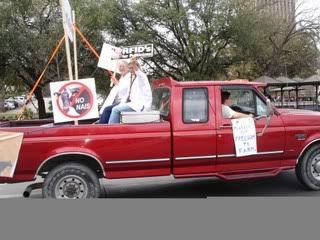
This series of journals discusses two issues which are linked. They are linked because they are both schemes which will transfer money and financial opportunities from many for the benefit of a few for terms of at least 50 years. Through proposed exercise of eminent domain, more acreage will move from private ownership to State ownership to be controlled for the financial benefit of private concessionaires (Cintra and Zachry). NAIS hits the farmers and ranchers hardest economically. However its impact reverberates throughout the economy and will fuel inflation which will take "buying power for the same dollar" out of the pockets of every business, man, woman and child in Texas. It will impact every consumer of goods produced and or marketed from Texas -- irregardless of where they live.
Construction of the Trans Texas Corridor and expansion and construction of other new highways using the private public partnership models of the TTC and Texas State Highway 121 will take money out of the pockets of every consumer who purchases goods that originate in Texas or are shipped through Texas.
I'll start out by discussing the cost of tuna fish. Most folks are familiar with buying tuna fish in the grocery store on sale. Last year we could usually find it on sale at 3 cans for a dollar. This year on sale it is more frequently offered as 10 cans for $10. Last year it was 33 cents can – this year it is a dollar a can. That is a 200% increase in one year for a commonly purchased food product. Rich and poor alike buy groceries. They are basic necessities. We could have used hamburger meat instead of tuna fish for this example but I chose tuna. The cost of tuna rose, not because of increase manufacturing cost or a significant shift in supply or demand for tuna. It rose last year because of increased gasoline costs for shipping. Shipping costs are usually passed on 100% to the consumer. Inflated fuel costs results in inflation when we go to the checkout counter in the grocery store.
Implementing the private public toll road partnership for building Texas Highways as toll roads will have a very similar impact on the price of goods when we are standing at the check out counter. When we buy hammers or nails, when we buy feed, when we buy tuna fish, when we buy clothes, when we buy medication, we'll pay higher prices to cover the merchants’ increases in shipping costs for the goods. When we buy meat we’ll pay for the increase in shipping for the feed and supplies to feed the beef plus increases in shipping costs to the slaughter houses and then to the market. If the TTC or another toll road is cut through a ranch or farm, that will be the route to market. They’ll have to pay to use the road that cuts through land they used to own!
Proponents of the private/public transportation partnership argue that those who choose to drive on the roads will be the ones to pay the tolls. However, all of us, no matter where we live and even if we never drive or ride down the toll road, we’ll pay for it. When we check out at the grocery store, part of our grocery bill will cover profit for the private company operating toll roads and for “up front money” for local politicians to control and divide up as “pork”. It will be a very poorly hidden regressive tax which will fuel inflation and force us to make tough personal financial decisions. State and local elected officials have ducked out and avoided facing the tough budgetary issues head-on. These private/public partnerships are appealing to them on the surface but will deliver a financial payload that will be devastating to local citizens, businesses and government alike.
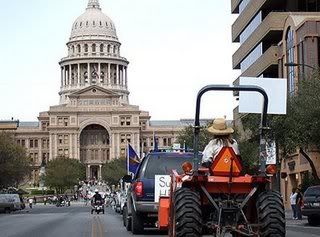
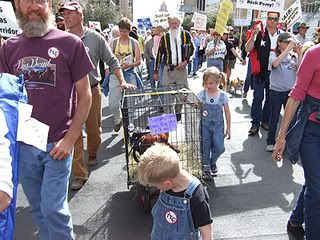
One of the cruelest aspects of the Cintra/SH121 contract (which is the first of many TxDot plans to sign in the near future all over Texas) is that children (including two generations who are not even born yet) will be paying the highest tolls and related shipping fees for goods and services under the escalating toll private public partnership agreements.
There will be some increase to pay for road maintenance and construction no matter what policies are implemented. However, the private/public partnership toll road schemes devised to generate as much "excess toll revenue" so that private partners can make profit while distributing substantial sums as "up front money" to regional transportation committees will help accelerate the rise in inflation. It is probable, that coupled with implementation of NAIS and continuing high energy costs, we'll return to the nightmare days of double-digit inflation. It is quite possible that we'll be seeing escalating inflation while salaries and real income stays flat or drops off. To control inflation we usually see interest rates on loans, and home mortgages rise. Folk make only the same or less money but have to spend more for a can of tuna, for clothes, people have to pay higher house payments for the same house when inflation rises. Folks pay more to finance automobiles. These are issues which are of paramount importance to every city dweller and every business person.
The farmers and ranchers are leading the charge in Texas in opposition to NAIS and TTC. We all must join in.
There are many cost in implementation of NAIS. We'll discuss them further in the comments section and in journals later this week. Please pass links to this journal along to your friends and ask them to join in the conversation. The more that recommend and comment on this series, the more visibility we can give this issue.
Crossposted on Texas Koas, Daily Kos and Diatribune.
Photos used by permission, courtesy of Sal Costello, Judith McGeary, Pam Thompson, Tatum Evans and Tom Blackwell.
Supporters of the TTC and NAIS appear to be concentrated in urban center. Regional Councils of Government Transportation Committees (RTCs) are the most ardent supporters of the TTC and other proposed private public partnership toll road construction and /or operation contracts. In attempting to get a short term solution for scarce transportation funding for local and regional projects, many city councils and county governments have signed on to the "Toll them as much as you can for as long as you can" schemes which will cost motorists (and consumers) more to travel and ship goods along most of the states future roads and road expansion projects.
It could appear to be a rural vs. city issue, but it is not. It is really a power grab through TxDot by some local elected politicians to transfer "upfront" money to unelected appointed Regional Transportation Committees. Combined with implementation of the mandatory National Animal Identification System in Texas, it will result in surges of inflation which will threaten the economic welfare of every person and business in Texas.
They sold this scheme with a carrot of "up front money" dangled to local governmental officials through RTCs. No one examined the payload of hidden costs, detrimental financial impact or short term/long term inflation. TxDot and RTCs have downplayed the significant difference in the cost for funding road projects with private for profit companies instead of using public money, indexing the gas tax and applying designated funding to transportation.
This series of journals discusses two issues which are linked. They are linked because they are both schemes which will transfer money and financial opportunities from many for the benefit of a few for terms of at least 50 years. Through proposed exercise of eminent domain, more acreage will move from private ownership to State ownership to be controlled for the financial benefit of private concessionaires (Cintra and Zachry). NAIS hits the farmers and ranchers hardest economically. However its impact reverberates throughout the economy and will fuel inflation which will take "buying power for the same dollar" out of the pockets of every business, man, woman and child in Texas. It will impact every consumer of goods produced and or marketed from Texas -- irregardless of where they live.
Construction of the Trans Texas Corridor and expansion and construction of other new highways using the private public partnership models of the TTC and Texas State Highway 121 will take money out of the pockets of every consumer who purchases goods that originate in Texas or are shipped through Texas.
I'll start out by discussing the cost of tuna fish. Most folks are familiar with buying tuna fish in the grocery store on sale. Last year we could usually find it on sale at 3 cans for a dollar. This year on sale it is more frequently offered as 10 cans for $10. Last year it was 33 cents can – this year it is a dollar a can. That is a 200% increase in one year for a commonly purchased food product. Rich and poor alike buy groceries. They are basic necessities. We could have used hamburger meat instead of tuna fish for this example but I chose tuna. The cost of tuna rose, not because of increase manufacturing cost or a significant shift in supply or demand for tuna. It rose last year because of increased gasoline costs for shipping. Shipping costs are usually passed on 100% to the consumer. Inflated fuel costs results in inflation when we go to the checkout counter in the grocery store.
Implementing the private public toll road partnership for building Texas Highways as toll roads will have a very similar impact on the price of goods when we are standing at the check out counter. When we buy hammers or nails, when we buy feed, when we buy tuna fish, when we buy clothes, when we buy medication, we'll pay higher prices to cover the merchants’ increases in shipping costs for the goods. When we buy meat we’ll pay for the increase in shipping for the feed and supplies to feed the beef plus increases in shipping costs to the slaughter houses and then to the market. If the TTC or another toll road is cut through a ranch or farm, that will be the route to market. They’ll have to pay to use the road that cuts through land they used to own!
Proponents of the private/public transportation partnership argue that those who choose to drive on the roads will be the ones to pay the tolls. However, all of us, no matter where we live and even if we never drive or ride down the toll road, we’ll pay for it. When we check out at the grocery store, part of our grocery bill will cover profit for the private company operating toll roads and for “up front money” for local politicians to control and divide up as “pork”. It will be a very poorly hidden regressive tax which will fuel inflation and force us to make tough personal financial decisions. State and local elected officials have ducked out and avoided facing the tough budgetary issues head-on. These private/public partnerships are appealing to them on the surface but will deliver a financial payload that will be devastating to local citizens, businesses and government alike.
One of the cruelest aspects of the Cintra/SH121 contract (which is the first of many TxDot plans to sign in the near future all over Texas) is that children (including two generations who are not even born yet) will be paying the highest tolls and related shipping fees for goods and services under the escalating toll private public partnership agreements.
There will be some increase to pay for road maintenance and construction no matter what policies are implemented. However, the private/public partnership toll road schemes devised to generate as much "excess toll revenue" so that private partners can make profit while distributing substantial sums as "up front money" to regional transportation committees will help accelerate the rise in inflation. It is probable, that coupled with implementation of NAIS and continuing high energy costs, we'll return to the nightmare days of double-digit inflation. It is quite possible that we'll be seeing escalating inflation while salaries and real income stays flat or drops off. To control inflation we usually see interest rates on loans, and home mortgages rise. Folk make only the same or less money but have to spend more for a can of tuna, for clothes, people have to pay higher house payments for the same house when inflation rises. Folks pay more to finance automobiles. These are issues which are of paramount importance to every city dweller and every business person.
The farmers and ranchers are leading the charge in Texas in opposition to NAIS and TTC. We all must join in.
There are many cost in implementation of NAIS. We'll discuss them further in the comments section and in journals later this week. Please pass links to this journal along to your friends and ask them to join in the conversation. The more that recommend and comment on this series, the more visibility we can give this issue.
Crossposted on Texas Koas, Daily Kos and Diatribune.
Photos used by permission, courtesy of Sal Costello, Judith McGeary, Pam Thompson, Tatum Evans and Tom Blackwell.
Subscribe to:
Posts (Atom)
