By The Associated Press - Mon Jul 2, 2007
Similarities and differences in House and Senate lobbying bills that have to be merged into one before becoming law.
Both bills would:
_Require lobbyists to report when they "bundle" campaign contributions for one candidate from multiple donors.
_Forbid lawmakers from pressuring lobbying firms to hire employees based on political affiliations.
___
The Senate bill, but not the House bill, would:
_Require former lawmakers to wait two years, rather than one, before becoming lobbyists.
_Prohibit lobbyists from throwing parties for specific lawmakers at national conventions.
___
The House bill, but not the Senate bill, would:
_Require lobbyists who try to place "earmarks" — special home-state projects — in spending bills to identify their efforts.
_Require lobbyists to report bundled donations given to political action committees — or PACs — set up by unions, corporations or special interest groups, as well as to candidates.
___
The Senate bill is S 1.
The House bill is HR 2316
See Article
Ethics reform bogged down in Congress
By CHARLES BABINGTON, Associated Press Writer - Jul 2, 2007
WASHINGTON - Toughening ethics laws, once a priority of Democrats, has bogged down in Congress as party leaders find their campaign promises colliding with lawmakers' re-election concerns.
Two months have passed since a task force was supposed to have recommended how an independent panel might look into ethics complaints before they go to the House ethics committee. A key sticking point is opposition in both parties to letting outsiders file complaints against members of Congress.
Currently, only House members can initiate an ethics probe. Public watchdog groups call the restriction self-serving and unreasonable.
Some of the same groups, however, are balking at a second proposal floated by task force members. It would require any group that lodges an ethics complaint against a House member to reveal its donors.
Rep. Chris Van Hollen, D-Md., said the demand for donor lists from groups that file complaints "is what has tied this thing up for now."
The nonprofit groups call it intimidation. Lawmakers say it's a way to ascertain whether such groups are backed by right- or left-leaning forces with partisan motives.
Meanwhile, a Senate spat over rules governing senators' requests for special projects in their home states is blocking efforts to merge into one bill separate House- and Senate-passed measures to restrict lawmakers' dealings with lobbyists. The Senate passed its version in January, and the House passed its bill in May.
"I find it distressing that they haven't dealt with these issues," Craig Holman of Public Citizen said, referring particularly to the House task force.
For years, self-described government-reform groups have denounced the House ethics committee, which is evenly divided between Democrats and Republicans, as listless and largely toothless. Unlike the Senate ethics committee, the House panel no longer accepts complaints from nonmembers. And it sometimes says little or nothing about its inquiries, leaving the public unsure whether serious investigations took place.
On Jan. 31, Speaker Nancy Pelosi, D-Calif., appointed a bipartisan task force to recommend whether an independent panel of nonmembers should investigate ethics complaints and play a role in enforcing rules of conduct. That report was due May 1.
Long past the deadline, task force members privately briefed colleagues on a plan in which the speaker and minority leader would each appoint three members to a panel that would look at complaints — from members or nonmembers — and recommend whether the House ethics committee should pursue them. The independent panel's findings, in most cases, would eventually become public.
The proposal immediately drew fire from seemingly every direction. "They have problems inside and outside," said Meredith McGehee, policy director of the nonpartisan Campaign Legal Center.
Several House members said political adversaries could use an open-complaint system to file dozens of frivolous allegations and then cite them in campaign attack ads. The concern is understandable, McGehee said, but senators have long allowed nonmembers to file ethics allegations "and they're not in peril."
Watchdog groups called the plan weak, especially because the new panel would lack subpoena powers to compel testimony and demand documents. The panel "would have a free hand to recommend the dismissal of a complaint and would be greatly restricted in recommending anything else," lawmakers were told in a letter last week from groups including Democracy 21, the League of Women Voters, Public Citizen and the Campaign Legal Center.
They also objected to the donor-disclosure proposal, which they called unprecedented for the House, Senate, Justice Department, Federal Election Commission and other agencies that receive public allegations of official wrongdoing.
"Now they want your donor base," if a group tries to file an ethics complaint, said Sarah Dufendach, chief of legislative affairs for Common Cause, which on balance supports the House proposals. "It may chill some groups from actually filing," she said.
Many lawmakers are insisting on such disclosures, saying the public should know as much as possible about people behind allegations that could hurt a politician's career. Some Republicans particularly like the disclosure proposal because they believe groups such as Common Cause are heavily financed by Democrats and liberals.
Dufendach shrugged off the concern. "Whatever kind of information you give is going to be spun," she said.
Rep. Michael Capuano, D-Mass., the chairman of the House task force, said its tentative recommendation to consider ethics complaints from outside groups remains a sticking point.
"We've had some push-back" from House members and outsiders, he said in an interview last week. "We're plugging ahead. The goal is to get something meaningful that can pass."
Capuano added, however, that could not predict whether the task force can settle on a plan that would win House approval.
___
The Senate lobbying bill is S 1.
The House lobbying bill is HR 2316.
Read article
Monday, July 02, 2007


Saturday, June 30, 2007
Tarrant County officials seek to cut two tax rates
By AMAN BATHEJA - Star-Telegram staff writer - Sat, Jun. 30, 2007
Most Tarrant County commissioners say they want to cut taxes for both the county and the Tarrant County Hospital District for next year.
County Judge Glen Whitley and Commissioners Roy Brooks, Gary Fickes and J.D. Johnson signaled plans to reduce taxes more than last year, when commissioners cut the county rate by one-tenth of a cent and left unchanged the rate for the hospital district, which operates the JPS Health Network.
Commissioner Marti VanRavenswaay did not return a call seeking comment.
The county tax rate is now 27.15 cents per $100 of assessed value. The hospital district tax rate is 23.5397 cents.
"I will not vote for a budget that does not include a tax rate decrease for the county taxes or the hospital district," Fickes said. "I'm not sure if we'll get to a penny, but I'd like to see a penny [reduction] for both."
Brooks said he hopes to approve at least a half-cent cut in the county rate and up to a full cent off the hospital district rate.
"We're approaching this budget with an eye toward doing the most with the least and being able to give something back in terms of tax relief to the taxpayer," Brooks said.
Johnson said he expected rising property values to allow the county's budget to grow while still cutting taxes.
For the owner of a $100,000 home, the 1-cent drop would mean $10 off a county tax bill of $271.50 and $10 off a hospital district tax bill of $235.40.
Property owners would not necessarily pay less in taxes, however, because many have seen increases in their property values.
Commissioners said they also plan to look closely at the hospital district's budget for next year. At the commissioners' meeting Tuesday, Whitley took the unusual step of asking for the JPS board to meet with commissioners in July before JPS approves its budget.
"I would like to get a sense of their priorities," Whitley said.
In the past year, the hospital district has drawn increasing criticism for amassing a multimillion-dollar surplus while not expanding services for poor and uninsured patients.
"We just have a lot of questions what is going on out there," Johnson said. "Going through their budget in detail and looking at it the same time that the board looks at it would be a wise idea."
A call to Robert Earley, JPS' senior vice president of public affairs and advocacy, was not returned Friday.
See Fort Worth Star-Telegram
Friday, June 29, 2007
Trinity toll road foes say 80,000 signed petition for November vote
By BRUCE TOMASO - The Dallas Morning News - June 29, 2007
Dallas voters will decide in November whether to scrap the Trinity River toll road, if referendum petitions submitted Friday by opponents of the road are certified as valid.
City Council member Angela Hunt said her group, TrinityVote, had gathered more than 80,000 signatures to stop the toll road, a key component of the Trinity River Corridor Project. If 48,000 of those signatures are certified by the city secretary as valid and belonging to registered voters living in Dallas, a measure will be placed on the November ballot.
That measure would prohibit the construction of any road inside the river levees that is more than four lanes wide, with a speed limit of more than 35 mph.
“Here you see before you a mandate from 80,000 people in Dallas who say they want a voice in the future of our Trinity River,” Ms. Hunt said at a City Hall news conference. Behind her stood more than 50 volunteers from TrinityVote, many of them wearing T-shirts that said, “Park or toll road? Let the voters decide.”
Striking a populist chord, Ms. Hunt alluded to the fact that the toll road is supported by many members of the city’s civic, business and political elite.
“There are some politicians who want to pave the Trinity,” she said. “But that option is no longer in their hands. As of today, the decision is in our hands, the hands of the voters, where it rightfully belongs.”
Ms. Hunt contends that the toll road should be scrapped because it will detract from the proposed downtown river park that many perceive as the centerpiece of the Trinity Project. She said that when Dallas voters approved $246 million in bonds for the Trinity project in 1998, many thought they were voting for a low-speed parkway, not a high-speed, multi-lane toll road.
Supporters of the road say it's needed to alleviate downtown congestion, and that removing it now from the plans could delay work on other aspects of the Trinity project, including the park and flood-control improvements
Wednesday, June 27, 2007
5-4 Supreme Court Weakens Curbs on Pre-Election TV Ads
Ruling on McCain-Feingold Law Opens Door for Interest Groups in '08
By Robert Barnes - Washington Post Staff Writer - Tuesday, June 26, 2007
The Supreme Court yesterday substantially weakened restrictions on the kinds of television ads that corporations and unions can finance in the days before an election, providing special interest groups with the opportunity for a far more expansive role in the 2008 elections.
Read more
RESPONSE FROM MARTIN FROST
Election ad ruling: I told you so
By Martin Frost - June 26, 2007
I almost never crow about a prediction. But Monday’s U.S. Supreme Court decision on the McCain-Feingold campaign legislation passed by Congress is the exception. Damn it, I told you so.
During congressional consideration of this legislation in 2001 and 2002, I repeatedly told my House colleagues that this was a terrible bill that would have truly awful consequences when the Supreme Court got through with it.
I even tried to insert a nonseverability clause into the legislation, which would have provided that the whole legislative scheme would fail if any portion of it were declared unconstitutional.
Almost nobody would listen. Other than Sen. Mitch McConnell (R-Ky.), who also tried to sound the alarm, virtually everyone in Congress turned a deaf ear to my prediction.
You see, my colleagues in the House and Senate did not want to offend the editorial pages of The New York Times and the Washington Post. They did not want to be painted as “anti-reform.”
Here is the crux of my argument made repeatedly to members of the House Democratic Caucus:
The legislation neutered our two major political parties by prohibiting them from raising soft money (large corporate, union and individual contributions) that could be used for issue ads during the closing weeks of a campaign.
At the same time, the legislation enacted a Rube Goldberg scheme that permitted corporations and unions to finance issue ads until 60 days before general elections, after which they were banned until the election.
It was my position (which proved to be 100 percent accurate on Monday) that the U.S. Supreme Court would strike down the ban on corporate and union issue advertising during the two months before an election as an unconstitutional intrusion on free speech.
Thus special interests would have a green light to attack federal candidates during the closing days of a campaign (as long as they avoided using the magic words “vote for” or “vote against”) and the two major political parties would be defenseless to come to the aid of their own incumbents from these attacks because they could no longer raise soft money (the exact type of money being used by outside groups to launch these attacks).
Political parties could use “hard money” for these type ads. But “hard money” is, by definition, raised in much smaller amounts and primarily used for other purposes by parties.
My colleagues ignored my prediction and simply said, “Our lawyers have told us this is legal and we are going to do it,” even though the Supreme Court throughout the 1970s and 1980s had handed down a series of opinions equating the right to spend money on politics with the right to free speech.
And so we now have the worst of all worlds – unlimited special interest spending on federal campaigns and political parties powerless to combat it.
I told you so.
Martin Frost, a Democrat, represented the Dallas-Fort Worth area from 1979 to 2005. He rose to caucus chairman and head of the DCCC. He is now an attorney with Polsinelli Shalton Flanigan Suelthaus PC in Washington and serves as president of America Votes, a grass-roots voter mobilization and education effort.
--
Tuesday, June 26, 2007
Guilty Verdict in the Case Against Arthur Andersen
Verdict seen as fatal blow to firm
By TOM FOWLER - Copyright 2002 Houston Chronicle - June 19, 2002
"I think everyone understands the firm is dead," said Columbia University law professor John Coffee.
Surprisingly, the jurors said they didn't consider the company's extensive shredding of documents to be an important part of the case.
The nine-man, three-woman jury delivered the verdict at 10:25 a.m., more than five weeks after testimony began and after 72 hours of deliberations over 10 days.
Despite the prosecution's elaborate description of widespread document destruction, jurors told reporters it had been the effort of Andersen in-house lawyer Nancy Temple to remove her name from the draft of a memo that led them to convict the firm.
Jury foreman Oscar Criner described the Temple memo as a "smoking gun."
"You read it, you read the law in the charge, and it just stands out," Criner said.
The memo in question, created and revised several times in mid-October, was designed to document how Andersen handled a disagreement with Enron over using the word "non-recurring" to describe a loss.
In an Oct. 16 e-mail to lead Enron auditor David Duncan and others, Temple said her name should not be left on the final memo because " ... it increases the chances that I might be a witness, which I prefer to avoid." She also mentioned checking into other ways to " ... protect ourselves from potential Section 10A issues," referring to a provision in Securities and Exchange Commission auditing regulations.
Jurors said by changing the memo and mentioning the SEC issues, it was clear Temple's intent was to keep information away from investigators.
Discussing the verdict afterward, prosecutors said they were not initially aware that the memo was central to the verdict.
But when told what jurors had said to reporters about the Temple memo, they said the jury's finding was consistent with many aspects of their case.
"That memo was an important one that we referred to several times in our case," said Assistant U.S. Attorney Andrew Weissmann. "She made every effort to sanitize their files."
Jurors also said they all agreed Temple was the "corrupt agent" in the case, indicating that a ruling on Friday that the jurors did not have to agree on a single culprit was not as significant as previously thought.
Lead Andersen attorney Rusty Hardin praised the jury for its diligence but said the firm was a victim of "a system out of balance."
He criticized prosecutors for bringing the charges against Andersen and U.S. District Judge Melinda Harmon's rulings on a variety of issues.
"Our position as to whether Arthur Andersen committed a crime has not changed. They did not," he said.
The company plans to appeal after it is sentenced Oct. 11. Andersen officials said in a statement Saturday that the company expects to cease its audit practice by Aug. 31.
Andersen partner C.E. Andrews, who sat through much of the trial, said the company has no regrets about fighting the charge.
"We started with what was supposed to be an open-and-shut case and kept up the fight for our honor and dignity," Andrews said.
Andersen is already a shell of its former self. The firm has lost 690 of its 2,311 public company clients since Jan. 1. It has shrunk from 27,000 employees in the United States to no more than 10,000, a result of layoffs and departures of whole offices and practices to competing firms.
Prosecutors were cheered by the verdict, saying it will help them as they seek indictments against Enron and its executives.
Weissmann denied Andersen's accusations that the Justice Department destroyed the livelihood of 28,000 U.S. workers with the indictment, saying it was Andersen's management decisions that led to the trial, the verdict and the likely death of the accounting firm.
"No other audit firm in the nation has more problems with the SEC than Andersen," Weissmann said, referring to fines and warnings the firm received for its work with companies Waste Management and Sunbeam. "They chose to handle it this way and made martyrs out of their employees."
The case was initially thought to be an easy win for prosecutors, but Assistant U.S. Attorney Sam Buell said he never assumed it would be a slam-dunk case.
"We were prosecuting the largest, most resourceful defendant in the country that brought the most resources it could to bear," Buell said.
Indeed, up until a few days ago the lengthy jury deliberations had many assuming the trial would end with an acquittal or a deadlocked jury.
The jury did indicate that it was deadlocked at the end of day seven, on June 12, but was told by Harmon to keep trying.
...
Martin Bienenstock, an attorney for Enron, said he didn't want to pass judgment until the appellate process was completed, but he acknowledged he was surprised by the verdict.
"The verdict accentuates how so many innocent, hard-working people at Andersen and Enron have been hurt badly by the actions of a few people," said Bienenstock. "I was hoping the acts of at most a handful of people wouldn't destroy a fine institution."
Andersen was the auditor for Enron, the Houston-based energy trading giant that collapsed in a crisis of investor confidence late last year. Government investigators charge that Enron used complicated accounting schemes, many of which were sanctioned by Andersen, to report misleading financial results.
Enron officials have denied the charges.
Former Enron CEO Jeff Skilling had no comment, according to his wife, encountered pulling out of the family's River Oaks home driveway.
Kelly Kimberly, spokeswoman for former Enron Chairman Ken Lay, said Lay had no comment. And efforts to reach former chief financial officer Andrew Fastow were unsuccessful.
Neither side disputes the events in question behind the trial. They differ on how those events should be interpreted.
In October 2001, as the scope of the accounting problems for Andersen client Enron became clear, a number of Andersen employees in Houston and other offices destroyed documents related to their work with Enron.
The directive to destroy the documents was passed from Temple to the Enron team via e-mail, and later discussed in staff meetings and conference calls. It wasn't until the SEC subpoenaed Andersen on Nov. 8 that the document destruction stopped.
But what prosecutors called an organized effort to hide documents from the SEC was described by Andersen officials as an effort to catch up with long-overdue housekeeping motivated not by criminal intent but fear of reprisals from superiors at company headquarters in Chicago.
Before the trial began May 6, many observers said those differing views on the events would not -- and should not -- have led to a courtroom.
Andersen reported the shredding voluntarily in early January, and went so far as to fire lead Enron auditor Duncan, and put other top partners on administrative leave.
The company initially believed it could reach a settlement with SEC officials and investigators, a route followed by many corporations since major criminal cases against companies rarely make it to the courtroom.
But during February and March, attempts to settle never came together. Prosecutors saw Andersen's previous SEC problems, particularly its probationary status after accounting problems with client Waste Management, as too serious to ignore. Andersen wasn't willing to concede guilt in the case and kept insisting that a small group of Houston partners acting alone led to the document destruction.
An indictment against the entire firm for one count of obstruction of justice was unsealed March 14. Andersen clients began to flee the firm in droves and employees took to the streets to protest what they said would be the death of the 90-year-old firm.
There were other settlement efforts, and it was widely believed an eleventh-hour settlement would prevent the trial. But it never came.
"The Justice Department saw the prior record of Andersen and wanted blood, and Andersen didn't believe it had done wrong and didn't want to negotiate," said Art Bowman, author of a monthly accounting industry newsletter. "So they were both hard-headed and both fighting to the death. That's why it ended up in trial."
Prosecutors seemed to have the clear advantage going into the trial May 6, bolstered by a plea agreement with Duncan that had him admitting his guilt and agreeing to testify against Andersen in exchange for a chance at a lighter sentence.
... When Duncan finally began testimony on May 14, he appeared to deliver as promised for the prosecution. On cross-examination, however, his story appeared to wilt.
Hardin questioned him closely about his testimony that it wasn't until a couple of weeks before he signed the plea agreement that he really believed he was guilty. He suggested that it was fear of prison, not honest soul searching, that led Duncan to plead guilty.
The calm precision of many of Duncan's answers also came across as coached, particularly as Hardin asked him about whether he tried to keep information away from the SEC. Duncan repeatedly used the phrase that he "knew the documents that I destroyed would not be available for others to review," a statement that fell short of admitting a crime.
"We couldn't have paid David Duncan to be this good a witness," Hardin said when he finished testimony May 17.
Prosecutors came back with a vengeance the following week, however, introducing into evidence handwritten notes from Temple, which seemed to indicate that early in October 2001 she and others at the firm knew the SEC would be interested in Enron's accounting problems.
In notes from an Oct. 9 phone call with a handful of Andersen partners, Temple wrote, "Highly probable some SEC investigation," and that there was the " ... probability of charge of violating (cease and desist order agreed to after the firm was prosecuted for auditing violations involving Waste Management)."
The Temple notes, and many other pieces of evidence, had to be introduced by FBI agents simply reading them into record since Temple and two other witnesses refused to testify based on their Fifth Amendment right against self-incrimination.
The manner of presentation appeared to undermine the strength of the evidence, as indicated by comments from alternate juror Gloria Antia, who told the Chronicle she found it unseemly that the government spoke so badly about Temple without her being brought before the jury.
"I don't know if she refused to testify or if they didn't call her, but it seemed like they were talking behind her back," Antia said.
Just as Duncan proved beneficial to the defense, the defense's first witness on May 27 ended up benefiting the prosecution.
...
Andersen attorneys later tried to challenge key points in the indictment, such as the date the document destruction began and where it took place, through the testimony of several employees.
One former Andersen manager, Emily Madison, testified that she and a supervisor had e-mailed Andersen senior partner Michael Odom on Oct. 8 asking how the document-retention policy should apply toward a client that had just fired Andersen as its auditor.
The defense suggested that question may have been the motive for comments Odom made in a videotaped conference two days later, where he talked about how it was appropriate to destroy documents up until the day before litigation was filed against the firm.
Other Andersen employees testified that they didn't take the reminders about the policy to mean they should destroy documents, while Duncan's former administrative assistant, Shannon Adlong, said the Houston office was worried that their superiors in Chicago would see how far behind they had gotten in their regular document cleanup.
...
While Andersen is likely to be out of business before a full appeal can be heard, the company and its defense team is determined to go down fighting. The most immediate fight may be with state accounting regulatory agencies that will try to use the conviction to ban Andersen from doing audit work, a process the state of Texas has already begun.
"Everybody can jump in and pile on, and if an accounting board wants to, we say come on down," Hardin said. "We'll be there."
See full article, links to legal documents, Indictment, Andersen's ex-employees site, and timeline of Andersen event and Chronicle's archives of Andersen coverage
and Chronicle Archive of Enron coverage.
U-S marshal admits selling govt information
© 2007 The Associated Press - June 26, 2007
McALLEN, Texas — A South Texas lawman faces up to five years in federal prison after admitting he sold government information.
Sentencing is October ninth for U.S. Marshal Jose Magallan, who was assigned to the McAllen office.
A federal judge in Houston yesterday accepted the guilty plea involving two counts of Magallan exceeding his authorized access to information in a computer.
Prosecutors say Magallan last November and in January accepted money to do an unauthorized computer search for a private citizen and then deliver the information.
The 52-year-old deputy overall received -- 950 dollars.
The former McAllen policeman faces fines of up to $250,000 for each count.
Houston Chronicle
ON POLITICS - Greeting the season by closing loopholes
By KRISTEN MACK - Copyright 2005 Houston Chronicle - Jan. 27, 2005
With this year's city campaign season looming, City Council closed — or at least narrowed — a loophole that some believed gave certain candidates a head start in campaign funding.
[Houston] Council this week put a $10,000 cap on the amount that people who hold non-city elective offices can transfer from campaign coffers for those offices to fund city races.
Candidates in November's [Houston] city election cannot begin raising money until Tuesday. Council set the cap out of concern that non-city elected officials who have raised money previously for those offices could transfer unlimited funds into city campaign accounts.
Councilman Gordon Quan, who chairs council's ethics committee, said the changes specifically were prompted by the candidacies of Herman Litt, who is running for District C, and Jay Aiyer, who is running in at-large Position 2. Both are Houston Community College System trustees.
Aiyer held a fund-raiser this fall for his HCC seat, and at least one of his council opponents complained that he would use the money for his council run.
Under the new rules, Quan said, committed contributors can always write checks for the city races.
"It's more honest that way," he said. "Give it to them for what they are running for, rather than false pretenses."
Aiyer said he doesn't believe the change targeted him.
"It is not a problem for me," he said. "Folks that contributed in the past, I assume will be contributors in the future."
Whatever their funding sources, candidates already are declaring for four seats that term-limited members council members will have to vacate at the end of this year.
And a fifth seat may open up if M.J. Khan, first-term councilman in District F, runs for the at-large Position 2. His political consultant, Spencer Neumann, expects Khan will announce this spring that he will be running for the citywide seat.
Some council members see at-large positions as more alluring because they allow them to focus on higher-profile citywide issues instead of con-
stituent-based concerns.
Council members who jump from district to at-large seats still are subject to the city's three-term limit.
Quan, a Chinese-American who is term-limited in Position 2, said he is concerned that Khan and Aiyer, both South Asians, will split the Asian vote.
But Aiyer said the growing Asian community still isn't big enough to swing an election anyway.
Houston Independent School District Trustee Kevin Hoffman, who was eyeing the Position 2 and District B seats, has decided not to run.
Architect Peter Brown is trying to position himself as the front-runner for at-large Position 1, being vacated by term-limited Councilman Mark Ellis. Brown, a Democrat and urban planning advocate who also ran for council in 2003, officially declared in May that he would run again.
Earlier this month Brown began circulating a letter asking people to join his campaign effort. The letter was signed by state Sen. Rodney Ellis, D-Houston, real estate developer Ed Wulfe, attorney Michael Solar and engineer Terry Cheng — covering several ethnic and political bases.
Businessman Jeff Daily, Brown's ideological opposite and also a 2003 City Council candidate, said he still is mulling whether to run for Position 1.
Attorney and former University of Houston track star Jolanda Jones, who along with Brown challenged Councilwoman Shelley Sekula-Gibbs in 2003, has said she also intends to run again, probably for Position 1.
Jones was a contestant on the CBS reality show Survivor, which airs beginning Feb. 17. A confidentiality agreement prohibits her from revealing whether she won the $1 million jackpot when the show taped last year.
If she did, it might help her survive an expensive council race.
HCC Trustee Aiyer charged with felony - accused of tampering with campaign finance report
By KRISTEN MACK - Copyright 2007 Houston Chronicle - June 26, 2007
Houston Community College Trustee and one-time City Council candidate Jay Aiyer is facing a charge of tampering with a governmental record, a felony that could cost him his law license, authorities said Monday.
The Harris County District Attorney's Office accused Aiyer of committing the offense in March 2005, by "unlawfully removing, destroying, and concealing, the original filing" of a portion of his campaign finance report and substituting it with another document.
The charges were filed in the 184th criminal court last Thursday. Aiyer posted a $2,000 bond the following day.
Aiyer, reached Monday, said he could not talk about the charges in detail.
"We will be able to work this thing out in a couple of days," he said. "I think it's going to be resolved."
Aiyer, 38, a lawyer who once served as chief of staff to former Mayor Lee Brown, has hired Dennis Cain to represent him. Cain did not return a call seeking comment.
The charges stem from a complaint initially filed with the Texas Ethics Commission more than two years ago. The complaint, lodged by an associate of Aiyer's then-competitor and now City Councilwoman Sue Lovell, accused Aiyer of trying to hide expenditures from his HCC campaign account, including a loan repayment to himself of $5,000, when there was no record of the original loan. It also accused him of failing to report payments to political consultants and failing to itemize credit card payments.
The ethics commission referred the complaint to the Harris County district attorney's office in April 2006. The DA's office looked into whether Aiyer tampered with government records, but did not investigate potential election code violations, said Donna Goode, the division chief over the DA's public integrity unit.
When Aiyer became aware of the allegations, he met with HCC officials, who keep campaign finance filings. Over a period of a few months he reviewed his reports, according to the affidavit from the DA's office. Officials said it was during that time documents appear to have been switched.
On one occasion, Aiyer arrived with papers in his hand and was left unsupervised. During another visit, Aiyer asked to see a copy of public information requests filed for copies of his reports. He was provided one copy of a report by the legal assistant to the HCC general counsel and never returned with the file. On a third trip to the general counsel's office, Aiyer reportedly asked for a staple remover and stapler.
The DA's office also said different fonts appeared on paperwork Aiyer said he retyped and filed on a typewriter at HCC.
"The allegation is he obtained these records and destroyed or removed them with the intent to defraud to harm," Goode said.
Chronicle reporter Robert Crowe contributed to this report.
Read more
NOTE: This story is a follow-up to an earlier story by Kirsten Mack
HCCS account at root of candidate scrutiny
By KRISTEN MACK - Copyright 2005 Houston Chronicle - Aug. 4, 2005
The race is for the City Council, but campaign-finance reports under scrutiny are for the Houston Community College System.
Two candidates for Council At-Large Position 2 are studying the reports hoping to find an issue against a third candidate, HCCS board member Jay Aiyer. Aiyer says there's nothing to find.
Candidate Sue Lovell says the reports show that Aiyer has attempted to hide expenditures out of his HCCS campaign account — including a loan repayment to himself, unreported payments to political consultants and unitemized credit-card payments.
Aiyer was appointed to fill a vacancy on the college system board of trustees in 2001 and was elected to a six-year term later that year without opposition. Though his spot isn't up again until 2007, he has kept a campaign war chest.
Monitoring expenditures
Under a city law passed just this year, Aiyer can transfer no more than $10,000 from that account to his city race. But that potential head start has Lovell and another opponent, John Elford, scrutinizing Aiyer's reports.
Lovell produced Aiyer campaign-finance reports from 2004 listing a $5,000 disbursement to Aiyer and recording that it was to repay a loan he had made to his campaign.
Kathryn McNiel, who was Aiyer's political consultant in 2004 and completed the HCC campaign forms on his behalf, said she remembers seeing a $5,000 check to Aiyer and listing it among the campaign's reported expenditures.
The $5,000 payment doesn't show up on Aiyer campaign-finance reports provided to the Houston Chronicle by HCC's general counsel office, which keeps reports filed by board candidates.
Neither those documents nor the ones Lovell has record a loan from Aiyer to his campaign.
Many of the documents on file now are affidavits of correction that Aiyer filed in April.
Aiyer maintains his corrections weren't substantive and brushes off Lovell's complaints as "classic political stuff" designed to cast a cloud on his campaign.
Lovell says her complaints have nothing to do with politics.
"Campaign-finance reports tell a lot about the integrity of a person," she said. "Where you get your money and how you manage your money tell a lot about how you will manage taxpayer money when you're on council."
Filing ethics complaint
Allen Blakemore, political consultant to Aiyer's other announced opponent, John Elford, said he also has noticed discrepancies in Aiyer's reports.
"Jay Aiyer is not complying with the letter or spirit of the law," Blakemore said. "They are hiding things and playing fast and loose with the rules."
Kevin Roach, a friend of Lovell, filed a complaint with the Texas Ethics Commission in April alleging Aiyer converted campaign funds to personal use, failed to report political expenditures, failed to report the "payee and purpose" of certain expenditures and failed to itemize payments to credit-card companies.
Ethics complaints are confidential, unless the commission issues an "agreed order," meaning it has investigated allegations and found evidence of a violation.
All of this, remember, is over campaign-finance reports that don't involve the Position 2 race. Lovell also has perused Aiyer's City Council campaign-finance reports and says she sees no problems there.
That doesn't mean you won't hear more talk about campaign-finance issues as the council race gets hotter.
Read story
Houston Community College Trustee and one-time City Council candidate Jay Aiyer is facing a charge of tampering with a governmental record, a felony that could cost him his law license, authorities said Monday.
The Harris County District Attorney's Office accused Aiyer of committing the offense in March 2005, by "unlawfully removing, destroying, and concealing, the original filing" of a portion of his campaign finance report and substituting it with another document.
The charges were filed in the 184th criminal court last Thursday. Aiyer posted a $2,000 bond the following day.
Aiyer, reached Monday, said he could not talk about the charges in detail.
"We will be able to work this thing out in a couple of days," he said. "I think it's going to be resolved."
Aiyer, 38, a lawyer who once served as chief of staff to former Mayor Lee Brown, has hired Dennis Cain to represent him. Cain did not return a call seeking comment.
The charges stem from a complaint initially filed with the Texas Ethics Commission more than two years ago. The complaint, lodged by an associate of Aiyer's then-competitor and now City Councilwoman Sue Lovell, accused Aiyer of trying to hide expenditures from his HCC campaign account, including a loan repayment to himself of $5,000, when there was no record of the original loan. It also accused him of failing to report payments to political consultants and failing to itemize credit card payments.
The ethics commission referred the complaint to the Harris County district attorney's office in April 2006. The DA's office looked into whether Aiyer tampered with government records, but did not investigate potential election code violations, said Donna Goode, the division chief over the DA's public integrity unit.
When Aiyer became aware of the allegations, he met with HCC officials, who keep campaign finance filings. Over a period of a few months he reviewed his reports, according to the affidavit from the DA's office. Officials said it was during that time documents appear to have been switched.
On one occasion, Aiyer arrived with papers in his hand and was left unsupervised. During another visit, Aiyer asked to see a copy of public information requests filed for copies of his reports. He was provided one copy of a report by the legal assistant to the HCC general counsel and never returned with the file. On a third trip to the general counsel's office, Aiyer reportedly asked for a staple remover and stapler.
The DA's office also said different fonts appeared on paperwork Aiyer said he retyped and filed on a typewriter at HCC.
"The allegation is he obtained these records and destroyed or removed them with the intent to defraud to harm," Goode said.
"A state jail felony is pretty serious for anybody. When you add on top of that that he is a licensed attorney and he is in an elected position, it's a very serious concern."
Chronicle reporter Robert Crowe contributed to this report.
Read more
NOTE: This story is a follow-up to an earlier story by Kirsten Mack
By KRISTEN MACK - Copyright 2005 Houston Chronicle - Aug. 4, 2005
The race is for the City Council, but campaign-finance reports under scrutiny are for the Houston Community College System.
Two candidates for Council At-Large Position 2 are studying the reports hoping to find an issue against a third candidate, HCCS board member Jay Aiyer. Aiyer says there's nothing to find.
Candidate Sue Lovell says the reports show that Aiyer has attempted to hide expenditures out of his HCCS campaign account — including a loan repayment to himself, unreported payments to political consultants and unitemized credit-card payments.
"Anyone can file a complaint and allege that someone did something wrong," responded Aiyer. "In my case, it's not true. Her allegations are all factually incorrect."
Aiyer was appointed to fill a vacancy on the college system board of trustees in 2001 and was elected to a six-year term later that year without opposition. Though his spot isn't up again until 2007, he has kept a campaign war chest.
Monitoring expenditures
Under a city law passed just this year, Aiyer can transfer no more than $10,000 from that account to his city race. But that potential head start has Lovell and another opponent, John Elford, scrutinizing Aiyer's reports.
Lovell produced Aiyer campaign-finance reports from 2004 listing a $5,000 disbursement to Aiyer and recording that it was to repay a loan he had made to his campaign.
Kathryn McNiel, who was Aiyer's political consultant in 2004 and completed the HCC campaign forms on his behalf, said she remembers seeing a $5,000 check to Aiyer and listing it among the campaign's reported expenditures.
"Once those reports left my hands, I do not know what changes Jay made to them, when he finalized them,"McNiel said.
The $5,000 payment doesn't show up on Aiyer campaign-finance reports provided to the Houston Chronicle by HCC's general counsel office, which keeps reports filed by board candidates.
Neither those documents nor the ones Lovell has record a loan from Aiyer to his campaign.
Many of the documents on file now are affidavits of correction that Aiyer filed in April.
Aiyer maintains his corrections weren't substantive and brushes off Lovell's complaints as "classic political stuff" designed to cast a cloud on his campaign.
Lovell says her complaints have nothing to do with politics.
"Campaign-finance reports tell a lot about the integrity of a person," she said. "Where you get your money and how you manage your money tell a lot about how you will manage taxpayer money when you're on council."
Filing ethics complaint
Allen Blakemore, political consultant to Aiyer's other announced opponent, John Elford, said he also has noticed discrepancies in Aiyer's reports.
"Jay Aiyer is not complying with the letter or spirit of the law," Blakemore said. "They are hiding things and playing fast and loose with the rules."
Kevin Roach, a friend of Lovell, filed a complaint with the Texas Ethics Commission in April alleging Aiyer converted campaign funds to personal use, failed to report political expenditures, failed to report the "payee and purpose" of certain expenditures and failed to itemize payments to credit-card companies.
Ethics complaints are confidential, unless the commission issues an "agreed order," meaning it has investigated allegations and found evidence of a violation.
All of this, remember, is over campaign-finance reports that don't involve the Position 2 race. Lovell also has perused Aiyer's City Council campaign-finance reports and says she sees no problems there.
That doesn't mean you won't hear more talk about campaign-finance issues as the council race gets hotter.
Read story
Federal bribery probe grips El Paso
Investigation links several city leaders to corruption, multiple plotsBy GARY SCHARRER - Copyright 2007 Houston Chronicle Austin Bureau
EL PASO — Alleged bribery payoffs plotted in a bathroom stall. A truckload of county records hauled off by FBI agents. A guilty plea that alleges routine corruption by a web of current and former officials.
This city of 735,000 has been riveted by a federal bribery investigation targeting a chain of suspects, including a former White House appointee.
"It's the Manhattan Project for the El Paso FBI," said one federal agent working the case, referring to the mammoth 1940s effort to develop the atomic bomb.
So far, the former chief of staff for El Paso County Judge Anthony Cobos has pleaded guilty to four counts of conspiracy and fraud, admitting his involvement in alleged payoffs for county contracts.
In his plea document, John Travis Ketner described 17 unnamed co-conspirators in ways that make them easily recognizable to observers of El Paso politics — so recognizable that the principals have not denied that he identified them.
They include Cobos, El Paso County Commissioners Miguel Teran and Luis Sarinana — whose offices and the homes of other civic leaders were raided by 75 federal agents last month — and Luther Jones, a former state representative described as "Co-conspirator One."
Ketner also described Arturo Duran, who was President Bush's former appointee to the International Boundary and Water Commission, as the "bag man" for several alleged bribery schemes.
All have denied wrongdoing.
Contracts in question
Speculation among some community leaders is that the two-year investigation could result in the indictment of 50 people, a number a federal agent called "not unreasonable."
Adding to the intrigue is an acknowledgment from current El Paso County Commissioner Dan Haggerty that he had met secretly with FBI agents for nearly two years.
Haggerty has long been suspicious that county contracts for goods, services and construction were rigged.
"Some of the people I have worked with on Commissioner's Court are really stupid," said Haggerty, brother of longtime state Rep. Pat Haggerty, R-El Paso. "They thought they could do whatever they were doing that was totally corrupt, not knowing that it was totally corrupt.
"If this is OK, why are we meeting in this stall in the bathroom on the basement floor of the courthouse?" Haggerty said. "Why does it smell in here?"
Ketner's pleading described a courthouse restroom meeting between Cobos (described as "Co-conspirator Five") and Duran ("Co-conspirator Seven") involving a promise of money from Duran for contracts benefiting Duran's clients.The document charges that county contracts were selected based on "who offered ... the greatest amount of remuneration in money or other benefits."
Duran and Cobos have denied the allegations.
Placing blame
Duran served on the boundary commission until a scathing report by the State Department's inspector general two years ago forced his resignation. The report blamed Duran for creating internal management problems that engulfed the agency, "threatening its essential responsibilities for flood control and water management in the American Southwest."
After Ketner's plea became public, an indignant El Pasoan, Lisa Turner, showed up at the next commissioners court meeting to urge Cobos, Teran and Sarinana to resign.
Replying for the embattled three, Cobos blamed unnamed local power brokers for the legal storm.
"When you go against the status quo, you better be ready, because that's what I have done," Cobos said. "There are many people in this community with so much money and so much power. If I rubber-stamped what they wanted to do, this never would have happened."
Expanding investigation
After the FBI searched his office, Cobos told local reporters the agents could have simply requested documents and suggested the raid might be a "political blunt instrument to tarnish reputations."
He didn't appear any more rattled after his former chief of staff accused him.
Ketner's allegations did not trouble him, Cobos said, "because I know the truth. Obviously, they are encouraging him to get creative."
The FBI and the U.S. Attorney's Office have not commented except for terse news releases after the searches and after Ketner's guilty plea.
"We have been very tight-lipped about this investigation," acknowledged El Paso FBI spokeswoman Andrea Simmons. "It's an ongoing investigation, so it's not at a stage where we can give any details."
The probe initially focused on the alleged improper use of federal funds at a nonprofit called the National Center for Employment of the Disabled, since renamed ReadyOne. It has expanded to the county courthouse and is expected to reach El Paso school districts. The FBI also has requested documents from a prior City Hall administration, two current City Council members said.
Far-reaching probe
The FBI executed search warrants of 22 El Paso residences or businesses and wiretapped phones for nearly a year, an unusually long time, according to a former federal prosecutor.
"It tells me that the investigation is very far-reaching," said San Antonio lawyer Ron Ederer, a former U.S. attorney for the Western District of Texas under President George H.W. Bush. The probe is based on allegations of wrongdoing, not politics, Ederer said.
The investigation is "the subject of conversation everywhere," said longtime El Paso attorney Tom Diamond, who has served several terms as chairman of the El Paso Democratic Party.
"Out here, we're a little bit desensitized to the mordida (bribes). We have it right across the border. It's something that you don't consider because it's so prevalent in Mexico. I think it kind of bleeds over into our society," he said.
But that's changing, said Ederer, who practiced law in El Paso for 18 years before becoming a U.S. attorney.
"The city is no longer a little border town," he said. "It's growing by leaps and bounds and, as a result of that, law enforcement is becoming more sophisticated."
And industry expanding to border communities won't tolerate backroom deals, he said.
The probe, especially its gigantic scale, has angered some El Pasoans.
"We're shaking our heads. It's terrible. There is shock and outrage throughout the county," said Don Kirkpatrick, a Democratic Party activist. "What we have is a huge interlocking scandal, and at the center of it is Luther Jones."
'Cloud of gossip'
Jones, 60, served four terms in the Texas House in the 1970s. He later became El Paso county attorney and then county judge. For most of the past two decades, Jones has helped elect members to school boards, the City Council and county Commissioners Court, and he helped Ketner get his chief-of-staff job with Cobos.
Critics contend his influence has helped him secure contracts for friends.
"The city is just consumed in a cloud of gossip and rumors," Jones said in a recent interview. "My name is mentioned all the time, everything from being someone who's going to be dragged off in shackles to someone who's actively working behind the scenes with law enforcement people."
FBI agents searched Jones' home last fall.
Jones said he's not worried but acknowledges that "when lay people see your name in the papers associated with anything that has the word 'FBI' in front of it, automatically it conjures up notions that not only are you a criminal, but you're a seriously dangerous criminal."
Seeking a change
The allegations by Ketner "are all beneath contempt and unworthy of any response except categorical denial," Jones said.
The county commissioners whose offices were searched also deny any wrongdoing.
"I am not concerned. I never solicited nor have I ever accepted a bribe or money in exchange for any decision in the court," Teran said.
"I sleep comfortable at night," Sarinana said.
Whatever happens, some young El Paso political leaders are calling for a sea change in local politics.
"If good people are willing to step in and take leadership roles, then good things will happen," said Susie Byrd, a member of the El Paso City Council. "It won't happen on its own."
Read more
Saturday, June 23, 2007
State to pay schools' legal fees - DISD, others in funding lawsuit awarded $4.2 million
By TERRENCE STUTZ - The Dallas Morning News - Friday, June 22, 2007
AUSTIN – Dallas and hundreds of other school districts that successfully challenged Texas' school finance system scored a follow-up victory Thursday when an appeals court awarded them $4.2 million in legal fees.
The 3rd Texas Court of Appeals overruled objections by state attorneys and ordered the state to pay the school districts' attorney fees.
In a unanimous decision, the appellate court said its decision was based in part on the failure of the state to file a timely appeal after a state judge awarded fees to the school districts.
The lawsuit culminated in a decision by the Texas Supreme Court in November 2005 that ordered the Legislature to fix the state's unconstitutional property tax system to finance public schools.
Six months later in a special session, state lawmakers approved a school funding system that was less dependent on property taxes. The legislation reduced local school property taxes by a third and replaced the revenue with higher taxes on businesses and smokers.
While the school districts won on the property tax argument, they lost on another argument that the state was not providing adequate funding to educate their students. The high court ruled for the state on the latter issue, but did caution that current funding levels for schools are barely adequate.
Because it was a split decision, the attorney general's office later argued that the school districts were not entitled to recovery of legal fees in the case.
But the appellate court justices said state attorneys made their argument too late and should have raised the point when the case was originally appealed to the Supreme Court. Because of that failure, the state waived its right to contest a lower-court decision from state District Judge John Dietz awarding the fees, according to the ruling.
Dallas lawyer George Bramblett, who represented one group of school districts, said the $4.2 million award would go back to the school districts, which have already paid their lawyers. "It is a reasonable amount considering that it covers legal work done over six years," Mr. Bramblett said. "We clearly had a right to recover fees because we won the case."
A spokesman for the attorney general's office said no decision has been made on whether to appeal the decision to the Supreme Court.
Read more
AUSTIN – Dallas and hundreds of other school districts that successfully challenged Texas' school finance system scored a follow-up victory Thursday when an appeals court awarded them $4.2 million in legal fees.
The 3rd Texas Court of Appeals overruled objections by state attorneys and ordered the state to pay the school districts' attorney fees.
In a unanimous decision, the appellate court said its decision was based in part on the failure of the state to file a timely appeal after a state judge awarded fees to the school districts.
"We hold that the award of attorneys' fees to each of the school districts was equitable and just, in light of the fact that the districts were required to pursue extensive and costly litigation in order to remedy a school finance problem with statewide implications,"the three-judge panel said in its opinion.
"The record reflects that the districts made significant contributions in what turned out to be a highly complex lawsuit that required large amounts of statistical and demographic data."
The lawsuit culminated in a decision by the Texas Supreme Court in November 2005 that ordered the Legislature to fix the state's unconstitutional property tax system to finance public schools.
Six months later in a special session, state lawmakers approved a school funding system that was less dependent on property taxes. The legislation reduced local school property taxes by a third and replaced the revenue with higher taxes on businesses and smokers.
While the school districts won on the property tax argument, they lost on another argument that the state was not providing adequate funding to educate their students. The high court ruled for the state on the latter issue, but did caution that current funding levels for schools are barely adequate.
Because it was a split decision, the attorney general's office later argued that the school districts were not entitled to recovery of legal fees in the case.
But the appellate court justices said state attorneys made their argument too late and should have raised the point when the case was originally appealed to the Supreme Court. Because of that failure, the state waived its right to contest a lower-court decision from state District Judge John Dietz awarding the fees, according to the ruling.
Dallas lawyer George Bramblett, who represented one group of school districts, said the $4.2 million award would go back to the school districts, which have already paid their lawyers. "It is a reasonable amount considering that it covers legal work done over six years," Mr. Bramblett said. "We clearly had a right to recover fees because we won the case."
A spokesman for the attorney general's office said no decision has been made on whether to appeal the decision to the Supreme Court.
Read more
Tuesday, June 12, 2007
Williams possibly preparing run for office
Perry could tap current or former aides
to replace him as chief elections officer.
COMMENTARY:
by W. GARDNER SELBY - AMERICAN-STATESMAN STAFF -Tuesday, June 12, 2007
to replace him as chief elections officer.
by W. GARDNER SELBY - AMERICAN-STATESMAN STAFF -Tuesday, June 12, 2007
Secretary of State Roger Williams is stepping down as the state's chiefRead more
elections officer, most likely to prepare for running for statewide office.
Williams on Monday announced his resignation, effective July 1. He declined to detail his plans except to say, "I don't think I'm going to be a lobbyist."
He had nearly $194,000 in his office's political account as of Dec. 31 and hasn't cloaked his ambitions. He said recently that he'd be interested in a U.S. Senate bid if Sen. Kay Bailey Hutchison of Texas tries for governor in 2010.
...
Gov. Rick Perry, who appointed Williams to the post in late 2004, said Williams "has been an incredible salesman for the State of Texas, and his leadership will be missed."
Williams, 57, a Weatherford car dealer and businessman, took office Feb. 8, 2005. Before that, he was a high-dollar fundraiser for President Bush's campaigns and a former major-league baseball prospect.
Perry's office said nothing Monday about possible successors. Names circulating at the Capitol include those of Phil Wilson, Perry's deputy chief of staff, and Brian Newby, Perry's general counsel. Other possibilities include lobbyists Robert Howden, a former senior adviser and communications director for Perry, and Luis Saenz, a former assistant secretary of state who directed Perry's 2006 re-election campaign.
Howden said: "If (Perry) asked me to come back, I would be all ears." Saenz had no comment.
...
The secretary of state oversees elections and doubles as liaison for the governor on border and Mexican affairs. The office also serves as the state's repository for official and business records, and it publishes government rules and regulations.
...
The office as a launch pad for politics "isn't the same as having your name on the ballot," Kirk recalled. "But it's better than starting from scratch."
Saturday, June 09, 2007
Ethics issues confront Calif. politicians
By Erica Werner - Associated Press - June 9, 2007
WASHINGTON — Hollywood party girls don't have a monopoly on trouble in California. A disproportionate number of the state's congressional Republicans are facing ethics questions that threaten to sink their careers and their party's political fortunes too.Read more
Of 201 House Republicans, at least six are known to have attracted the attention of federal investigators — and four are from California. Their woes come in the wake of the lurid corruption scandal that sent ex-GOP Rep. Randy "Duke" Cunningham of San Diego to prison last year for taking $2.4 million in bribes.
Although their situations have a few common threads, some analysts attribute the cluster of California cases to coincidence, plus the state's large size and district lines drawn to protect incumbents.
"When your seat is so safe that you're not concerned about perception, you become too wedded to Washington and you lose touch with your constituency, and you lose touch with your real purpose," said Karen Hanretty, a Republican strategist and former California Republican Party spokeswoman.
Rep. John Doolittle, a nine-term Northern California conservative under investigation in the influence-peddling scandal around jailed GOP lobbyist Jack Abramoff, has his own theory about why federal corruption investigations seem to be concentrated in California.
Sheehan's protest site in Crawford to be peace memorial
Associate Press - June 9, 2007
Read more
FORT WORTH, Texas (AP) -- Cindy Sheehan will sell her war protest site near President Bush's ranch to a California radio talk show host, who will preserve it as a peace memorial, her spokeswoman said.
Sheehan, who announced on Memorial Day that she was stepping down as the face of the anti-war movement, will sell the 5-acre site in Crawford for $87,000 to Bree Walker, Sheehan spokeswoman Tiffany Burns said.
"Cindy is happy the land is going to be used for something positive," Burns said. "But Cindy does not plan to have a continued presence there."
A telephone message left Friday with Walker, a former TV news anchorwoman who hosts a weekend talk show on KTLK-AM in Los Angeles, was not immediately returned.
Read more
Friday, June 08, 2007
Comment to the NCTCOG RTC by e-mail
The RTC Meetings on changes to the Transportation Improvement Plan for the region and funding for toll roads, highways, and rail in the region are over. However, the public can still submit comments to the RTC.
The RTC established a policy to fund necessary expansion of existing state and federal highways in the region and to fund new construction with toll revenue. They expect to spend available gas tax revenue on Hwy 75 and LBJ Freeway.
They surveyed some attendees at public meetings (March-May 2007) along the SH 121, SH 183 and SH 161 corridors. They asked them some questions about toll rates,\ and whether they wanted CDAs applied to projects in Collin County. Out of a population of over 6.5 million people, there were 214 respondents to the questionaair. Not all counties were surveyed and it was not administered to citizens from the southern side of the region.
The RTC established a policy to fund transportation construction and expansion with toll revenue and they established a policy to set the toll rates higher than required to retire the debt and maintain the roads. They decided to set the toll rates high enough to generate billions of dollars of upfront toll revenue to fund other transportation projects.
The citizens of this region were never given opportunity to vote on this policy. Yet we will be required to retire the debt on these proposed state (and federal) highway projects. The contracts are for 50 years. Talk about taxation without representation. Many future citizens who have not been born yet will pay the largest share of these escalating upward toll fees.
They ignored the will of the people expressed in their limited survey. They ignored the hundreds of citizens who testified at TxDOT TTC hearings against private public partneships and exercise of eminent domain for private development and profit.
If you were unable to attend these three public meetings (or unaware that they were occurring) please use the link to their e-mail form and submit written comment to the RTC.
Leaders of the RTC (Judge Glen Whitley for one) are urging member governments to write the governor urging him to veto the eminent domain bill passed by the Legislature to correct excesses which were enacted in the previous two sessions of the Legislature. If you think 675 miles of toll roads is good for this region, please use that form and thank them. If there is something which concerns you about the plan, please use the form and tell them.
The deadline is July 6th.

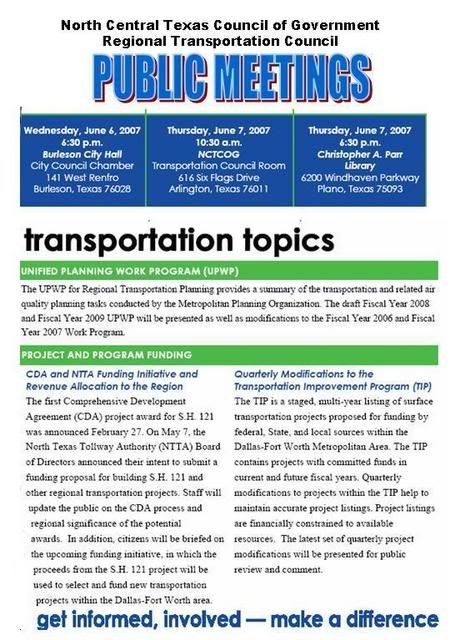
The RTC established a policy to fund necessary expansion of existing state and federal highways in the region and to fund new construction with toll revenue. They expect to spend available gas tax revenue on Hwy 75 and LBJ Freeway.
They surveyed some attendees at public meetings (March-May 2007) along the SH 121, SH 183 and SH 161 corridors. They asked them some questions about toll rates,\ and whether they wanted CDAs applied to projects in Collin County. Out of a population of over 6.5 million people, there were 214 respondents to the questionaair. Not all counties were surveyed and it was not administered to citizens from the southern side of the region.
The RTC established a policy to fund transportation construction and expansion with toll revenue and they established a policy to set the toll rates higher than required to retire the debt and maintain the roads. They decided to set the toll rates high enough to generate billions of dollars of upfront toll revenue to fund other transportation projects.
The citizens of this region were never given opportunity to vote on this policy. Yet we will be required to retire the debt on these proposed state (and federal) highway projects. The contracts are for 50 years. Talk about taxation without representation. Many future citizens who have not been born yet will pay the largest share of these escalating upward toll fees.
They ignored the will of the people expressed in their limited survey. They ignored the hundreds of citizens who testified at TxDOT TTC hearings against private public partneships and exercise of eminent domain for private development and profit.
If you were unable to attend these three public meetings (or unaware that they were occurring) please use the link to their e-mail form and submit written comment to the RTC.
Leaders of the RTC (Judge Glen Whitley for one) are urging member governments to write the governor urging him to veto the eminent domain bill passed by the Legislature to correct excesses which were enacted in the previous two sessions of the Legislature. If you think 675 miles of toll roads is good for this region, please use that form and thank them. If there is something which concerns you about the plan, please use the form and tell them.
The deadline is July 6th.
Wednesday, June 06, 2007
Perry stared down legislative blitz
Ben Ware - Austin American-Statesman -Monday, June 04, 2007
You may have heard that the Legislature this session approved a moratorium on toll roads.
If so, you heard wrong. No legislators that I ran into this session wanted to snuff out tollways.
Or you might have heard or read that lawmakers passed a moratorium on long-term toll road leases with private companies. This is true, but only in the most qualified sense.
This prohibition — contained in Senate Bill 792, which Gov. Rick Perry hasn't yet signed but almost certainly will when he makes it back from Turkey — is perforated with exceptions.
Under SB 792, private toll road contracts similar to the one already reached with Cintra-Zachry for Texas 130 could be done on seven projects in Dallas-Fort Worth, a proposed Interstate 69 from near Victoria to Brownsville, anything in Cameron County and all but one project in El Paso County, and on Loop 1604 in San Antonio.
And, oh yes, after Perry threatened to veto an earlier version of SB 792, the Legislature removed language that would have made it impossible to do private toll road contracts on the Trans-Texas Corridor tollway twin for Interstate 35.
Even taking the two counties and the corridor out of the discussion — lawmakers made it clear that no contracts should be signed on the corridor for the next two years, even if they didn't outright ban them — we're talking about $20 billion in contracts on those other nine roads. That's 10 zeros short of a freeze.
The obvious question, given all the public pressure and the periodic displays of legislative umbrage this session at a Texas Department of Transportation "run amok": How can this be? Everyone said they wanted to vote for a moratorium, but we didn't really get one?
It's all about commitment. In politics, all other things being equal, the side that wants it the most and is willing to do whatever it takes is going to win most of the time. In this case, that side was Perry and the Department of Transportation.
Legislators were conflicted. They wanted to please constituents, particularly rural ones, who don't want a bunch of new tollways "owned" by foreign companies cutting through farms. They were nervous about 50-year toll road leases that might outlive their children, and about corporations toting away profits that might otherwise go to building other roads.
But lawmakers also wanted urban highways, as many as possible and as soon as possible, and the Houston and Dallas delegations in particular wanted to build and run most tollways in their areas. And legislators also didn't intend to raise the gas tax, no matter how much the fiscal logic of the situation tells them they should. Those are, taken together, competing imperatives.
So the legislative commitment to stop private toll roads stretched from one end of the Capitol to the other, but it was about a centimeter deep. Perry, on the other hand, and his compadre Ric Williamson, chairman of the Texas Transportation Commission, have a passion for their agenda taller than the Capitol dome. Perry said he'd veto bills that materially curbed private toll roads and made it clear to legislators behind closed doors that he would call special sessions ad infinitum until he got what he wanted. Legislators believed him, and they blinked.
The Wednesday before lawmakers adjourned for good May 28, Williamson hosted his monthly briefing with reporters at Transportation Department World Headquarters, across 11th Street from the Capitol. By then it was looking like SB 792, which emerged as the toll road bill of choice after several pretenders had skidded into the ditch, would pass and would be acceptable to Perry.
Williamson, spotted several weeks earlier huddling with confederates at the Capitol after the Legislature passed a much tougher toll road bill, had looked grim. (Perry vetoed that earlier bill.) This day, though, Williamson sauntered into the room seeming pretty pleased with life. As he swung into his chair, he tossed some party favors onto the table, royal-blue plastic wristbands with white writing on them. The words succinctly captured why SB 792 turned out the way it did.
The Churchillian message: "Never ever give up."
Parties at toll agency invite new scrutiny
Auditors investigate roles of donors in Christmas bashes, golf tournaments
By BILL MURPHY, RAD SALLEE and PAIGE HEWITT - Houston Chronicle - with contributions by Chronicle reporter Dale Lezon - June 6, 2007
Read more
By BILL MURPHY, RAD SALLEE and PAIGE HEWITT - Houston Chronicle - with contributions by Chronicle reporter Dale Lezon - June 6, 2007
The Harris County Auditor's Office said Tuesday it is investigating whether the county's Toll Road Authority relied on donations from firms that do business with it to pay for Christmas parties, golf tournaments and summer outings during the past five years.
The widening probe follows last week's forced retirement of Toll Road Authority Director Mike Strech amid revelations that county contractors had paid thousands of dollars to fund an employee party at SplashTown last year.
Public Infrastructure Director Art Storey said earlier this week that Strech told him he planned to solicit contributions for a similar party at SplashTown in July, in direct violation of Storey's order not to hold such events or ask vendors to donate.
Also Tuesday, county officials released several documents involved in their investigation, including a "sponsorship list" for an employee picnic held at SplashTown last June.
The list of 31 county contractors, many of them engineering firms, is broken down by the amount each donated or pledged. The amounts ranged from $250 to $5,000, with companies classified as copper-, bronze-, silver-, gold-, or platinum-level donors.
The total sponsorship was listed as $59,750. Of that, the authority spent $45,000 on the SplashTown outing, leaving $15,000 an off-the-books social account, district attorney's investigator Dan McAnulty said.
Several vendors contacted by the Houston Chronicle on Tuesday said they had no problem with the parties, to which they and their families were invited. They said they did not feel pressured to contribute and did not receive any improper benefits.
"If we didn't donate, that wouldn't affect our relationship with the authority," said V.N. Vijayvergiya, president of Geotest Engineering, Inc. "It's a request. It's not an obligation."
Robert Barnett of the engineering firm Sparks, Barlow & Barnett Inc. called the events "a community effort."
"We get jobs through the Commissioners Court, but we want the authority staff to know we appreciate them," he said.
Strech, who made $153,275 annually, said Tuesday he would not comment while under investigation by the district attorney's office.
District Attorney Chuck Rosenthal on Monday said his office had found no criminal wrongdoing in the solicitations.
Steve Garner, chief assistant county auditor, said officials have found two off-the-books bank accounts overseen by Strech that were used to pay for parties and celebrations for Toll Road Authority employees.
Garner said that in one instance, Strech took $1,800 from an "HCTRA Helping Hands" fund, set up for needy toll road workers, to rent Tin Hall in Cypress for a 2006 Christmas party.
Strech later paid back the fund with $1,800 taken from another account, where money solicited from toll road vendors was deposited, Garner said.
Peter Key, who was appointed deputy director of the authority by Storey 20 months ago, said Tuesday that Strech said he would seek the Commissioners Court's approval to use toll road funds for the party.
An Oct. 18, 2006, e-mail to Strech and Key from the authority employees' "Celebration Committee" says the party — with barbecue, a deejay and a gift for each employee — would cost about $30,000 based on a "pre-head count" of 900 attendees.
Key said he initially approved the expenditure at Strech's request, then withdrew his approval the next day.
"I decided it was just not appropriate to use public funds to hold a Christmas party," he said.
Key said Storey told Strech "not to have any more events or parties." But later, Storey said, he learned that the authority was planning to solicit donations from vendors for an employee picnic at SplashTown in July. A similar event had been held there in 2006.
In a letter delivered Thursday, Storey told Strech he would fire him if he didn't retire before the end of Friday. Strech retired, and his executive assistant, Diana Wilcox, resigned.
Garner said auditors also will look at whether Electronic Transaction Consultants, a Toll Road Authority vendor, paid for an authority golf tournament in February.
"We're not going to comment on this," ETC spokeswoman Carla Kienast said.
County Judge Ed Emmett said the public should not be concerned that vendors were winning county contracts based on their contributions.
...
Even if no crime was committed, Key said afterward, "it looks bad, it smells bad, and it calls into question the integrity of this agency and the people who work here."
Read more
Three Heroes in Mesquite
Monday, June 4, 2007, three Registered Nurses’ employment by Health Management Associates at Dallas Regional Medical Center in Mesquite was terminated. Why?
They complained that their nurse to patient ratio was being raised critically high, so as to possibly endanger patients.
Normally, the nurse to patient ration in an Intensive Care Unit (ICU) would be 1:2. They were being ordered to increase that ratio to 1:5. Patients in ICU are in critical peril, and increasing the ratio only means that each critical patient will get less necessary attention.
Michael B. Rothburg, M.D., MPH, assistant professor of medicine at Tufts University and a physician at Baystate Medical Center, Springfield, Massachusetts, conducted a cost effectiveness study that seems to apply to the Mesquite case.
Dr. Rothburg found that the standard of an average ratio of 1:4 patients throughout the whole of the facility was maximum effective. Such a ratio could save 72,000 lives annually, and could result in fewer patient complications that increase patient stays by three to four days, “at a cost of $4,000 and $5,000 per day.” [“Study Finds Nurse-to-Patient Ratios Cost-Effective” by Christina Orlovsky, NurseZone, Wednesday, June 6, 2007]
Considering the health of the patients and even the cost efficiency, the three Registered Nurses took the correct position to complain to their Supervisor. However, they were terminated.
All Nurses take an Oath --
The Florence Nightingale Pledge
I solemnly pledge myself before God and in the presence of this assembly, to pass my life in purity and to practice my profession faithfully. I will abstain from whatever is deleterious and mischievous, and will not take or knowingly administer any harmful drug. I will do all in my power to maintain and elevate the standard of my profession, and will hold in confidence all personal matters committed to my keeping and all family affairs coming to my knowledge in the practice of my calling. With loyalty will I endeavor to aid the physician in his work, and devote myself to the welfare of those committed to my care.
Obviously, the choice of these Nurses was a morally difficult one if they knew their employment might be jeopardized. They decided to uphold their own Oath, and now they will pay the price to Administrators who fail to understand that both patient care and bottom line economics share one decision. The three Nurses were right.
People who stand by their morals, even when risk is real, are Heroes.
Tuesday, June 05, 2007
Bill Moyers Journal - Cleaning House
Today is Bill Moyer's birthday. Bill Higgins posted a tribute to him on epluribusmedia
He included this UTUBE video of Moyers coverage of lobbyist!
Higgins wrote:
Born on this day in 1934
"America's corporate and political elites now form a regime of their own, they're privatizing democracy. All the benefits, the tax cuts, policies and rewards flow in one direction: up."
Bill Moyers
I happened to be reading Moyer's Blog early this morning looking for his interview with Public Citizen's Joan Claybrook which I missed when it aired on PBS last Friday on "Bill Moyers Journal."
The subject of the segment was lobbying and lobbyists and their pervasive influence on our political system.
I have a large measure of respect for both Moyers and Claybrook and an enormous loathing for lobbyists and their destructive influence on MY country and I was disappointed to have missed the program.
I responded:
Bill Moyers continues to serve
He's from my hometown, Marshall, Texas, and although he was in Washington before I was aware enough to care deeply about the issues he champions and the dark corners he brings to the foreground through intellectual examination and discussion, I like having ties to him, however remote.
Lobbying is not evil in itself. We have laws that can monitor it. However, the way that much of it operates today is out of acceptable boundaries.
We have seen Transportation Codes of states and the Federal Government changed through sophificated change management re-engineering strategies funded by international business and US firms who smell dollars they can transfer from public coffers and private citizens pocketbooks into their corporate bottom lines.
Kansas City Southern (de Mexico) RR, Carter Burgess, Zachry Construction, BSNF Railway, Ross Perot, Jr and the Alliance group, Ed Bass and others involved in the Texas Pacific Group (who are negotiating to buy TXU electric), and other international player (all members of NASCO) helped underwrite legal, educational, lobbyist and other logistical initiatives resulting in more changes to the Texas Transportation Code in two legislative sessions than had been enacted in 50 years plus major changes in US Transportation Code.
Identical language migrated into many bills in both houses of the Texas Legislature during the 78th and 79th sessions. They were accepted by the Legislative Counsel office and the parties presenting the language are legally allowed to remain hidden, protected behind the attorney client priviledge of the attorney who carried the language to the Legislative Counsel. Despite lobby disclosure laws and rules which require lobbyists to disclose their clients, amounts of money spent on contacts with legislators, most of the heavy hitting special influence peddleing is done without ANY DISCLSOURE REQUIRED because of such practices.
Now it is apparent where much of the funding came from for these far sweeping iniatives which have literally changed how America funds public infrastructure. This past weekend in Fort Worth NASCO held its annual conference. Confident that they have succeeded in enacting enough changes that there is little chance that America will revert to practices which have sustained our system for generations, they are now listing resumes of their board members on their websites and taking credit for their efforts.
It was apparent that change agents, opinion leaders, stakeholders were identified about a decade ago. Along the corriders they anticipated developing, they identified local elected officials, courted them, and incorporated them into their organizations. Contacts with folks with very deep pockets are very enticing to ambitious city commissioners and county commissioners. They established a number of non-profit educational 501s. (Educational 501s can act similar to PACS but do not have to comply with the same financial disclosure laws).
They invited Universities, local governments, transportation planning groups, and corporations to join their non-profit educational organizations and attend their seminars. Local and county governments began to help finance the "change management" initiatives by paying membership fees and fees to attend the seminars.
Local elected officials in key counties were invited to join the board of directors. No one yelled about City Council people and County Commissioners holding offices in these educational 501 non-profit transportation organizations (even though their mission statement was lobbying) because the county or city was also a member. No one stopped to consider the responsiblity that an elected official accepts when accepting an elected office: To give fair and impartial consideration to issues coming before the body.
There is no way a person can give fair and impartial consideration to an issue before the local city council or county commission if they are an officer or board member in an organization with a stated mission to adopt one of the alternatives placed before that body for consideration!
In the past decade we have seen formulation of transportation policy move out of the elected bodies and into the private non-profit forums funded by for profit corporations.
Now we are seeing our gas tax money and city tax money used to fund transportation projects where private partners will charge citizens tolls for 50 years to ride on what was previously state or Federal highways. Citizens no longer can control what gets funded by refusing to approve a bond initiative at a bond election. (American rarely vote down transportation bond initiatives --- even though the toll proponents try to create that illusion).
Bill Moyers understands how the process works, how it used to work and how it should work. I'm thankful that he continues to stimulate discussion, inform the people, and question the holes in the system which is designed to protect citizens and preserve Constitutional government in Texas and the USA.
Friday, June 01, 2007
What's all this Non-Sense
What’s All This Non-Sense?
What’s all this nonsense of you people opposing the Trans Texas Corridor. Why, this plan has got to reign supreme of the accomplishments of this great state’s great Governor. What other Governor could win the gubernatorial seat against two other Republicans and one Democrat opponents and could still force legislation through Austin. He wears the tag 39% proudly.
Just think about the wide benefits that might be reaped by the completion of this Highway System.
First, numerous family farms will be shut down. Well, farmers are going broke anyway since they cannot sell their produce at the actual cost of production. In a letter I got from the Governor’s own office, Dede Keith writes, "No property will be taken without just compensation." Well, if they’re losing money anyway, isn’t it a gift to them to pay them anything at all?
Cintra Zachry will not only make that land more profitable from toll revenues for 50 years, but can also claim farm subsidies for every acre they do not use.
Second, all these proposed roads go to other states that have no similar system designed. Now wouldn’t ya’ think that those folks in Oklahoma might see what we have and want something like it? They aren’t going to want these super highways to come to their borders and just stop are they?
Third, in that same letter from the Governor’s office, Keith writes, "Demographers predict that the Texas population will double over the next 25-30 years." So there may be twice the number of cars on all the roads. So why not expand the TTC and just double the size of every road? Why talk about rail transport when more concrete can solve the problem.
I’ve been thinking long and hard about what a super highway might look like. Eight lanes each way might work best. One lane for joggers and walkers, and I guess those homeless people with their grocery store carts so they can all go town to town. Second, a lane for bicycle riders. Third a lane for people trying to hitchhike since they can’t afford the price of a car or even of the gasoline. Fourth an entry and exit lane. Fifth a lane for slow drivers. Sixth a lane for the triple trailer semis coming from Mexico. Seventh a lane for those car poolers (some people call them HOV lanes) --now isn’t that the solution for air pollution. Finally, a lane for those people who are in a hurry, ya’ know, no speed limits.
Now just think, all eight lanes with Tolls, maybe charging the speeders a little more in case they hit someone else, and not charging the truckers as much as the walkers since they are really transporting products around. Oh heck, just let the trucks keep on going for free since they belong to companies, and why should the drivers be hurt.
When ya’ think about it, why do your kids need to see Grandma anyway? If ya’ can’t afford the toll, then why are ya’ driving anyway? And when ya’ factor in all those who couldn’t afford unregulated tolls, maybe not too many folks will be likely to get out onto that super highway anyway.
Now Cintra Zachry could fret a bit over that, but then they will get their farm subsidies anyway, just like the Railroad Lines in California -- the number 1 recipient of farm subsidies in California.
Finally, what is so special is what Keith also wrote, "You should also know that limited tax dollars will be spent on the corridor." Since our gas tax goes to building roads I assume she meant the taxes from the State and Federal Governments. Why shouldn’t tax payers help to build roads for a private company, isn’t that like these new Stadium deals all over? And if they’re going to limit the amount of these tax dollars going into building these roads, then isn’t that a great deal?
And those Federal dollars are going to stop anyway since most of Texas cannot reach the EPA’s demands. But air pollution ain’t all bad -- it keeps doctors and pharmaceutical corporations busy.
Now some people are complaining about the cost of food and all going up. But I say, so what. If you’re so tight for money then just quit driving and paying so much for gasoline and tolls. Ya’ couldn’t even gripe about unregulated insurance charges then either.
Three things in life are sure -- death, taxes, and inflation.
But just think about no one driving because they can’t afford to. That would also reduce air pollution which all you tree huggers fret so much about.
Just think about the game that hunters could go after when the migration paths are blocked. In a decade or so all those pesky deer could be gone, and fishing licenses could begin to rise since more people might be looking to help feed their families.
Unregulated Tolls on roads paid for by tax dollars and profiting, as Keith writes, "a Spanish Company" and a "family-owned Texas company." Now if that ain’t Texas Family Values, what is?
So all you whiners, what’s you’re problem now?
Thursday, May 31, 2007
Breaking News . . . Toll Road Giant Buys Newspapers to Silence Critics
Constitutional Lawyers . . . Where Are You?
By Daneen G. Peterson, Ph.D. American Chronicle - December 2, 2006 - Updated January 20, 2007
© Daneen G. Peterson, Ph.D., All Rights Reserved
This article is found with additional photographs here:
By Daneen G. Peterson, Ph.D. American Chronicle - December 2, 2006 - Updated January 20, 2007
© Daneen G. Peterson, Ph.D., All Rights Reserved
Critics charge that the Macquarie [an Australian Bank] purchase of American Consolidated Media is designed to silence critics of a Texas toll road project [Trans-Texas Corridor (TTC-35)].Read more
Australian toll road giant Macquarie agreed Wednesday [1/24/07] to purchase forty local newspapers, primarily in Texas and Oklahoma , for $80 million. Macquarie Bank is Australia's largest capital raising firm and has invested billions in purchasing roads in the US, Canada and UK.
Most recently the company joined with Cintra Concesiones of Spain in a controversial 75-year lease of the 157-mile Indiana Toll Road.(44)
Our country is being sold out from beneath us, often to foreign entities who will control them in times of national emergencies and in violation of the Exon-Florio law and our Constitution. All is being accomplished while many Americans remain uninformed by the media AND those who loudly object are being ignored or silenced by the fascist One World Monopolists, in collusion with the corrupt main stream media, in their drive to conquer America from within.
This article is found with additional photographs here:
Constitutional Lawyers . . . Where Are You?
Daneen G. Peterson, Ph.D. The American Chronicle - January 31, 2007 - © Daneen G. Peterson, Ph.D., All Rights Reserved
Read more
Of course all lawyers are very busy, but there's a significant issue that needs your attention which could be of substantive legal import regarding the creation of a Mexican customs office which is planned for the KC SmartPort. It will stand on American soil as part of the federal government's Security and Prosperity Partnership (SPP), a stealthful mega-project being developed under the aegis of the Department of Commerce. Supposedly, the Kansas City SmartPort agreement will allow Mexico to claim 'sovereign territory' on American soil and arrogantly fly their Mexican national flag over it.
It is posited here that a learned Constitutional lawyer might be able to stop ALL the Security and Prosperity Partnership (SPP) projects in their tracks since they ALL involve the signing of agreements with 'Foreign Powers' ALL of which are being done without Congressional approval, in violation of our Constitution, as detailed below in Part I.
In addition to the KC SmartPort . . . there are other signed agreements with foreign governments for the CANAMEX corridor, and the Trans-Texas-Corridor (TTC-35) also discussed below. There exists many more signatories since there are some 80 super-corridor projects planned and in motion across the country. All these projects are aimed at creating the North American Union without ANY congressional oversight in violation of our Constitution.
It would be a coup de grace for 'We the People' if the One World Monopolists were stopped in their tracks using the very instrument they seek to shred, crush and destroy . . . our Constitution.
Also below in Part II is a discussion that will detail the selling of our infrastructure that ALSO violates the aforementioned Constitutional law as well as others, such as Exon-Florio. What's being done is part of creating the North American Union (NAU) that is being fraudulently forged under the radar, without Congressional approval or oversight, nor the knowledge or agreement of 'We the People'.
These machinations are the work of a cabal of elite globalists, both within and without our government, who are working towards a North American Union (NAU) as part of their quest for a One World Monopoly (OWM). It is a world monopoly that they have euphemistically called a 'New World Order'. All that has been accomplished thus far, was deviously facilitated by a complicit and deliberately silent media
Part I ~ Constitution Violations Involving Signing Agreements with Foreign Powers
The Constitution of the United States . . . Article I: Section. 10.
Clause 1:
No State shall enter into any Treaty, Alliance, or Confederation; grant Letters of Marque and Reprisal; coin Money; emit Bills of Credit; make any Thing but gold and silver Coin a Tender in Payment of Debts; pass any Bill of Attainder, ex post facto Law, or Law impairing the Obligation of Contracts, or grant any Title of Nobility.
Clause 2:
No State shall, without the Consent of the Congress, lay any Imposts or Duties on Imports or Exports, except what may be absolutely necessary for executing it's inspection Laws: and the net Produce of all Duties and Imposts, laid by any State on Imports or Exports, shall be for the Use of the Treasury of the United States; and all such Laws shall be subject to the Revision and Controul of the Congress.
Clause 3:
No State shall, without the Consent of Congress, lay any Duty of Tonnage, keep Troops, or Ships of War in time of Peace, enter into any Agreement or Compact with another State, or with a foreign Power, or engage in War, unless actually invaded, or in such imminent Danger as will not admit of delay.
Signed Agreements with a Foreign Power: KC SmartPort
Lazaro Cardenas, Mexico, Prepares to Sign Cooperative Agreement with Kansas City, March 15, 2005, Kansas City Smart Port: Press Room, http://www.kcsmartport.com/sec_press/releases/lazaro_031505.htm.
KANSAS CITY, MO – March 15, 2005—Officials from Kansas City and Lázaro Cárdenas, Mexico, will sign a historic cooperative agreement next week to establish a new trans-Pacific trade corridor that will alleviate delays and congestion at West Coast ports. The signing, at 6 p.m. on Tuesday, March 22, will take place at Cathedral Square, 427 W. 12 th St. This significant agreement will promote trade growth and development along the new corridor.
“This signing is an exciting and historic moment for the international trade in the Kansas City region,” Chris Gutierrez, president, KC SmartPort, said. “The partnership with Lazaro Cardenas puts Kansas City in a pivotal position to become the Pacific port’s primary U.S. inland port and puts KC another step ahead of our competition for economic growth and job creation.”
A delegation of seven Mexican officials including Eloy Vargas Arreola, Secretary of Economic Development, Government of the State of Michoacan, will spend three days—Monday through Wednesday, March 21-23-- in Kansas City, MO.
------
Kansas City SmartPort to Sign Trade Route Agreement with Province of Manitoba: North American Inland Port Network Initiated, October 11, 2005, http://www.kcsmartport.com/sec_press/releases/manitoba_101105.htm.
KANSAS CITY, Mo., October 11, 2005 – Kansas City SmartPort President Chris Gutierrez today announced that Kenneth Hoffman, chairman of Kansas SmartPort, and Gary Doer, premier of the Province of Manitoba, will sign a memorandum of understanding to establish a secure trade and transportation corridor between Kansas City and the Province of Manitoba on Friday, October 14, 2005 at 1:15 p.m. in the Kauffman Foundation's Town Square Room. The agreement, which will create a streamlined transportation network between Kansas City and the Province of Manitoba, which includes the city of Winnipeg and the deepwater port of Churchill, will take place during North America Works in Kansas City, a conference to promote development and expansion of transportation links and infrastructure across Canada, the United States and Mexico.
--------
KC, Mexican officials will set up trade corridor, March 21, 2005, The Kansas City Business Journal, http://www.kcsmartport.com/sec_news/media/articles/kcbj_032105.htm.
Officials from Kansas City and the Mexican city of Lazaro Cardenas will sign an agreement March 22 to establish a new trans-Pacific trade corridor and establish the Kansas City area as an inland port.
The creation of the trade corridor also is designed to alleviate delays and congestion at West Coast ports.
A signing ceremony is scheduled for 6 p.m. March 22 at Cathedral Square, 427 W. 12th St.
"This signing is an exciting and historic moment for the international trade in the Kansas City region," Kansas City SmartPort President Chris Gutierrez said in a written release.
------
U.S.-Mexico trans-PAC corridor deal, March 28, 2005, Journal of Commerce, http://www.kcsmartport.com/sec_news/media/articles/joc_032805.htm.
Officials from Kansas City, Mo., and Lázaro Cárdenas, Mexico, signed a cooperative agreement to establish a new trans-Pacific trade corridor to alleviate delays and congestion at West Coast ports, and promote trade growth between the U.S. Midwest and Mexico.
Under the agreement, Kansas City and Lázaro Cárdenas will jointly fund a neutral marketing campaign designed to attract trans-Pacific traffic between the cities' ports, promote in-bond transfers between the cities' Foreign Trade Zones, and promote the development and deployment of security tracing and tracking systems along the U.S. Midwest-to-Mexico corridor.
"In terms of opening the Midwest to Asian trade through Mexican ports, this agreement signifies substantial completion of [some] extensive efforts over the past several years," said Alfred Figuly, president of the greater Kansas City Foreign Trade Zone, in a prepared statement.
------
...
Signed Agreement with a Foreign Power: TTC-35 (Trans Texas Corridor)
Comprehensive Development Agreement TTC-35 High Priority Corridor, by and between: Texas Department of Transportation and Cintra Zachry, LP, March 11, 2005, keeptexmoving.com, http://www.keeptexasmoving.com/pdfs/projects/ttc35/TTC-35cda_signed_version.pdf.
This is actually who they are dealing with as all others are front groups with Limited Partnerships:
In addition, copies of all notices to proceed, notices regarding Disputes, and suspension, termination and default notices shall be delivered to the following persons:
Cintra Concesiones de Infraestructuras de Transporte, S.A. Plaza Manual Gomez Moreno, 2 Edificio Alfredo Mahou 28020 Madrid, Spain Attn: General Counsel Telephone: 0013491-418-5615 Facsimile: 00134-915-556-786 E-mail: lucas.osorio@cintra.es
-----
24.5.1 TxDOT and Developer shall each designate an individual or individuals who shall be authorized to make decisions and bind the parties on matters relating to the Contract Documents ("Authorized Representative"). Exhibit P to this Agreement Note: Exhibit P was not available with this document.
Note: Since those with the authority to make decisions would indicate who REALLY is in charge it would be interesting to see Exhibit P.
READ MORE (Much more of this heavily researched and footnoted article by Dr. Daneen G. Peterson, PhD, former professor at Temple and Jefferson Universities in Philadelphia, PA, where she taught behavioral science research methodology and statistics. After leaving academia, she created and directed the first Department of Research and Program Evaluation for Big Brothers/Big Sisters of America's National Office in Philadelphia, PA.
Read more
Angela Hunt Proves It: The Mayor's Been Lying About the Trinity River Toll Road
By Jim Schutze - The Dallas Observer - May 01, 2007
Angela Hunt has just blown the center right out of Laura Miller's defense of the Trinity River toll road, and she has done it with a bit of investigative reporting that should have our tree-climbing ex-reporter mayor tied in little green Boy Scout knots.Read more
Miller has been defending her plan for a big fat expressway through the park we're trying to build on the Trinity River downtown by saying the idea was OK'd, blessed and signed off on by the expert she brought down here a couple years ago from Harvard, Alex Krieger. Now, by filing open records demands for Miller's e-mails, Hunt has found the smoking gun: On the Trinity Vote Web site this morning is an e-mail from Krieger to Miller telling her he is dismayed that the city intends to build "a great big interstate highway instead of a parkway" along the Trinity.
Miller's other expert, transportation planner Bill Eager, also weighs in with an e-mail agreeing with Krieger.
What Hunt has uncovered here is an enormous public deception on Miller's part. In appearance after appearance, statement after statement, Miller has insisted that Hunt doesn't know what she's talking about. Miller keeps saying the current design for the toll road is what everybody agreed on and the Harvard guy designed.
Now we learn that Krieger wrote Miller a month ago telling her the road had bloated into something he didn't recognize. Here is the full text of Krieger's e-mail:
From Alex Krieger
March 22, 2007
to Bill Eager, Laura
Laura,
I'm not sure in what context the issue of alternative alignments for the Trinity Parkway has come up, but during my recent visit -- at the initial charette with the Trinity Lakes Planning Team -- what concerned me most was that the engineering of the road was proceeding as if it were a great big interstate highway instead of a parkway and that there was absolutely no evidence of concern for the "context sensitive design" that was promised as part of the balanced vision plan. Devoting MUCH MUCH more attention to the design of the roadway - and making sure that it results in a road worthy of being part of great park and open space environment -- is what I think is most immediately necessary.
Best,
Alex Krieger
Wednesday, May 30, 2007
Feuds, failures in Austin may cost lawmakers
By Jay Root - Star-Telegram Staff Writer - Wed. May 30, 2007
Looking ahead
Republican Jon Taylor, a political scientist at the University of St. Thomas in Houston, said the infighting could leave the GOP badly fractured in 2008, which is already shaping up to be challenging for the party.
"There could be a lot of blood on the floor and then some come primary time in 2008," Taylor said. "The Republicans could easily lose the state House as a result of this."
He cited in particular the formation of a political fundraising organization called We Won't Forget PAC, designed to punish Craddick loyalists who deserted him. Taylor said the speaker would "guarantee the legacy of being an autocrat or an outright dictator" if he did not halt the efforts to defeat his enemies.
Craddick, elected in 1968, was one of eight Republican lawmakers when he first walked onto the floor of the Texas House. Thirty-four years later, he became the first GOP speaker since 1871. Since then, Republicans have controlled every statewide elected office and both houses of the Legislature.
Craddick presided over some of the most bruising legislative battles in modern times, including a redistricting effort spearheaded by former U.S. House Majority Leader Tom DeLay. But, like DeLay, Craddick paid a political price for the confrontational tactics he used to produce policy victories.
In January he survived a tough speaker's race, in which fellow House members choose a presiding officer. Then, a few days ago, the struggle morphed into a Shakespearian political drama. Betrayed by loyal allies who helped elevate him to his powerful post, Craddick came within a hair of being removed. He beat back the challenge by claiming that the rules gave him "absolute discretion" to ignore his opponents, even if a majority wanted him out.
Looking ahead
Mike Hailey, editor of the online newsletter Capitol Inside, said the ploy paid off in the short term by keeping Craddick in the speaker's chair. Further down the road, it could be a different story.Read more
"It could hurt him in the long run," Hailey said. "It has a lot of potential to backfire." Taylor, the GOP political scientist, said the messy fight in Austin projected an unseemly spectacle for voters, and the speaker's use of phrases like "absolute" power and "there is no appeal" conjured up images of tyrants from another era.
Monday, May 28, 2007
Craddick opponents walk out - Lack of quorum shuts down business after budget passes.
By Laylan Copelin, Jason Embry - AMERICAN-STATESMAN STAFF -
Monday, May 28, 2007
Coverage on Daily Kos
Coverage on Texas Politics - Houston Chronicle - San Antonio Express News Blog
WFAA Channel 8 DFW Coverage
CBS News Coverage
Texas Kaos Coverage
Burnt Orange Report Coverage
Monday, May 28, 2007
Dozens of lawmakers shut down the Texas House shortly after midnight by walking out after a member tried to take a roll call vote on Speaker Tom Craddick's leadership.Read more
Rep. Pat Haggerty, R-El Paso, stunned the House leadership when, during a personal privilege speech, he began taking a roll call vote on Craddick's leadership. Meanwhile, the Midland Republican sat on the podium.
As Haggerty called out the members' names, he asked them to shout out "aye" or "no." Many of Craddick's supporters stood and objected when their names were called.
When Speaker Pro Tem Sylvester Turner, D-Houston, who had been presiding, finally stopped the roll call, Haggerty urged the members to leave the chamber.
As the rebel House members streamed out of the chamber, led by Haggerty, a crowd that had been watching in the gallery quickly poured into the hallways and began cheering. Shouts echoed through the Capitol: "Go! Go! Go! Out! Out! Out!"
Inside the chamber, Turner called for a vote. With only 94 votes registered — many suspect because members who left were shown present — there was no longer a quorum. Turner adjourned the House until 2 p.m. today.
The 140-day session ends at midnight, and more than 30 bills are pending on the House calendar. It will take a two-thirds vote of members present to consider any legislation. Among bills in danger are ones dealing with water, child protective services, border security and parks.
Coverage on Daily Kos
Coverage on Texas Politics - Houston Chronicle - San Antonio Express News Blog
WFAA Channel 8 DFW Coverage
CBS News Coverage
Texas Kaos Coverage
Burnt Orange Report Coverage
Subscribe to:
Posts (Atom)

